- Distinguish heat entering a home from air movement and heat removal.
- Use contextual observations to compare shading, ventilation and mechanical options.
- Plan access to a cooler place when passive measures cannot meet the conditions.
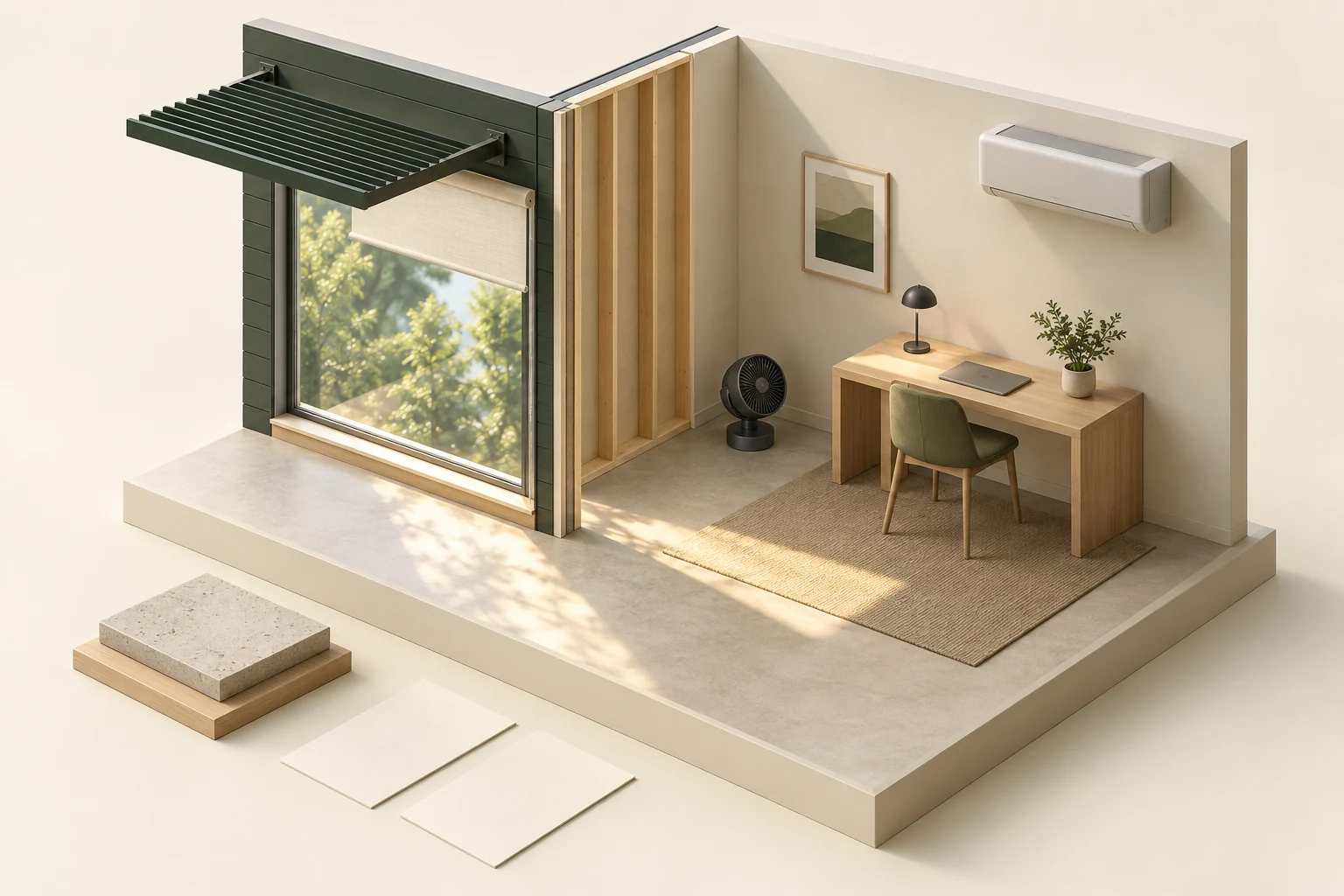
The room model shows an exterior blade shade, a closed window with a roller shade at the glazing, a sunlit floor patch, a guarded room fan and a separate closed wall unit. A desk, lamp, closed laptop and detached stone-like specimen are also visible.
About this illustration
Window ratings, orientation, shade effectiveness, actual gains, surface temperatures and appropriate installation are not established. The attached shade form supplies no anchorage, approval or saving percentage. This is a conceptual teaching model, not an assessment of your home.
10 picture lessons appear beside the questions in this guide. Use them to understand the explanation, then consider what it means for your home.
Read the room as an energy balance
A room warms when gains exceed the heat it loses or removes over the relevant period. Sunlight, outdoor conditions, occupants and equipment can contribute, while the building stores and releases heat. This is a conceptual balance rather than a prediction of indoor temperature. A large window is one possible influence, not a complete explanation for a particular overheated room.
Record the pattern before choosing a product: which room warms first, which orientation is involved, when discomfort occurs, how overnight conditions change, and what equipment is running. Keep dates, weather and occupancy in the record. Comparing one afternoon with a different-weather afternoon can confuse a weather change with the effect of a new blind or fan.
The overheating diagram represents energy inputs and removal, not measured building loads. It does not calculate a safe temperature, a required cooling capacity or a guarantee that a passive strategy will work. Use the illustration to identify the next measurement or assessment question, then keep the actual observations beside it.
Separate heat arriving from outside from heat produced inside. Sun reaching a floor through glazing is a radiation question. A warm outdoor surface transferring energy through the enclosure is a heat-transfer question. Cooking, lights, electronics and people can add indoor gains even after the sun has left that room. The same room can experience several of these at once; turning down one source does not establish that the others are small.
An observation log becomes more useful when it names the activity as well as the thermometer reading. Was the oven operating? Did afternoon sun reach the bed or floor? Was the bedroom door closed while the rest of the house was cooler? These details help frame a building or distribution question. They are not a reason to reproduce dangerous indoor heat or delay going somewhere cooler.
Follow the heat before choosing a fix
Glazing, an outside shade and room surfaces are visible. The same scene can prompt different questions about gains and stored heat.
Numbers identify the parts explained below.
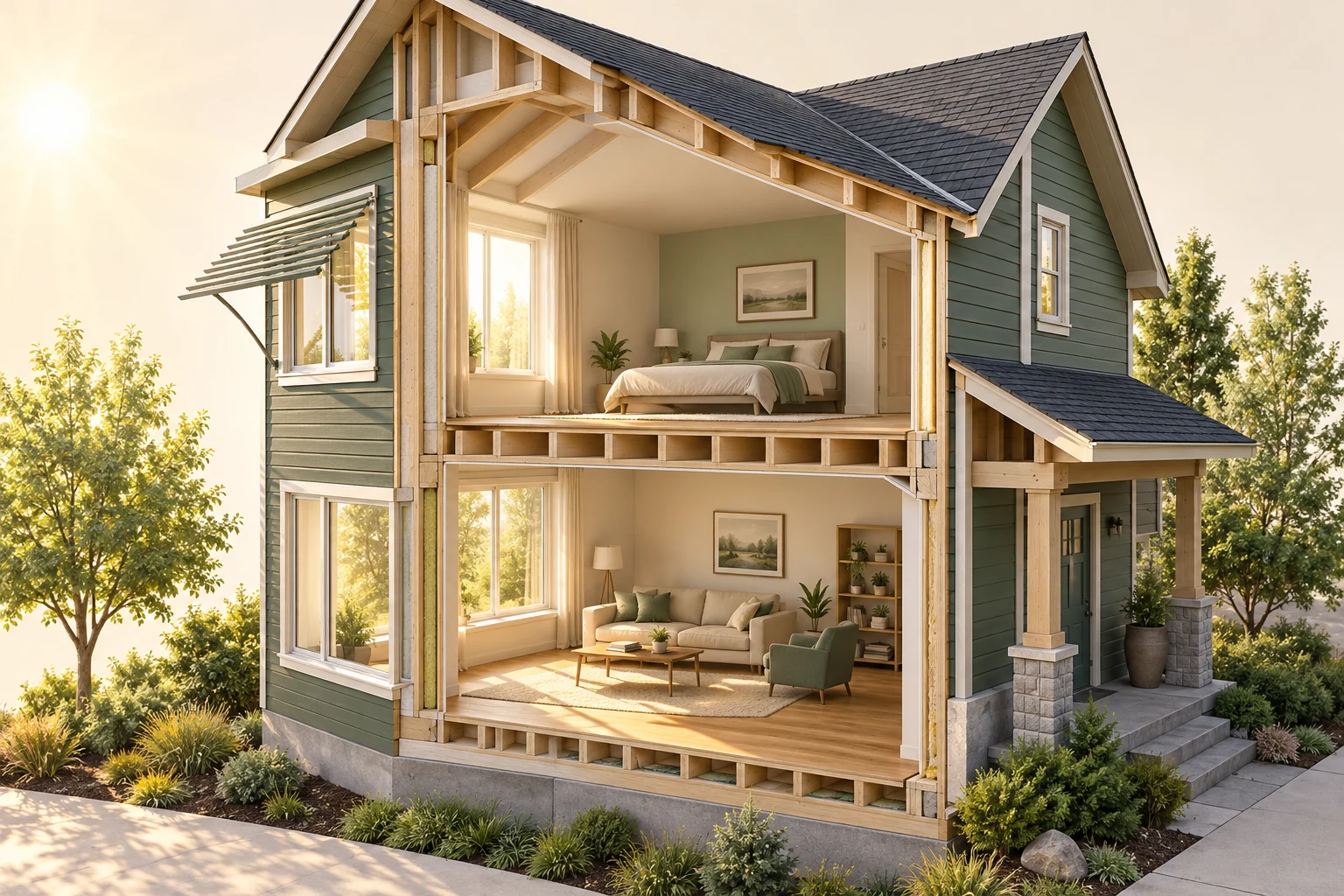
- Outside shade
Ask which exposure and time of day it addresses; appearance does not establish its effectiveness.
- Glazing
Window specifications and exposure explain more than the apparent brightness of a room.
- Room surfaces
Materials may store and release heat; a picture cannot quantify that contribution.
What does this illustration leave out?
Orientation, glass properties, actual temperatures, cooling load and health risk require separate evidence. This illustration explains an idea. It is not an installation guide.
What should I record to distinguish solar gains, stored heat and cooling distribution in my warm room?
Explore this with HomeAI ↗Opens an editable question. Nothing is sent until you choose to send it.Shade the sun; keep indoor gains in the question
Exterior shade can intercept sunlight before it reaches the glazing. Cooking and lighting can still add indoor heat. Amber marks show concepts, not measured energy, savings or a room temperature.
Numbers identify the parts explained below.
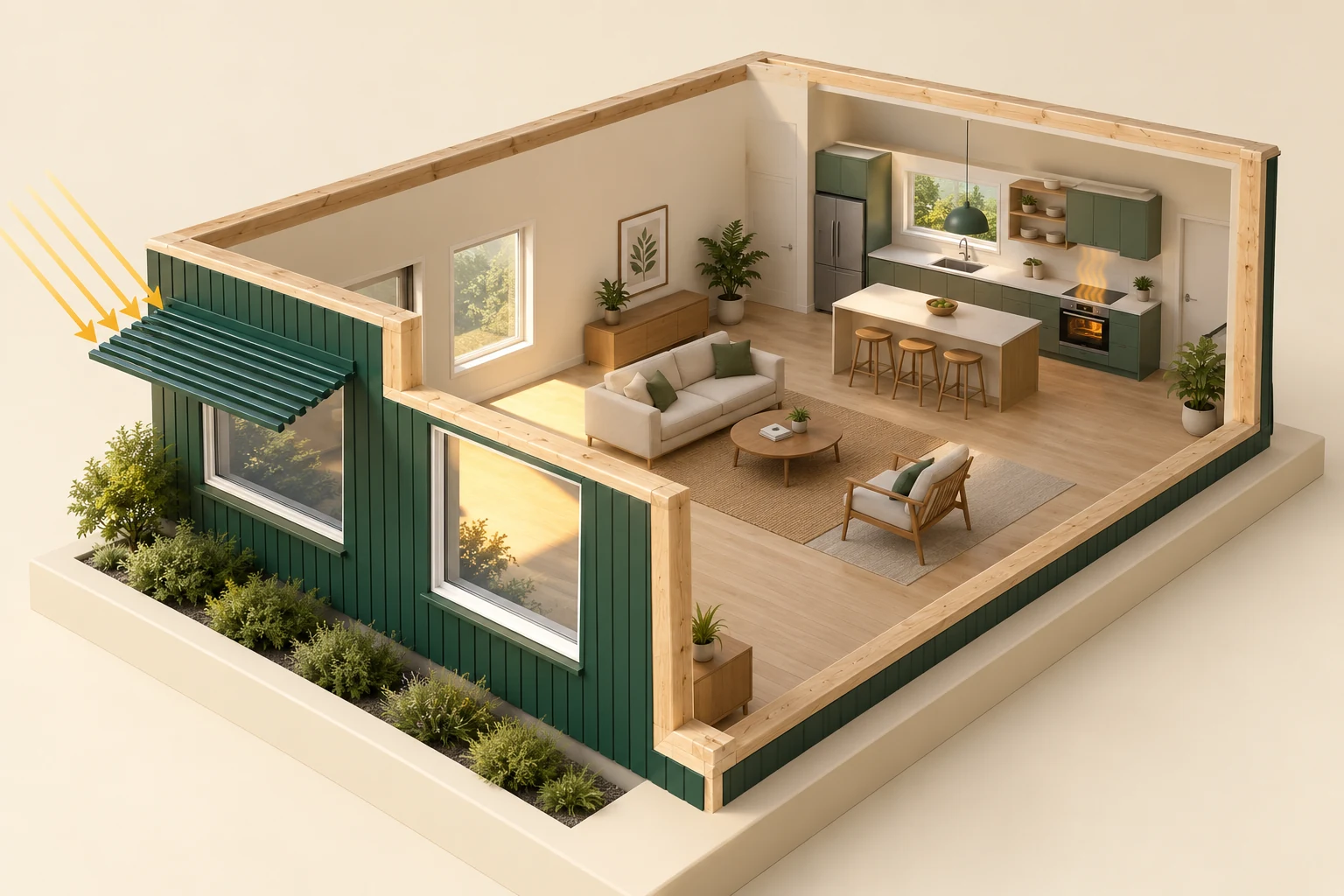
- Sun stopped outside
The shade is outside the glass. Ask which actual orientation, hours and seasons it covers; this model supplies no performance percentage or mounting specification.
- A separate solar input
The other window admits a sun patch. Glass properties, sun angle and coverage matter; brightness does not measure solar load or temperature-driven heat transfer.
- Heat made indoors
Cooking and lighting can add heat even when another opening is shaded. These warm marks do not identify fuel, operation, watts or the cause of an actual overheating complaint.
What does this illustration leave out?
Orientation, hours of sun, glass properties, actual internal gains and room temperatures need their own evidence. The shade form gives no mounting detail, approval or saving percentage; warm marks do not identify equipment fuel or operation. Exposed cut faces are a teaching convention, not an accessible or approved building assembly. This illustration explains an idea. It is not an installation guide.
What observations about sun exposure, actual window and shade details, cooking and lighting would help distinguish the heat inputs in my warm room?
Explore this with HomeAI ↗Opens an editable question. Nothing is sent until you choose to send it.Trace the route. Then close the heat balance.
Sunlight through glass, heat transfer through an opaque wall and heat made indoors reach the room in different ways. Follow each route, then ask how gains, losses, storage and time fit together.
Six conceptual views. Colours, moving marks, node size and spacing represent categories and direction only. They give no relative energy share, speed, elapsed time, indoor temperature, cooling capacity or predicted result.
Animation starts paused. The still routes contain the complete explanation.
Sunlight can reach the floor without first heating the glass.
A portion of the incident sunlight can pass directly through glazing. When that radiation reaches a floor, furniture or another indoor surface, some of its energy can be absorbed there. The material can then exchange heat with its surroundings. The mechanism is not simply outdoor heat being conducted through glass before it can reach the room.
Glazing can also absorb some incident solar energy and subsequently release part inward. This is a separate contribution to solar admission, rather than the direct-transmission route drawn here. Actual fractions depend on the confirmed product and conditions; the illustration supplies no percentage. Reflected or outward-released portions are not counted as heat admitted indoors.
An exterior shade can intercept sunlight before it reaches the glazing. Its effect depends on the opening, exposure, sun angle, coverage and installation. An indoor blind acts after light has reached the window and may change absorption, radiation and glare. These controls do not have a universal equivalence or a demonstrated saving in the pictured room.
- Keep in the record
- Record which indoor surfaces receive ordinary sunlight and at what times. Obtain actual glazing and shade information. A bright patch shows light at a location; it does not measure solar load, SHGC, surface temperature or cooling need.
- What stays unknown
- The product, transmitted and absorbed fractions, exposure and installed shading effect are unknown. No mounting, film or glass-selection instruction follows.
A useful next question: Does the proposed option address direct solar admission through this opening, and what does its actual product and exposure information establish?
Evidence scope: NRCan, Keeping the Heat In, sections 8.1.4 and 8.1.11; reviewed October 3, 2026, page modified January 14, 2025; NRC, Construction Technology Update 71 (2008), printed p. 3 / PDF p. 4; historical glazing mechanism only.
Keep window ratings and solar admission separate ↗A sun-warmed exterior wall is a different route.
Sunlight absorbed at an exterior wall or roof can raise that surface’s temperature. A resulting temperature difference can contribute to heat transfer through the assembly. Solid materials conduct heat, while the complete assembly can include other heat-transfer relationships. This route differs from solar radiation transmitted directly through transparent glazing.
Do not draw an exterior face radiating straight inward through an opaque wall. Radiation occurs between relevant surfaces; energy reaching the room through an assembly needs the actual component and boundary context. An indoor-facing surface can exchange heat with the room once its condition changes, but that is not the same geometry as direct sunlight entering through a window.
The direction and amount of real transfer depend on temperatures, assembly properties and conditions over time. This conceptual warmer-exterior example is not a declaration that every wall always transfers heat inward. Solar exposure, thermal resistance, framing, air leakage and installation have separate evidence requirements.
- Keep in the record
- Keep accessible observations and existing drawings, product records and scoped enclosure findings together. Compare the real exposure and conditions before attributing a room complaint to the wall, roof or window.
- What stays unknown
- No material order, effective resistance, concealed continuity, surface temperature or installed defect is established. Do not open the enclosure or climb to reproduce the view.
A useful next question: Which actual assembly and temperatures would support an inward-transfer explanation, and which other routes have not been examined?
Evidence scope: NRCan, Keeping the Heat In, sections 2.1.2–3; reviewed October 3, 2026, page modified January 14, 2025; NRC, Techniques for estimating the energy consumption of houses (1983), printed p. 205 / PDF p. 8; historical mechanism only.
Read the separate envelope functions ↗Outside shading does not switch off indoor sources.
Cooking, lighting, electronics, equipment and people can contribute indoor heat. They remain part of the question even when a window is shaded or direct sun has moved away. A kitchen and a bedroom may also be connected through actual air paths and building materials; a room boundary in this lesson is an organizing choice, not a survey of the home.
Energy from a source can exchange with both air and surfaces. It should not automatically be described as heating only the air immediately. Some can be stored in materials and exchanged later. A depicted lamp, cooker or occupant provides no wattage, operating schedule or measured contribution.
An ordinary activity record can distinguish coinciding inputs. If a room felt different after a new shade, were the weather, occupancy, cooking and equipment use also different? The useful next question is about those conditions, rather than claiming that one casual comparison proved the shade’s effect.
- Keep in the record
- Use existing ordinary-use observations. Name the room, time, weather, sunlight and known activities. Do not deliberately create extreme heat, operate combustion equipment for a test or change electrical equipment to establish a baseline.
- What stays unknown
- Actual source output, exchange paths, timing and relative contribution remain unknown. The illustration cannot diagnose a cooling fault or choose equipment.
A useful next question: Which indoor activities still contribute, and would a comparable ordinary-use record change the proposed next assessment?
Evidence scope: Health Canada, extreme-heat home-cooling guidance; reviewed October 3, 2026, page-details date September 25, 2026; NRC, Techniques for estimating the energy consumption of houses (1983); historical internal-load and storage mechanisms only.
Read the fictional comparison and its limits ↗The gain subtotal is not a room temperature.
Adding solar and indoor contributions gives a subtotal of gains, not the full heat balance and not a temperature. The accounting must also consider energy leaving or being removed during the same relevant period. Air, materials and their exchanges affect how energy is stored and how particular temperatures change.
For this boundary, a net excess of incoming over outgoing energy increases energy stored within the air-and-material system. When the net exchange is outward, stored energy can decrease. This organizing relationship gives no particular room-air temperature: the distribution among materials and air, their thermal properties, past conditions and ongoing transfers remain necessary context.
A floor releasing energy to room air is internal redistribution when both are inside the chosen boundary. Count the original admission when it crosses the boundary; do not count that same energy again as a new outside gain each time it moves between indoor components. A different chosen boundary needs its own clearly named accounting.
- Keep in the record
- Retain the measurement location, method, interval and conditions. A thermostat in another room or a sensor in direct sunlight may represent a different question. A point reading is not the complete room/material energy history.
- What stays unknown
- No net rate, energy quantity, thermal capacity, duration or temperature prediction is supplied. This lesson is not a sizing tool, a heat-safety threshold or a universal summer equation.
A useful next question: What boundary, period, gains, removal routes and stored-energy effects does the actual assessment include?
Evidence scope: NRC, Techniques for estimating the energy consumption of houses (1983), printed p. 205 / PDF p. 8; historical storage and time-dependent balance mechanism only; NRCan, Keeping the Heat In, section 2.1.7; systems context reviewed October 3, 2026, page modified January 14, 2025.
Keep a sensor reading inside its measurement scope ↗A surface can keep exchanging energy after the patch disappears.
Materials and furnishings can absorb energy during an earlier period and exchange it later. A room can therefore remain warm after direct sunlight has left the floor. The vanished sun patch does not mean the earlier energy vanished, nor does it show that an operating cooling system failed at that moment.
Accessible material, exposed area, thermal properties and the temperature history affect storage and exchange. A thick-looking model base is not a measured thermal mass, and a finish hidden behind other materials does not necessarily interact like an exposed surface. The drawing gives no delay, capacity or cooling benefit.
Later release can occur while new internal gains, enclosure transfer and heat removal continue. It does not dictate that the room must become hotter, cooler or reach a particular temperature. Ask where energy can leave, and keep a reliable cooling or cooler-place plan when passive measures are insufficient.
- Keep in the record
- Describe the ordinary sequence: sunlight ended, the room remained uncomfortable, known activities continued, and the available cooling or outdoor conditions were recorded. Keep observations separate from a diagnosis of mass, distribution or equipment.
- What stays unknown
- No material identity, stored quantity, delay or guaranteed overnight recovery is established. Adding heavy finishes requires actual structural and design review; the model is not a retrofit instruction.
A useful next question: How might earlier absorption and later exchange fit this record, and which removal route or professional evidence would distinguish the alternatives?
Evidence scope: NRC, Techniques for estimating the energy consumption of houses (1983), printed p. 205 / PDF p. 8; historical storage mechanism only; BC Housing / FPInnovations, Pathways to High-Performance Housing in BC (2014), printed p. 32 / PDF p. 42; historical illustration only.
Keep the stored-heat explanation beside the record ↗A shade, a room fan and cooling answer different questions.
Intercepting sunlight can reduce one incoming contribution. It does not, by itself, remove energy already stored indoors or switch off other sources. A room fan can change a person’s heat exchange and comfort while recirculating room air; that alone does not supply an outside heat-removal route or certify safe conditions.
Suitable outside-air exchange can help remove indoor heat when the relevant outdoor conditions, usable airflow path and safe access support it. Night alone does not establish cooler or clean air. Smoke, security, opening safety and current public-health directions matter. HRV/ERV recovery can affect loads under suitable conditions; it is not automatically active cooling for this room.
Mechanical cooling also needs actual equipment, controls, distribution and operating evidence. A buyer or new-build household should ask which occupied rooms were demonstrated, under what conditions and what could not be checked in winter. If the home cannot provide adequate relief during heat or smoke, an accessible cooler or cleaner location remains part of the plan.
- Keep in the record
- Use the actual equipment instructions and scoped professional records. Keep the observation separate from the demonstrated operating result. Do not stage hazardous heat, override protective controls or improvise exterior shade attachments.
- What stays unknown
- No window schedule, safe indoor temperature, air-change rate, capacity, health clearance or performance guarantee is supplied. Current local health advice and individual needs govern heat response.
A useful next question: Which occupied space can provide reliable heat relief, what evidence supports that scope, and what is the household alternative when conditions defeat passive measures?
Evidence scope: Health Canada, extreme-heat guidance, page-details date September 25, 2026, and combined wildfire smoke / extreme-heat guidance (2024); reviewed October 3, 2026; NRCan, Keeping the Heat In, sections 2, 8 and 9; mechanisms reviewed October 3, 2026, pages modified January 14 and September 29, 2025.
Ask what the new-home commissioning records demonstrate ↗Separate solar gain from conductive heat transfer
Window performance has more than one dimension. NRCan's window guidance distinguishes solar heat-gain characteristics from heat transfer associated with temperature difference. A window can therefore have different implications for summer sun and winter heat loss. Orientation, shading, climate and the whole year's goals matter; one preferred label cannot be assumed to suit every Canadian home.
Observe when sun actually reaches the room and which surfaces receive it. An interior blind may change glare and comfort without answering the same question as a project that intercepts sunlight outside the glazing. Any exterior change also needs its own installation, wind, building and local-rule assessment. Do not improvise attachments at height to test an idea.
Ask a qualified professional how a proposed window or shading option relates to the measured pattern. A brochure's comparative property is useful evidence about the product, while the installed effect depends on the actual opening and conditions. Replacing all windows should not be the automatic response to a warm room without this context.
Read three window properties separately. U-factor describes the heat-transfer performance of the whole window under specified rating conditions; centre-of-glass performance omits the frame and edge. Solar heat-gain coefficient describes the fraction of incident solar energy admitted through the product. Visible transmittance describes visible light. Brightness, winter insulation performance and summer solar admission therefore cannot be reduced to one number or judged by tinted appearance.
An outside shade intercepts sunlight before it reaches the glazing. An inside blind acts after sunlight has reached the window and can change both radiation and glare. Their actual effects depend on the sun angle, coverage, glass and installation; this picture gives no saving percentage. Ask which hours and seasons a proposed shade is intended to address, including whether it preserves wanted daylight and winter gains. A west-room afternoon concern deserves that specific question, rather than an assumption that the same overhang works on every exposure.
If a window film is proposed, ask the window manufacturer and qualified supplier about glass compatibility, thermal stress and warranty implications. NRCan identifies these as separate considerations. A film or low-E description does not replace the complete product information, and a supplier’s solar-control option is not automatically the right annual choice for every Canadian climate.
Sunlight, glazing and indoor gains answer different questions
The room model shows an exterior blade shade, a closed window with a roller shade at the glazing, a sunlit floor patch, a guarded room fan and a separate closed wall unit. A desk, lamp, closed laptop and detached stone-like specimen are also visible.
Numbers identify the parts explained below.
- Outside shade
Interception outside the glazing is a different question from an interior blind. Ask which real exposure, hours and seasons the proposed shade addresses.
- Window
Whole-window U-factor, SHGC and visible transmittance describe different product properties. Brightness cannot supply those ratings or demonstrate the installed opening.
- Indoor equipment
Cooking, occupants, lighting and electronics can add gains within the home. A depicted lamp or laptop supplies no measured heat contribution.
What does this illustration leave out?
Window ratings, orientation, shade effectiveness, actual gains, surface temperatures and appropriate installation are not established. The attached shade form supplies no anchorage, approval or saving percentage. This illustration explains an idea. It is not an installation guide.
Which observations and actual window information distinguish solar gain, temperature-driven heat transfer and indoor gains in my warm room?
Explore this with HomeAI ↗Opens an editable question. Nothing is sent until you choose to send it.VISUAL DEEP DIVE
Follow the heat: three different questions
Start with the problem you are trying to explain. Sunshine entering glass, delayed release from materials and air moving around a person are different mechanisms.
These are symbolic relationships, not the air paths or measured heat flows of the skeleton room. They do not establish a temperature, cooling capacity or a safe ventilation condition.
Understand stored heat and delayed cooling
Building materials and furnishings can absorb heat during a warm period and release it later. A room may therefore remain warm after direct sun has moved away. Evening discomfort does not prove that an operating cooling system has suddenly failed; it may raise questions about the day's gains, stored heat, distribution or equipment operation.
Record indoor and outdoor conditions over a relevant period rather than relying on a single hottest reading. Use known device locations and recognise measurement uncertainty. A thermostat in a different room may not represent the bedroom, and a sensor in direct sun may be answering a different question from the surrounding occupied space.
An energy advisor or HVAC professional can use appropriate methods to investigate the building and equipment. Ask which method addresses the intended decision and what it excludes. A room-temperature log can support the assessment, but cannot determine required equipment size or establish the cause of every warm area.
Thermal mass is the ability of accessible building materials to absorb and later release heat. It changes the timing of the room’s response; it does not make the day’s energy disappear. A sunlit tile or concrete surface can continue exchanging heat with the room after direct sunlight ends. How much is stored depends on the material, exposed area, temperature history and contact with the room. A thick surface hidden behind other finishes may interact differently from an exposed one.
A useful cooling plan therefore asks where stored heat can go later. A cooler outdoor period may offer an opportunity for heat removal if a safe, suitable air path is available; a warm night may offer little relief. The historical BC design example illustrates daytime absorption and later release, without establishing a particular night schedule or temperature drop for your home. Adding heavy finishes also needs structural and design review, rather than treating mass as a universal retrofit.
Follow the heat before choosing a fix
Glazing, an outside shade and room surfaces are visible. The same scene can prompt different questions about gains and stored heat.
Numbers identify the parts explained below.
- Outside shade
Ask which exposure and time of day it addresses; appearance does not establish its effectiveness.
- Glazing
Window specifications and exposure explain more than the apparent brightness of a room.
- Room surfaces
Materials may store and release heat; a picture cannot quantify that contribution.
What does this illustration leave out?
Orientation, glass properties, actual temperatures, cooling load and health risk require separate evidence. This illustration explains an idea. It is not an installation guide.
What should I record to distinguish solar gains, stored heat and cooling distribution in my warm room?
Explore this with HomeAI ↗Opens an editable question. Nothing is sent until you choose to send it.Stored heat changes the timing
The room model shows an exterior blade shade, a closed window with a roller shade at the glazing, a sunlit floor patch, a guarded room fan and a separate closed wall unit. A desk, lamp, closed laptop and detached stone-like specimen are also visible.
Numbers identify the parts explained below.
- Detached stone-like specimen
This separate teaching sample introduces material storage. Its appearance does not establish the room’s actual material, exposed mass, heat stored or delay.
- Sunlit floor
Incoming energy can be absorbed by room surfaces. Storage changes timing; it does not remove energy or establish a temperature from the picture.
- Closed window
Later heat removal depends on actual outdoor conditions and a safe suitable path or cooling system. The closed daylight view establishes no night ventilation or smoke condition.
What does this illustration leave out?
A material shape does not establish thermal mass quantity, heat stored, time delay, room temperature or the effectiveness of overnight cooling. This illustration explains an idea. It is not an installation guide.
Why can my room remain warm after direct sun ends, and what would a temperature/activity log establish about stored heat and later cooling?
Explore this with HomeAI ↗Opens an editable question. Nothing is sent until you choose to send it.Follow the sun patch without inventing a heat quantity
The model shows closed glazing, a sunlit floor patch and opaque walls. Sunlight can be admitted through glazing and absorbed indoors; materials can exchange stored energy later. The picture measures none of those quantities or their timing.
Numbers identify the parts explained below.
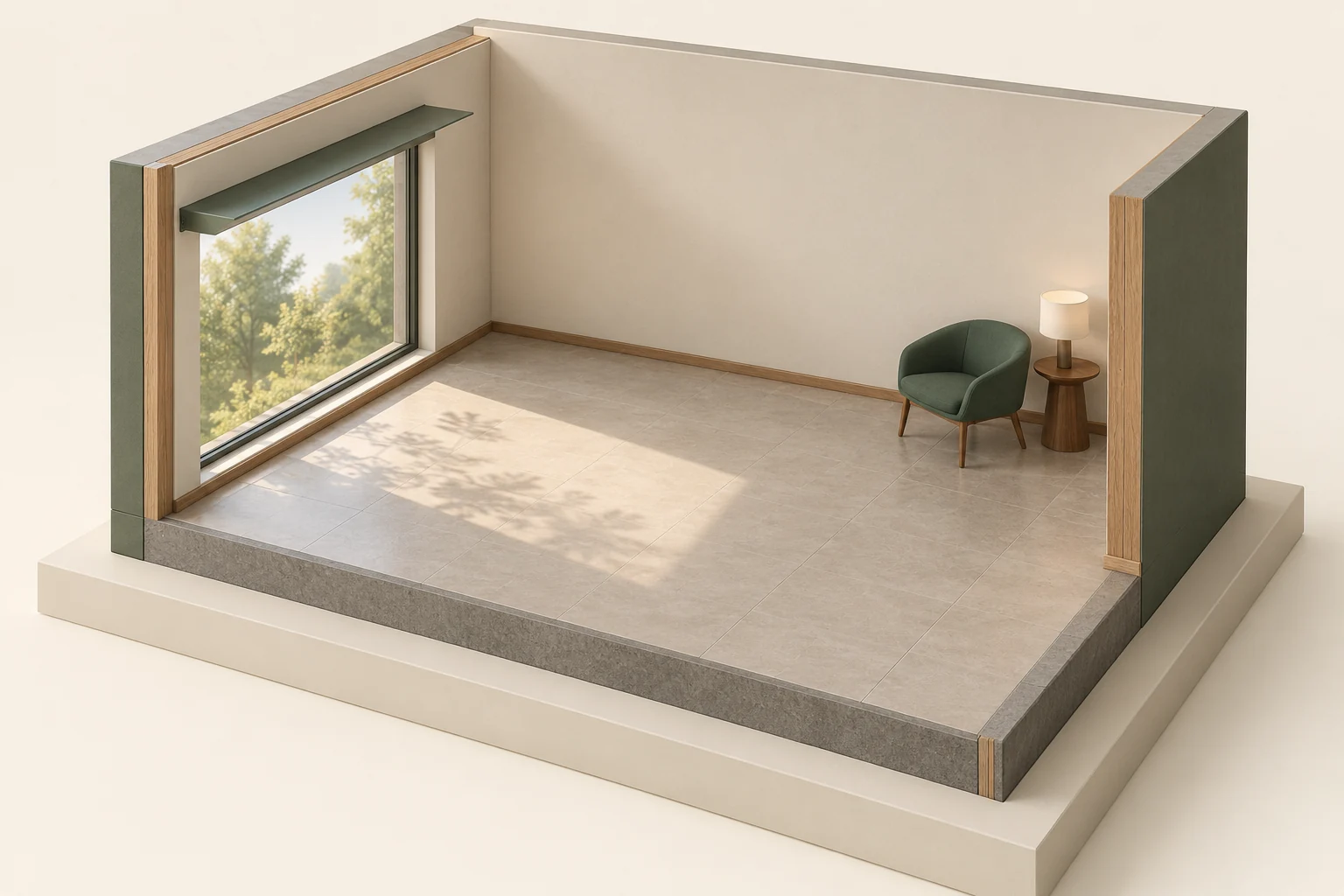
- Closed glazing
Directly transmitted solar radiation can reach indoor surfaces. Energy absorbed in glazing and released inward is a separate contribution; neither fraction is measured by this specimen.
- Sunlit floor patch
Indoor materials can absorb energy and exchange it later. This pale patterned floor and shadow patch provide no material identification, stored quantity, surface temperature, delay or cooling result.
- Opaque room-side wall
Heat transfer through an opaque enclosure is a different route from direct sunlight through glass. This indoor face does not show an exterior face radiating straight through the wall or establish the assembly’s actual temperatures.
What does this illustration leave out?
Floor appearance does not identify an installed material or thermal capacity. The front cut edge is a model/display convention, not an approved assembly. The solid blade gives no mounting, exposure coverage or saving percentage. Closed glazing establishes no airflow, product rating or seal performance; the lamp supplies no measured operating gain. Room temperatures, energy shares, stored quantity, exchange duration and actual heat-removal routes remain unknown. This illustration explains an idea. It is not an installation guide.
How do direct solar admission, heat transfer through the opaque enclosure, indoor gains and later material exchange fit the room balance, and which actual observations or professional records could distinguish them?
Explore this with HomeAI ↗Opens an editable question. Nothing is sent until you choose to send it.Use night ventilation only under suitable conditions
Outdoor air can help remove heat when the relevant conditions permit, but opening a window does not guarantee useful cooling. The outdoor temperature, actual airflow route, smoke conditions, security, noise and safe access all matter. Health Canada's heat guidance includes taking advantage of cooler outdoor periods where appropriate; it is not an instruction to leave every home open regardless of conditions.
Check the actual sequence. A cooler night may support a strategy that a hot night cannot. A window open briefly may provide little whole-room heat removal, and a breeze observed at one opening does not measure the rest of the space. Keep the possibility that passive cooling is insufficient rather than blaming the occupant when the weather does not support it.
Do not disable protective features, compromise security or create unsafe fan and cord arrangements to chase airflow. An HRV or ERV serves a ventilation function and is not automatically a night-cooling system. Ask the equipment professional how any ventilation control fits the actual arrangement and current conditions.
Natural air exchange needs a pressure difference and openings connected by a usable path. Wind can push on one side and draw on another; buoyancy depends on indoor–outdoor temperature difference and height. Interior doors, sheltered exposures and the available opening area affect the route. Two visible windows do not prove cross-ventilation, and opening a high window while outdoor air is warmer than a cooled interior can admit additional heat rather than remove it.
Distinguish a room fan recirculating indoor air from outside-air ventilation and from mechanical cooling. An HRV or ERV may reduce the energy penalty of ventilation through recovery, while its controls and configured routes determine actual operation. Recovery equipment is not automatically a cooling appliance or a suitable night-purge control. Ask the HVAC provider how the identified system handles the conditions in your own home.
A different outdoor condition changes the question
This paired evening illustration changes the outside light, not a measured room temperature.
Numbers identify the parts explained below.

- Outdoor conditions
Compare actual outdoor temperature and smoke conditions before considering natural airflow.
- Window and access
Ask whether the actual window can be opened safely and supports a usable air route. Security, fall protection, screens and wind matter; this picture cannot establish airflow.
- Stored heat
Indoor warmth can continue after the sun disappears. Mechanical cooling or a cooler place may still be needed.
What does this illustration leave out?
A cool-looking sky does not establish cooler outdoor air, clean air, safe access or enough cooling. This illustration explains an idea. It is not an installation guide.
When is a cooler-night ventilation strategy unsuitable for my home, and what is my alternative during heat or smoke?
Explore this with HomeAI ↗Opens an editable question. Nothing is sent until you choose to send it.A cooler-night possibility and a different daytime state
One possible window-to-window route is shown for a suitable cooler-night condition; night alone does not establish cooler or clean air. The daytime model closes and shades the openings. Neither state guarantees adequate cooling—consider smoke, security, safe openings and a cooler-place plan.
Numbers identify the parts explained below.
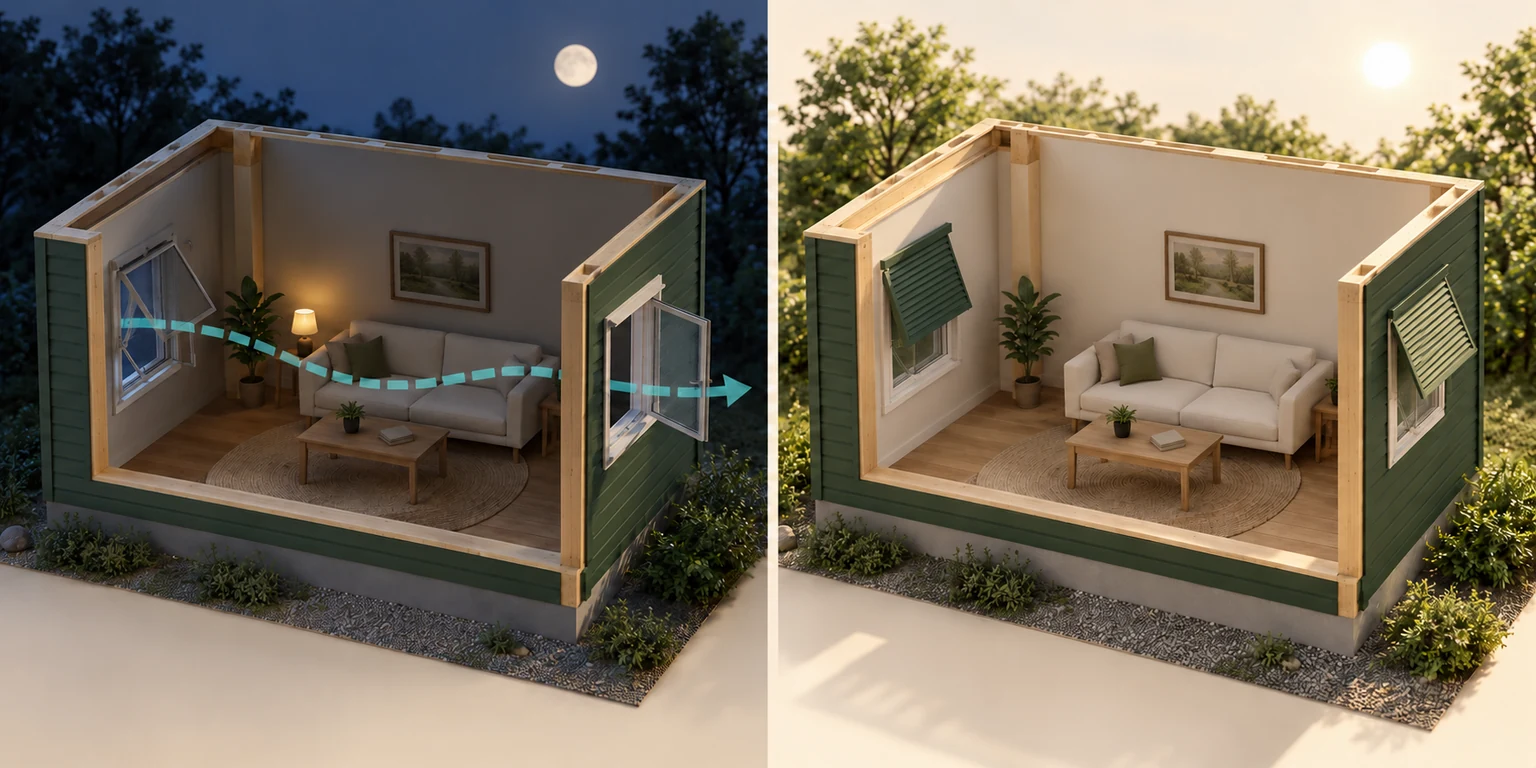
- A conditional opening
Opening a window depends on actual outdoor temperature, air quality, safe access and security. Night, screens and pictured hardware do not establish those conditions or permissions for a real home.
- A possible exchange path
The dashed line links two open windows as a conceptual wind-driven possibility. Direction, amount and room coverage depend on actual openings and pressure conditions; this is not a measured or simulated airflow result.
- Closed and shaded daytime
Closed panes interrupt the illustrated intentional window-air route; exterior shade can reduce solar input. Neither removes stored or internal heat or certifies a safe room. Keep a suitable cooler-place option in the heat and smoke plan.
What does this illustration leave out?
Actual outdoor and indoor temperatures, smoke, wind, opening safety, permissions, security and usable airflow remain unknown. Screens and hardware do not certify safe access or fall protection. The arrow is a possible relationship, not an airflow simulation; closed daytime windows do not certify a safe room or remove stored and internal heat. A suitable cooler or cleaner space may still be needed. This illustration explains an idea. It is not an installation guide.
When could a cooler-night window route help my home, what temperature, smoke and safe-opening conditions would make it unsuitable, and what cooling alternative should I plan?
Explore this with HomeAI ↗Opens an editable question. Nothing is sent until you choose to send it.Distinguish moving air from removing room heat
A fan moves air and can affect how a person exchanges heat with the surroundings. It does not provide the same room heat removal as an air conditioner. Extreme conditions and individual vulnerability can limit reliance on a fan alone. Follow public-health advice and individual healthcare guidance rather than treating perceived breeze as proof that the room is suitable.
Mechanical cooling also needs a complete route: appropriate equipment, distribution, controls and a building context. A functioning outdoor unit does not establish delivery to every occupied room. Likewise, a warm bedroom does not identify a refrigerant, duct or sizing fault. Preserve the operating pattern and ask for a qualified assessment of the relevant system.
If cooling equipment is being selected, request a professional explanation of the assumptions and scope. Do not estimate a required capacity from floor area alone or accept a household log as a complete design calculation. A larger unit is not an evidence-based remedy until the actual decision has been assessed.
A person and the room have different heat balances. Air movement around someone can change their heat exchange and feel helpful even when the room thermometer does not fall. A fan circulating the same indoor air supplies no outside heat-removal route by itself. Health Canada’s current heat guidance also warns that fan comfort has limits in extreme conditions. Perceived breeze should not replace a heat-relief plan.
For a buyer or new-build household, the practical question is which occupied room can actually provide reliable heat relief and under which operating conditions that was demonstrated. Ask what cooling equipment is included, which rooms it serves, what distribution and controls were assessed, and what could not be checked in winter. Keep that specific handover answer separate from a claim that every room or future heat event has already been covered.
A breeze and room heat removal are different
The room model shows an exterior blade shade, a closed window with a roller shade at the glazing, a sunlit floor patch, a guarded room fan and a separate closed wall unit. A desk, lamp, closed laptop and detached stone-like specimen are also visible.
Numbers identify the parts explained below.
- Guarded fan
Air movement near a person can affect comfort. Recirculating the same room air alone does not supply outside heat removal. Follow current heat guidance and keep a relief plan.
- Closed equipment
Identify the actual system, served rooms, controls and commissioning information before claiming it cools this room. This unlabelled specimen establishes none of those.
- Room boundary
Outside-air ventilation, recirculation and mechanical cooling are different functions. Smoke, outdoor temperature, safe opening access and the available route affect the ventilation question.
What does this illustration leave out?
Shape does not identify the cabinet, prove airflow, establish cooling capacity or show an external heat-removal route. No safe indoor temperature is determined. This illustration explains an idea. It is not an installation guide.
What distinguishes fan comfort, outside-air ventilation and reliable cooling in this room, and what should a buyer request when summer operation was not demonstrated?
Explore this with HomeAI ↗Opens an editable question. Nothing is sent until you choose to send it.Treat heat and smoke as a combined constraint
A strategy based on open windows can become unsuitable during wildfire smoke, while closing the home can leave insufficient passive cooling. BCCDC's combined guidance emphasises staying cool and seeking cooler, cleaner space when necessary. A resilient household plan includes an alternative location rather than expecting one window or filter setting to resolve both problems.
Identify cooling access, transport and practical household needs before an event. Check current local notices instead of assuming yesterday's information still applies. If the home becomes unsuitable, a plan to go elsewhere is an active response, not a failure of home maintenance. Individual medical concerns belong with the relevant healthcare professional.
Particle filtration does not remove all gases or resolve faulty combustion. Do not use outdoor fuel-burning equipment indoors for power or cooling. For an active CO alarm, leave immediately and call emergency services from outside. No passive-cooling experiment should delay an immediate hazard response.
Health Canada prioritizes keeping cool when extreme heat and wildfire smoke coincide. Closing windows as much as practical to reduce smoke entry must not turn into remaining in a dangerously hot room. The combined guidance identifies local cooling centres or cleaner-air spaces when the home cannot provide adequate relief. Plan how the household would reach that space, and follow current local health directions and urgent symptom guidance. A particle filter does not solve the heat-removal problem.
Connect the room, the envelope and the site
The model connects rooms, weather-facing surfaces and the ground. Its purifier and exterior shade represent different functions.
Numbers identify the parts explained below.
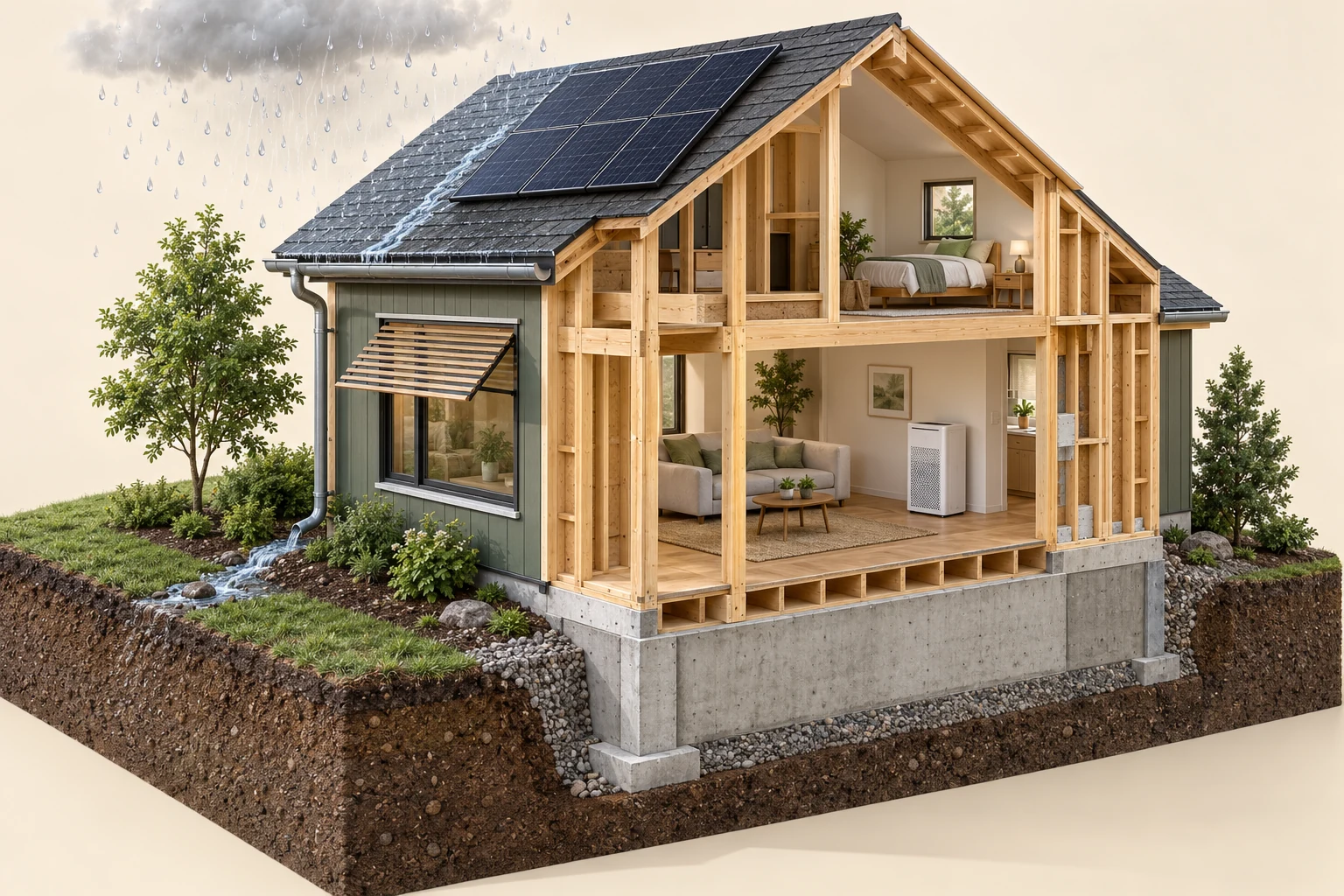
- Weather-facing roof
Observe safely from accessible ground; do not infer a cause from one mark.
- Room equipment
Confirm what the device does and the scope of its performance information.
- Ground connection
Site and buried conditions differ from the visible room.
What does this illustration leave out?
Exposure, airflow, filtration, moisture, foundation condition and parcel risk require specific evidence. This illustration explains an idea. It is not an installation guide.
How do I separate observations about the room, equipment and site before choosing a specialist scope?
Explore this with HomeAI ↗Opens an editable question. Nothing is sent until you choose to send it.Work through a fictional west-room comparison
A fictional owner records a bedroom becoming warm late in the day, then remaining warm overnight. They have a new interior blind and a portable fan, but no cooling assessment. One cooler afternoon after the blind is fitted seems promising. The observation alone cannot separate the blind's effect from that day's outdoor conditions and different household use.
The owner keeps a contextual log and asks an advisor to discuss solar exposure, stored heat and practical cooling options. They check whether a safe cooler-night strategy is available and identify an alternative during hot, smoky conditions. They do not conclude that window replacement is required or that the fan makes the room safe for every occupant.
If a scoped assessment later identifies a specific improvement, the record should retain its assumptions and expected limits. A passive measure may help under some conditions while mechanical cooling or a cooler location remains necessary during an extreme event. The worked example values a plan that acknowledges limits instead of promising one permanent comfort solution.
Build an annual decision rather than a summer guess
Keep temperature observations, equipment instructions, service findings, window information and any project assessment together. Describe a result by the conditions in which it was observed. Summer comfort, winter heat loss and moisture performance can interact; changing an envelope component needs a broader explanation than a single hot-day complaint.
Write purposeful next tasks: confirm a sensor location, identify available shading records, request a cooling assessment, or verify a practical cooler-place plan. A Home Plan status records evidence or an action, not a heat-safety certificate. Missing records do not automatically require every equipment test or a complete replacement project. When comparing options, ask which observation would show a meaningful improvement and under what weather and operating conditions that comparison would be valid.
Canadian climate, housing type, outdoor-air conditions and household needs vary. A strategy effective in one dry, cool-night climate may have different limits elsewhere. A qualified professional can assess the building and equipment choices, while current public-health advice governs heat response. HomeAI can help connect those questions without prescribing a universal temperature threshold or guaranteeing comfort.
Keep learning about the connected parts
Practice the distinction.
A warm bedroom after sunset
Fictional learning scenario: late-day sun, a new blind and a fan coexist with overnight warmth.
Reported observations
- The indoor pattern extends beyond direct sunlight.
- Weather differed between comparisons.
- Cooling capacity and distribution are not assessed.
Compare the explanations
Expand each possibility to see the evidence needed to distinguish it. Similar symptoms can have different mechanisms.
Gains and stored heat
These may be relevant without establishing the full cause of the room pattern.
Contextual observations and an appropriate building assessment.
Cooling or distribution question
Mechanical performance may need its own scope rather than a guess from room temperature.
Qualified equipment and distribution findings.
A useful next question
Compare observations with weather context and request an assessment suited to the intended comfort decision.
The example gives no design capacity, safe-temperature clearance or guarantee that passive measures will suffice.
Know what the words mean.
- Solar heat gain
- The contribution of solar energy entering or being absorbed by the building and affecting its heat balance.
- Stored heat
- Energy held in materials that can affect temperatures after the original gain changes.
- Passive cooling limit
- A condition in which shading, natural airflow or other passive measures cannot meet the relevant need.
- Energy balance
- Accounting for energy entering and leaving a chosen boundary over a stated period, together with the change in energy stored inside it. A subtotal of heat gains is not a temperature or a temperature prediction.
Questions to bring
to the conversation.
- What was actually observed?
- Which part was assessed, and what was inaccessible?
- What record supports the conclusion?
- Who can resolve the remaining technical question?
Separate a showing observation, an existing record and a new professional assessment. Unknown means a question remains; it does not automatically mean a defect.
Use the evidence planner ↗Go to the source.
Original HomeAI explanation informed by these public references. Sources support the underlying guidance; they have not reviewed or endorsed HomeAI. Diagrams are conceptual, and calculator outputs depend on your inputs.
Publication & source review
First published .
Sources reviewed .
- Health Canada · Protecting yourself during extreme heat
- Natural Resources Canada · Windows and exterior doors
- Natural Resources Canada · How your house works
- Natural Resources Canada · Operating heating and ventilation
- Health Canada · Ventilation and the indoor environment
- BCCDC · Wildfire smoke and staying cool
- Health Canada · Preventing carbon-monoxide exposure
- Natural Resources Canada · Window ratings and solar gain
Where this reference applies
Jurisdiction: Canada; general window education
Section 8.1.3–4 and8.1.11–12: U-factor, SHGC, visible transmittance, shading/film tradeoffs and reverse-stack mechanism. Numerical rules of thumb are not a specification for an individual home.
- Natural Resources Canada · Heat, air and moisture mechanisms
Where this reference applies
Jurisdiction: Canada; building-science education
Sections 2.1.2–7 and 2.2.1–2: heat transfer, airflow/pressure, moisture transport, condensation, system interactions and effective thermal resistance. Source examples are not an approved assembly or a property diagnosis.
- Health Canada · Keeping a home cool during extreme heat
Where this reference applies
Jurisdiction: Canada; public-health guidance
Prepare for heat; keep home cool; extremely hot home and heat-emergency response. Household choices and fan limits do not establish a universally safe indoor temperature.
- Health Canada · Natural airflow and ventilation distinctions
Where this reference applies
Jurisdiction: Canada; detached/duplex/row-house background with individual equipment
Edition: March 2018 technical background; page details 2018-04-19
Natural ventilation, HRV/ERV mechanisms, controls, room distribution and seasonal/outdoor-pollutant context. Historical code references, generic settings and rates are not current installation instructions.
- BC Housing / FPInnovations · Thermal mass and natural cooling (historical design education)
Where this reference applies
Jurisdiction: British Columbia; historical design education
Edition: Pathways to High-Performance Housing in British Columbia, SP-56; completion 2013–14; PDF created 2014 and modified 2018
Printed page 32, PDF page 42, Figure 3-8 and section 3.3.2.2: stored heat, shading and pressure-driven airflow. Numerical overhang ratios, airflow speeds, temperatures, humidity conditions and solar-contribution percentages are excluded.
- Health Canada · Combined wildfire smoke and extreme heat
Where this reference applies
Jurisdiction: Canada; public-health guidance
Edition: 2024; H144-126/2024E-PDF; 6 PDF pages
Entire 6-page public PDF, especially pages 5–6: prioritize keeping cool, qualified equipment/filtration choices, cooler/cleaner public spaces and urgent symptom response. No filter guarantees clean air or a safe room temperature.
- NRC · Direct and absorbed window solar gain (historical mechanism)
Where this reference applies
Jurisdiction: Canadian research; historical mechanism education
Edition: Construction Technology Update 71; original September 2008; repository wrapper 2008-12-01
Source reviewed: 2026-10-03 · UTC
Complete nine-page original and full extraction retained. Consequential mechanism reread: printed page 3 / PDF page 4, SHGC sidebar, directly transmitted solar radiation plus absorbed solar subsequently released inward. Historical CCHT energy fractions, costs, modelled locations, window rankings and ENERGY STAR criteria are excluded. This is neither a current requirement nor a property performance prediction.
- NRC · Storage, gains/losses and temperature over time (historical mechanism)
Where this reference applies
Jurisdiction: Canada; historical modelling mechanism education
Edition: D. M. Sander, 1983 CIB proceedings, pages 201–212; repository-created 2023 is not publication
Source reviewed: 2026-10-03 · UTC
Complete fifteen-page original and full extraction retained. Consequential mechanism reread: printed page 205 / PDF page 8, nonsteady storage, solar-warmed exterior surfaces, internal schedules, and temperature variation when gains exceed or fall below losses. No equation is transplanted to a house, no equipment capacity is derived, and no current design or code method is adopted.
Have a question about your home?
Start with the symptom, timing and what you have observed.
Ask HomeAI