- Start with a specific problem and ask which result would change your next choice.
- Temperature, airflow, energy and cost answer different questions; keep units, conditions and scope attached.
- Compare the actual proposal and verification records rather than assigning project savings from one lower bill.
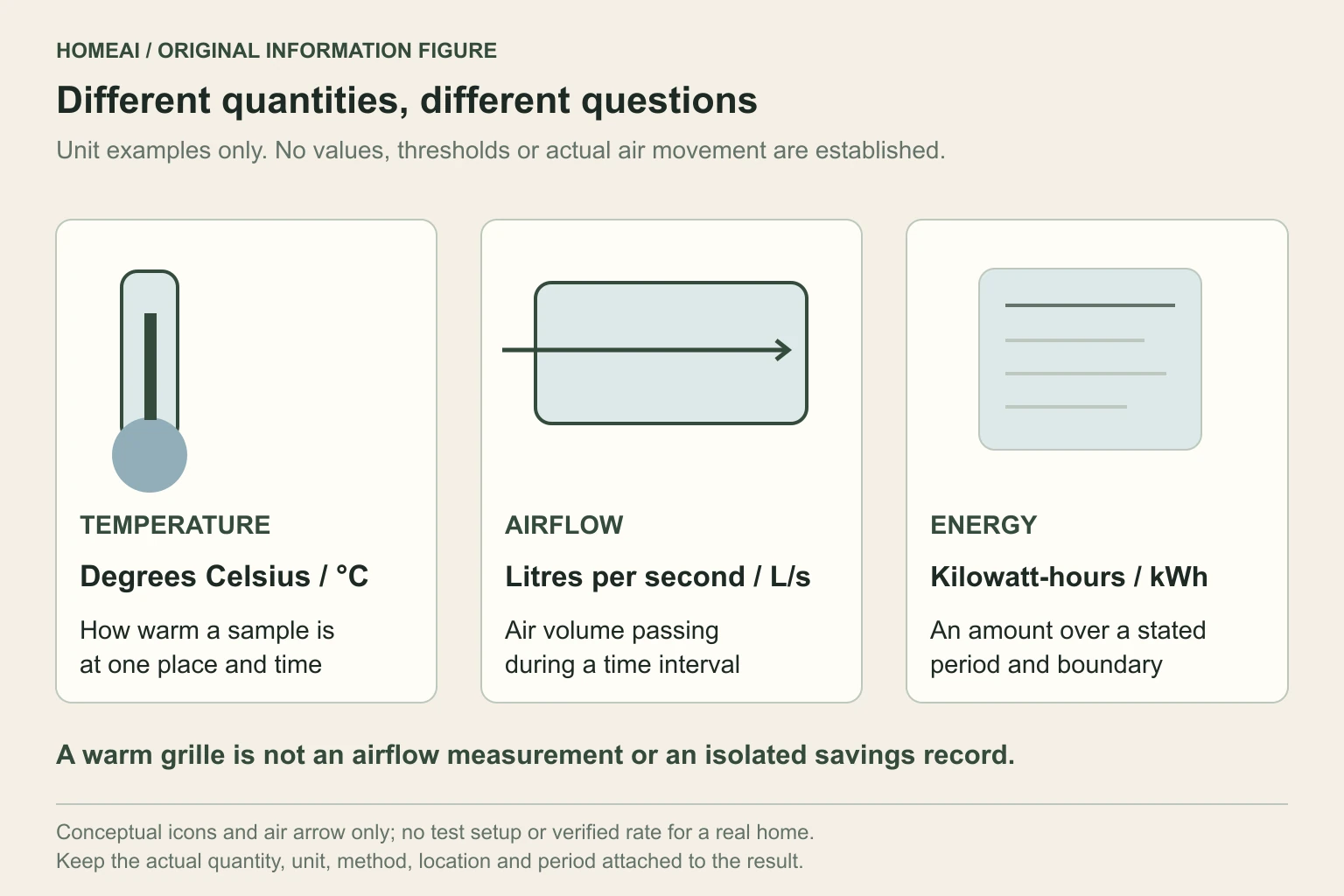
A sampled temperature, a conceptual air-volume boundary and an energy-period record, with their different units and jobs.
About this illustration
No measured temperature, airflow, delivered heat, acceptable range, instrument method or equipment condition is represented. This is a conceptual teaching model, not an assessment of your home.
4 picture lessons appear beside the questions in this guide. Use them to understand the explanation, then consider what it means for your home.
What question should I answer before replacing a part?
Start with the problem you want to change: a bedroom stays colder than the hall, a window feels cold, or a utility bill increased. Those are useful observations. They do not yet identify the part responsible or show that replacement is the best response.
A cold room can involve heat escaping, heat not reaching the room, or conditions that differ from the rest of the house. A cold window surface can affect comfort even without air leaking through that spot. NRCan explains that heat flow, airflow and moisture interact; a single sensation cannot separate them.
Make the question narrower: does this room remain colder than the hall under comparable ordinary conditions? Note the locations, time, weather and normal heating operation. Keep a reported symptom separate from a professional finding. Do not open equipment, disturb wiring or create a fault to make the problem easier to observe.
Ask what result would change the next choice. If either possible result leads straight to the same replacement, the proposed measurement may not answer the decision you are making. A useful investigation explains which possibilities it can distinguish and what remains outside its scope.
A measurement should help choose the next step
One reported concern branches into two questions before a defined measurement and decision.
Numbers identify the parts explained below.
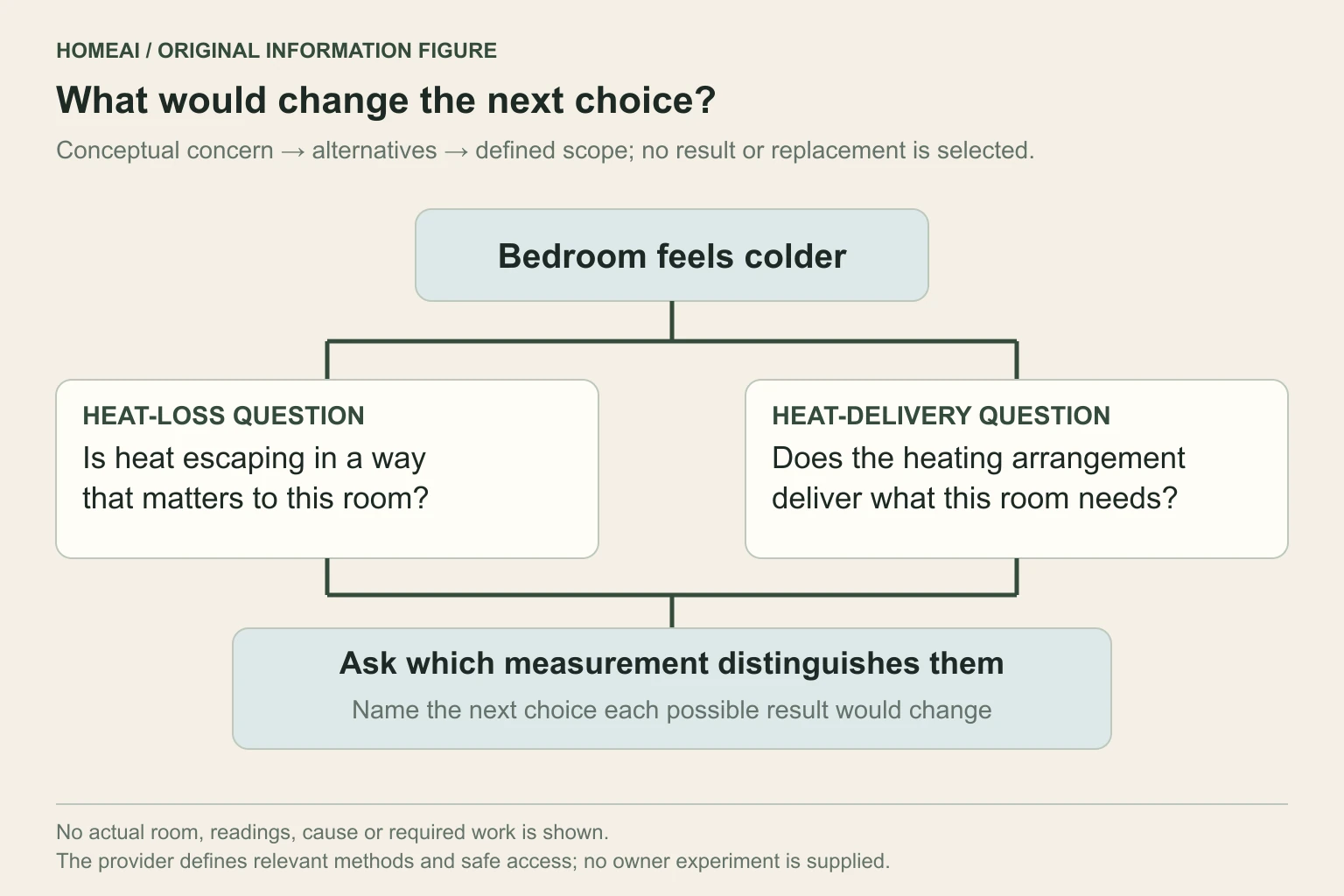
- Reported concern
The bedroom feels colder than the hall; location and ordinary conditions belong with the note.
- Possible explanations
Heat escaping and heat not reaching the room are questions, not findings.
- Relevant measurement
Ask which method can distinguish the relevant possibilities and what it excludes.
- Next choice
State which result would change the next assessment or proposal.
What does this illustration leave out?
No room temperature, airflow, actual defect, test result or replacement decision is established. Conceptual questions only. Read the complete explanation below.
What possible result would change the next choice?
Explore this with HomeAI ↗Opens an editable question. Nothing is sent until you choose to send it.A measurement should help choose the next step
Use a narrow question to connect ordinary observations to a defined investigation. This diagram does not choose a cause or a replacement.
- Reported concern
- A bedroom feels colder than the hall. Keep who observed it, where, when and under which ordinary conditions.
- Heat-loss question
- Is heat escaping from the relevant room or enclosure in a way that matters? A cold surface can affect comfort without proving a leak at that spot.
- Heat-delivery question
- Does the actual heating and distribution arrangement deliver what that room needs? A warm grille alone cannot answer the airflow or whole-room question.
- Measurement scope
- Ask which method distinguishes the relevant alternatives, which units it uses and what access or questions it excludes. The qualified provider defines and safely conducts any appropriate test.
- Decision relevance
- Before testing, ask which possible result would change the next scope or proposal. Do not create a fault, block openings or open equipment to make a result appear.
Conceptual information only. No actual home, measured result or equipment requirement is established. NRCan’s home-system and window guidance provide general Canadian mechanisms; actual provider scope and local conditions determine the investigation.
What does this measurement actually measure?
Temperature describes how warm something is. Airflow describes how much air moves in a given time. Energy describes an amount used or delivered over a period. A warm supply grille, a room temperature and a utility bill therefore describe different parts of the heating story.
For a ducted system, air carries heat into the room. Feeling warm air at one opening does not establish how much air reaches it or whether the whole distribution arrangement suits the home. A qualified heating provider can explain which temperature, airflow, equipment and building information their assessment needs.
A moisture observation has similar limits. A dry-looking wall today does not settle whether it became wet during an earlier storm. A surface reading and an assessment inside an assembly answer different questions. Keep the location, method and conditions with each result rather than treating every moisture number as interchangeable.
Ask the provider to name the quantity, unit and purpose before ordering a test. The figure separates temperature in degrees Celsius, airflow in litres per second and energy in kilowatt-hours. These are unit examples, not acceptable ranges, instructions to test equipment or a diagnosis of this house.
Warm air, air volume and energy are different quantities
A sampled temperature, a conceptual air-volume boundary and an energy-period record, with their different units and jobs.
Numbers identify the parts explained below.
- Temperature / °C
How warm the sampled air or surface is at a specified location and time.
- Airflow / L/s
How much air passes in a time interval under the actual measurement method.
- Energy / kWh
An amount used or delivered over a stated period and system boundary.
- Keep the task clear
Feeling warm air does not measure volume, and a bill does not isolate a room-distribution cause.
What does this illustration leave out?
No measured temperature, airflow, delivered heat, acceptable range, instrument method or equipment condition is represented. Unit examples only; no values, thresholds or testing instructions.
Which quantity does this record measure, and which question is still unanswered?
Explore this with HomeAI ↗Opens an editable question. Nothing is sent until you choose to send it.Warm air, air volume and energy are different quantities
These unit examples describe different quantities in a heating question. They supply no measured values, acceptable ranges or procedure.
| Quantity and example unit | What it describes | What it leaves open |
|---|---|---|
| Temperature / degrees Celsius (°C) | How warm sampled air or a surface is at its location and time. | Air volume and the whole room’s heat balance. |
| Airflow / litres per second (L/s) | Air volume passing in a time interval under the stated method. | All heat loss, comfort causes and equipment selection. |
| Energy / kilowatt-hours (kWh) | An amount used or delivered over a stated period and system boundary. | A particular room’s airflow, a defect diagnosis or isolated project contribution. |
| Cost / Canadian dollars (CAD) | Money charged under the actual period, rates and included items. | Whether energy changed for the same reason, or what a different tariff would cost. |
No numeric target or conversion between these quantities is supplied. The diagram uses conceptual air arrows rather than a measured rate or verified flow direction for an actual installation. NRCan’s heat-pump and home-system guidance supports the distinct roles; use actual methods and qualified assessment.
Match the quantity to the heating question
- Temperature / °CHow warm the sampled air or surface is at that position and time; it does not measure air volume.
- Airflow / L/sHow much air passes in a time interval under the stated method; it does not by itself identify the whole home’s heat loss.
- Energy / kWh or GJAn amount over a specified period; keep system boundaries and modelled versus recorded use clear.
- Cost / CADCharged money under the actual period, rates and included items; it is not an isolated equipment-efficiency measurement.
When are two readings a fair comparison?
A measurement needs context. Moving a room thermometer from a sunny window to a shaded shelf changes what it samples. Comparing a quiet mild afternoon with a windy cold evening changes the conditions too. Write down those differences before deciding that the home or equipment changed.
More decimal places do not automatically mean greater accuracy. Ask how the instrument is used, what uncertainty matters and whether the difference is large enough to support the conclusion. An estimate with unknown inputs should remain an estimate, even when a calculator displays a very precise answer.
For an ordinary owner log, use accessible safe positions and a consistent method. Record normal door positions, occupancy and weather rather than changing controls or blocking openings to provoke a result. A professional decides whether controlled testing is appropriate and manages its safety requirements.
A calculator also has a comparison boundary: its included equipment, energy, period and assumptions. A fixed heat-pump efficiency assumption is not a measurement of seasonal performance in this climate. Keep manufacturer ratings, a modelled estimate and observed household use separately labelled.
Which professional report answers my question?
An EnerGuide home evaluation examines energy-related features and uses a home model. NRCan describes an onsite evaluation by a registered energy advisor working through a service organization, including its airtightness testing. Ask what the actual engagement includes and which documents and safe access it requires.
That energy assignment is different from an equipment service visit, a condition inspection or an electrical assessment. An energy recommendation may leave a particular defect or repair question unanswered. Give each provider the symptom and intended decision, then ask what they will assess, exclude and deliver.
For a proposed heat pump, NRCan describes the importance of the home’s heating and cooling needs, the selected equipment, distribution and local conditions. Ask the qualified designer or installer how those inputs support the proposal. A room-temperature log or the printed electrical service rating cannot replace that scope.
Preserve the full report, equipment identification and limitations. NRCan also distinguishes onsite-based home labels from virtual labels using database assumptions. Check which record you have. Do not enter dangerous spaces or operate combustion, electrical or other unfamiliar equipment to prepare for a visit; follow the provider’s appropriate instructions.
Three reports can have three different assignments
Three report roles with a shared instruction to retain findings, methods and access limits.
Numbers identify the parts explained below.
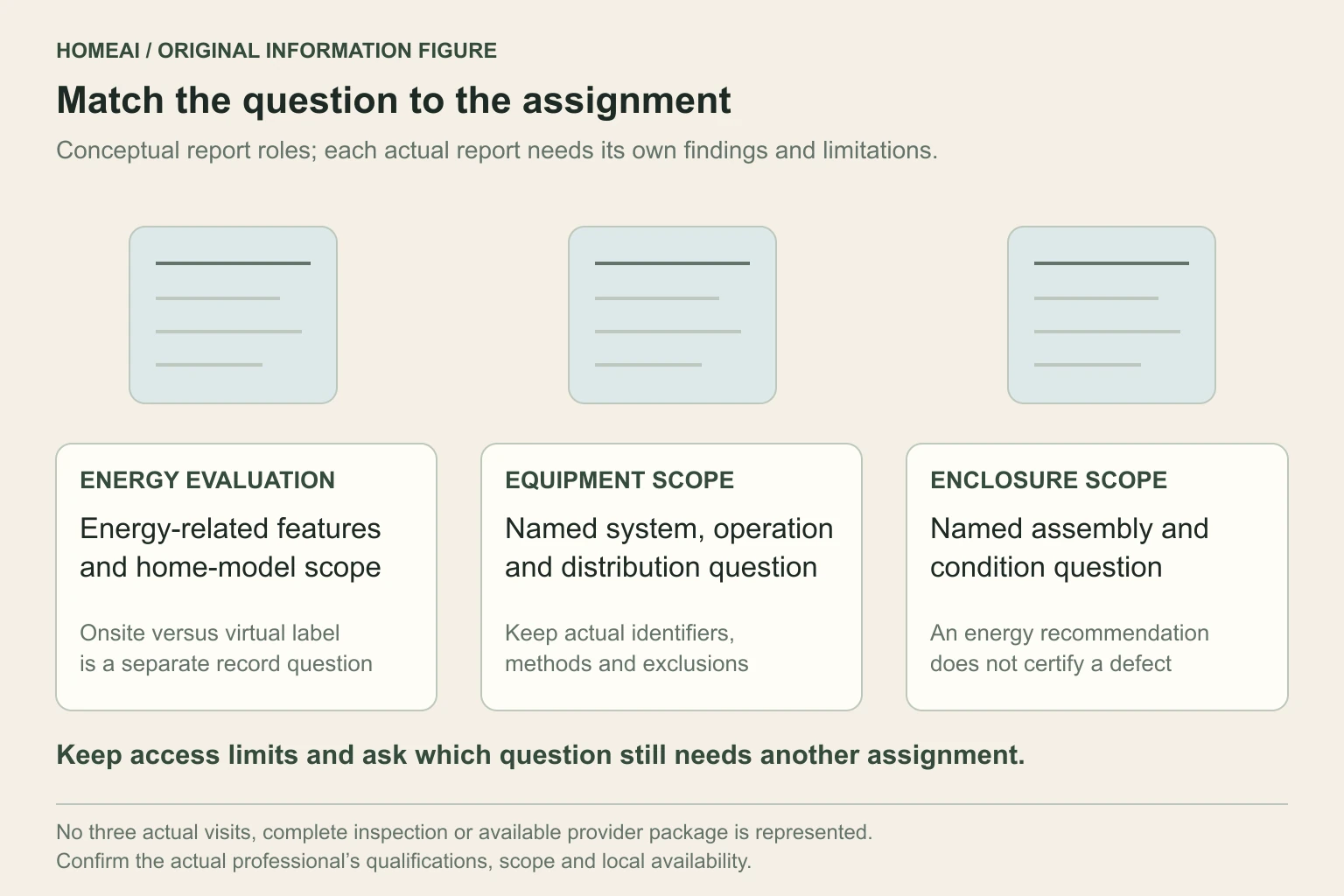
- Energy evaluation
An onsite energy assignment and home model answer their stated energy questions.
- Equipment assessment
Named system, operation and distribution scope address a defined equipment question.
- Enclosure assessment
Named window, junction or other assembly scope addresses its defined condition question.
- Coordinated file
Keep each report’s findings, exclusions and actual provider qualifications; ask which gap still matters.
What does this illustration leave out?
No actual professional visit, property conclusion, available provider or complete inspection is shown. Conceptual report roles, with no actual findings or provider promise.
Which named assignment will answer the decision this home needs?
Explore this with HomeAI ↗Opens an editable question. Nothing is sent until you choose to send it.Three reports can have three different assignments
Begin with the decision, then match each assignment to the question it can answer. Retain the named provider and complete report.
- Energy evaluation
- Read whether it is an onsite NRCan-registered advisor assignment, the energy-related features and airtightness testing within scope, and the home-model assumptions. An onsite-based and a virtual home label are different records.
- Equipment assessment
- Ask which actual equipment, operation and distribution question is covered. Relevant sizing, controls, installation and commissioning records have their own roles and limits.
- Enclosure assessment
- Ask which named window, junction or assembly and condition question is included. An energy recommendation does not automatically supply a defect investigation.
- Findings and exclusions
- Keep methods, sampled locations, access limits, assumptions and unassessed questions with each conclusion. One report does not certify every system.
- Provider and preparation
- Confirm actual relevant qualifications, licensing and local availability. Follow the provider’s appropriate preparation instructions rather than opening hazardous equipment or entering unsafe spaces.
This figure names conceptual report jobs rather than three actual visits or an available service package. NRCan’s national guidance does not provide this property’s findings, local permission or required equipment.
How should a replacement proposal connect the evidence to the work?
A clear proposal connects the reported problem, the findings and the work intended to address them. Ask the provider to explain that connection in everyday terms. If the concern is a cold bedroom, ask which finding supports replacing equipment rather than repairing a particular distribution or enclosure problem.
Read the specified equipment, affected locations, included work and exclusions. Ask which assumptions need confirmation and which permits, installation records or commissioning checks apply to this actual project. A quotation describes offered work; it is not evidence that the work has already happened.
Agree on how the completed work will be checked against its stated purpose. An invoice can record the paid scope while a commissioning record describes named installation checks. Neither automatically establishes every room’s comfort, all future savings or the condition of unrelated systems.
Compare proposals by their findings, scope and verification as well as price. Where HAUSE coordination is available, ask which actual provider will perform each task and confirm relevant qualifications, licensing and availability. HomeAI can help organize the brief; it cannot inspect the home or certify the proposed solution.
What does each project record establish?
- Observation logReported locations and conditions help define the question; they do not certify the cause.
- Scoped assessmentRecords named findings, methods and access limits within a professional assignment.
- ProposalDefines offered equipment, work, assumptions and exclusions; it does not record completed work.
- Completion and verificationDescribe the actual documented tasks and checks; preserve their limits rather than extending them to all comfort or savings.
Does an energy estimate predict my next bill?
An energy estimate and a bill serve different jobs. NRCan’s EnerGuide report estimates home energy under defined operating conditions. A household bill records charged use and other applicable amounts during its own billing period. Actual weather, household activity and pricing can differ from the model’s assumptions.
Retain the units. An EnerGuide annual estimate can be expressed in gigajoules per year; an electricity record can show kilowatt-hours over the stated period. Dollars also depend on the applicable prices and charges. A lower dollar bill does not by itself establish the same percentage reduction in energy.
Ask what comparison supports the claim: which energy sources, periods, conditions and costs are included? Equipment changes can also change the balance between fuels and electricity. Comparing only one of those records may omit part of the household’s heating cost or use.
NRCan’s heat-pump guide explains why local climate, the selected system, controls and energy prices matter. Its dated general examples do not establish savings, electrical requirements or payback for this home. Ask the appropriate provider or advisor to explain the actual assumptions, alternatives and uncertainty.
What can a lower bill after replacement really tell me?
Fictional owner Mina replaces heating equipment. Her earlier bill is CAD 200 for 1,000 kWh over 30 days; her later bill is CAD 160 for 800 kWh over 30 days. The teaching example assumes CAD 0.20 per kWh, no other charges and one electricity-only comparison. All amounts and conditions are invented.
The arithmetic shows CAD 40 less billed cost and 200 kWh less recorded energy in this invented pair. It does not isolate why. The later period is milder and Mina is away more often. The equipment could contribute, while the changed weather and use could also contribute.
Mina keeps the original proposal, commissioning record and both billing-period descriptions. She asks what a suitable comparison could establish and which conditions it cannot fully separate. Her still-cold bedroom remains a separate comfort question rather than being declared fixed by the lower bill.
A buyer or seller can ask the same questions about a claimed improvement. A realtor can coordinate authorized records and specialist access. If seeking a HAUSE-trained team, confirm the actual person’s training, licensing, scope and availability. This fictional example calculates no project-only savings, payback or property value.
Two lower numbers do not isolate the equipment effect
Two fully labelled invented periods, exact energy and cost differences, and separate weather and occupancy changes.
Numbers identify the parts explained below.
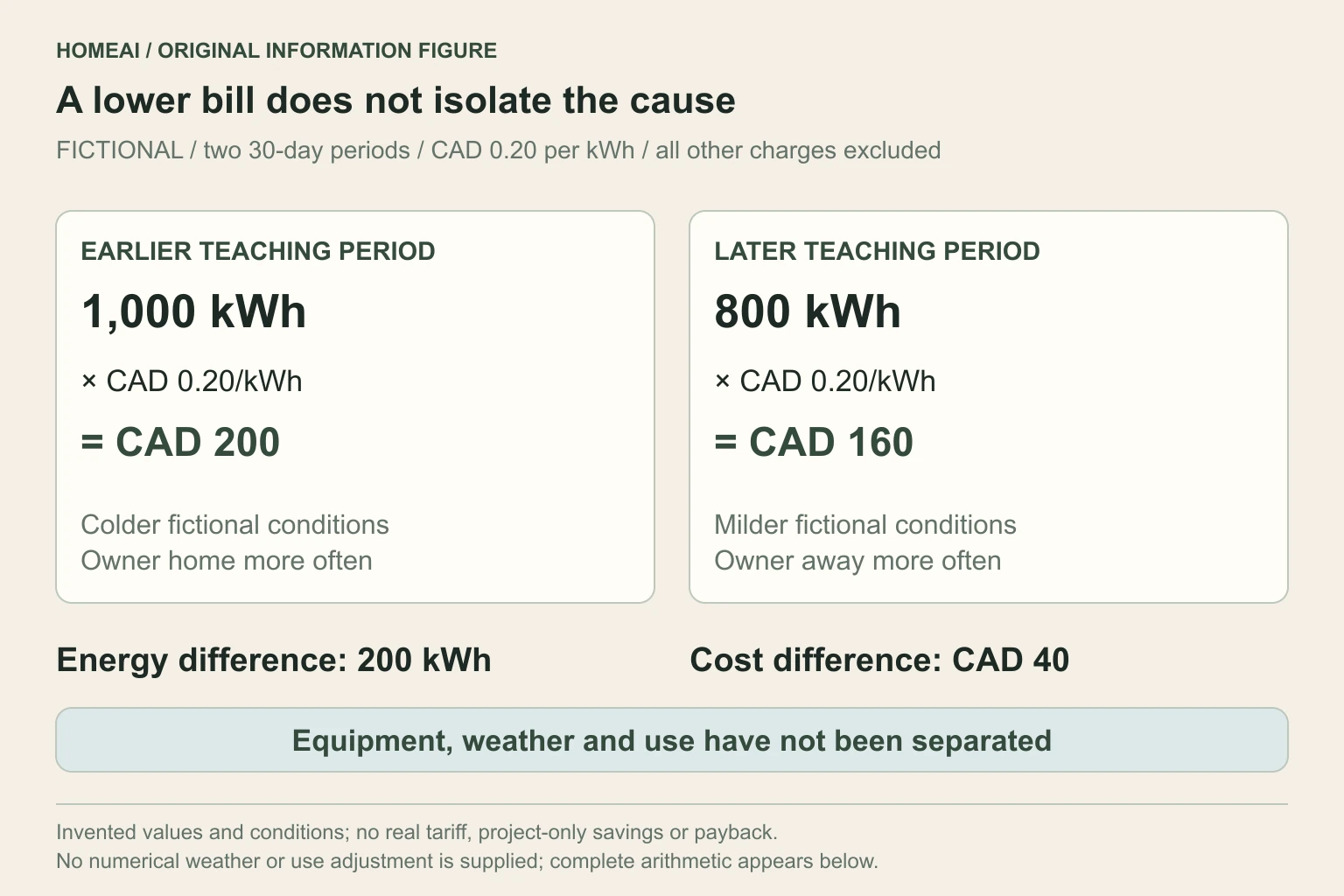
- Same invented boundary
Electricity only; two 30-day periods; CAD 0.20/kWh; all other charges excluded.
- Recorded difference
1,000 − 800 = 200 kWh; CAD 200 − CAD 160 = CAD 40.
- Other conditions changed
The later fictional period is milder and the owner is away more often.
- Separate the claim
The pair shows different recorded use and cost; it does not isolate the equipment contribution.
What does this illustration leave out?
No actual utility rate, project-only savings, equipment diagnosis, payback or home value is established. All values and conditions are invented. Full arithmetic is below.
What supports the project claim beyond this pair of bills?
Explore this with HomeAI ↗Opens an editable question. Nothing is sent until you choose to send it.Two lower numbers do not isolate the equipment effect
All amounts, people, periods and conditions are invented. The comparison includes only electricity and excludes taxes, fixed charges, other fuels and all other costs.
| Entry | Earlier teaching period | Later teaching period |
|---|---|---|
| Period length | 30 days | 30 days |
| Energy | 1,000 kWh | 800 kWh |
| Invented price assumption | CAD 0.20/kWh | CAD 0.20/kWh |
| Cost arithmetic | 1,000 kWh × CAD 0.20/kWh = CAD 200 | 800 kWh × CAD 0.20/kWh = CAD 160 |
| Other fictional context | Colder; owner home more often | Milder; owner away more often |
Recorded energy difference: 1,000 kWh − 800 kWh = 200 kWh. Recorded cost difference: CAD 200 − CAD 160 = CAD 40. These exact invented differences do not establish project-only savings. No numerical weather or occupancy adjustment is supplied.
- What to preserve
- Keep actual original bills and periods, proposal and equipment-identification records, appropriate commissioning information and ordinary weather or use context.
- What to ask
- Which comparison supports the claimed benefit, which conditions remain inseparable, and which energy sources or charges need inclusion?
Invented arithmetic prepared and reviewed October 5, 2026. No real tariff, actual household, payback, savings forecast or property value is represented. NRCan supports the model-versus-use and system-context limits, not these invented amounts.
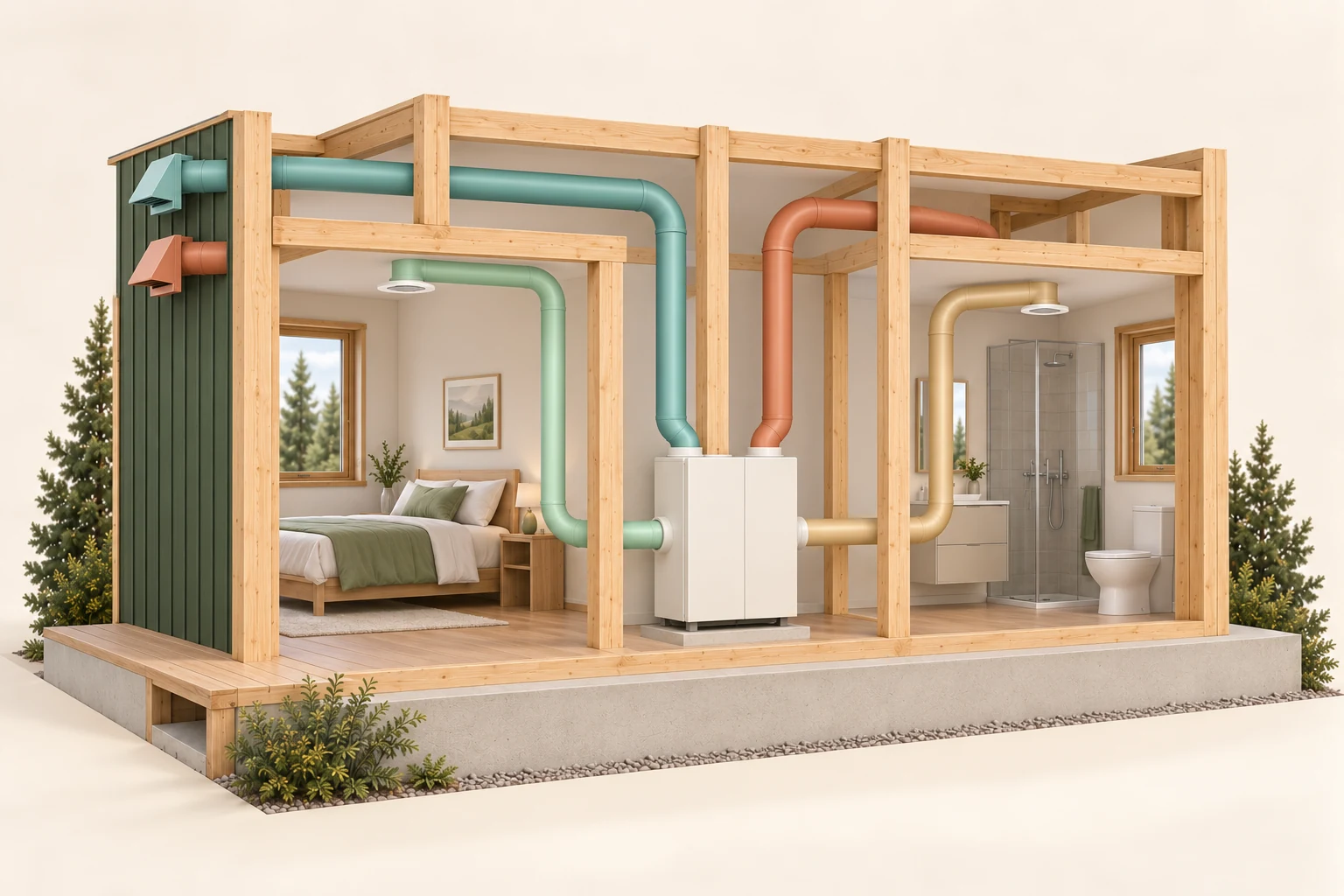
Outdoor and indoor routes meet at the equipment.
A closed ventilation cabinet with four separately coloured connections. Two outdoor hoods and two indoor grilles in an open timber-frame room model. Separate conceptual outdoor and indoor routes; part of an outdoor run passes behind framing.
The evidence the illustration cannot supply
The equipment type, recovery performance and manufacturer port arrangement. Commissioned airflow, balancing, controls, duct sizing and appropriate outdoor-terminal separation. Filtration performance, indoor-air exposure and the actual routing in a home. This is a separate conceptual teaching house, not another view of a surveyed property.
Practice the distinction.
A lower bill in a different month
Fictional owner Mina compares two invented electricity-only 30-day periods after heating work. Earlier: 1,000 kWh and CAD 200. Later: 800 kWh and CAD 160. Both use an invented CAD 0.20/kWh with all other charges excluded.
Reported observations
- The later period is milder and Mina is away more often.
- Recorded energy falls by 200 kWh and the fictional charged amount falls by CAD 40.
- The proposal and commissioning record do not isolate project-only savings from the two bills.
Compare the explanations
Expand each possibility to see the evidence needed to distinguish it. Similar symptoms can have different mechanisms.
Equipment may contribute
The new system could change use, but this pair does not separate its contribution.
Matched selection assumptions, actual commissioning scope and a suitable professional comparison.
Weather and use may contribute
Milder weather and changed occupancy also differ between the periods.
Billing-period, weather and household-use context with appropriate interpretation.
A useful next question
Ask what comparison would support the claimed benefit, and keep the still-cold room as its own comfort question.
All numbers, conditions and people are invented. No project-only savings, payback, diagnosis, real utility tariff or property value is calculated.
Know what the words mean.
- Decision-relevant measurement
- A measurement whose possible results can change the next choice; ask which alternatives it can distinguish.
- Comparison boundary
- The equipment, energy sources, period, units, conditions and charges included in a stated comparison.
Questions to bring
to the conversation.
- What exactly changed, where and under which ordinary conditions?
- Which quantity, method and unit can distinguish the relevant possibilities?
- Which actual professional scope answers the question, and what remains excluded?
- How does the proposed work connect the findings to its completion and follow-up checks?
Separate a showing observation, an existing record and a new professional assessment. Unknown means a question remains; it does not automatically mean a defect.
Use the evidence planner ↗Go to the source.
Original HomeAI explanation informed by these public references. Sources support the underlying guidance; they have not reviewed or endorsed HomeAI. Diagrams are conceptual, and calculator outputs depend on your inputs.
References read for this refresh on October 5, 2026. Current full NRCan Canadian energy-evaluation, labelling, home-system, window and heat-pump guidance read October 5, 2026. Modelled energy, actual use, equipment scope and local conditions remain distinct. No programme, current rating threshold, savings or payback is inferred.
Publication & source review
First published .
Sources reviewed .
- Natural Resources Canada · Prepare for an EnerGuide home evaluation
- Natural Resources Canada · How homes are labelled
- Natural Resources Canada · How your house works
- Natural Resources Canada · After an EnerGuide evaluation
- Natural Resources Canada · Windows and exterior doors
- Natural Resources Canada · Heating and cooling with a heat pump
Have a question about your home?
Start with the symptom, timing and what you have observed.
Ask HomeAI