- A device can contain several measured, calculated or undefined channels; identify each one from the actual manual.
- One location and averaging period cannot describe every room, pollutant or exposure question.
- A consumer trend or low score never overrides a CO alarm or replaces radon testing and qualified health advice.

A small rectangular device rests on the left side table. Side slots and a blank dark front panel are visible. A closed window, furniture and an adjoining doorway provide room context; no reading, channel or instrument method is displayed.
About this illustration
The picture identifies no model, sensing channels, direct CO2 or estimated CO2-equivalent method, optical particle method, VOC method, calibration, averaging period, measured concentration, recommended placement distance or safe-air conclusion. One depicted position cannot establish room or whole-home coverage, and the device is not identified as a CO alarm or radon test. This is a conceptual teaching model, not an assessment of your home.
4 picture lessons appear beside the questions in this guide. Use them to understand the explanation, then consider what it means for your home.
What is the monitor actually reporting?
An indoor-air display is a collection of channels, not a universal description of the home. Temperature, relative humidity, carbon dioxide, estimated particulate concentration and a vendor’s air score can be produced by different sensors and processing methods inside the same enclosure. Begin with the exact model, manual and channel definition. The name on the app needs to match a documented quantity before a reading can support a decision.
Write the unit beside the result. Parts per million describes a gas concentration ratio; micrograms per cubic metre describes mass per air volume; a percentage may describe relative humidity; an unqualified score may use the manufacturer’s own scale. These are not interchangeable. A dashboard colour or decimal place adds no independent measurement. Ask which channels are directly sensed, which are calculated from another signal and which are undocumented. An unknown channel should remain unknown instead of becoming a confident home diagnosis.
Which part of the home does one position represent?
A monitor samples at its position. A kitchen activity, exterior opening, ventilation outlet or nearby person can affect the local reading without describing every room. Placement that helps investigate a local source may differ from placement intended to describe ordinary occupied-room conditions. There is no universal HomeAI distance that makes every consumer device representative; follow its instructions and define the question first.
Record the room, level, approximate position and relevant nearby influences. If you move the device, record the move rather than presenting the subsequent line as an unchanged-location trend. Leave room for the device’s stated settling or operating requirements. Comparing a bedroom and hallway at different times changes both location and time; it is not automatically a simultaneous whole-home survey. In a shared building, retain any uncertainty about ventilation arrangements and involve the responsible manager when that system is the question.
One device position samples a context, not the whole home.
A small rectangular device rests on the left side table. Side slots and a blank dark front panel are visible. A closed window, furniture and an adjoining doorway provide room context; no reading, channel or instrument method is displayed.
Numbers identify the parts explained below.
- Side-table position
The device occupies one illustrated position. Follow the actual model instructions and record the sampling location rather than adopting a distance from this drawing.
- Closed window
Window context matters to a comparison, but the still establishes no opening event, outdoor concentration or ventilation rate.
- Adjoining doorway
An adjoining area is visible. A single position does not establish mixing, coverage or readings in other rooms.
What does this illustration leave out?
The picture identifies no model, sensing channels, direct CO2 or estimated CO2-equivalent method, optical particle method, VOC method, calibration, averaging period, measured concentration, recommended placement distance or safe-air conclusion. One depicted position cannot establish room or whole-home coverage, and the device is not identified as a CO alarm or radon test. This illustration explains an idea. It is not an installation guide.
Where was this home’s actual reading taken, under which window, door and occupancy conditions, and which rooms were not represented?
Explore this with HomeAI ↗Opens an editable question. Nothing is sent until you choose to send it.Why is a particle reading an estimate with conditions?
Many small particulate sensors use light scattering: airborne particles interact with light, and an optical signal is processed into particle information and an estimated mass concentration. The NRC-hosted research review explains that this conversion depends on particle properties and assumptions, including effective density. Particle composition, optical behaviour and moisture-related properties can affect the relationship. A monitor cannot weigh every particle in the room simply because it displays a mass unit.
A documented PM2.5 channel can still provide useful local trends within its operating limits. Keep the device identity and method beside them, and avoid attaching a universal error percentage or correction factor to an unknown product. Calibration under one reference condition does not establish identical performance for every indoor mixture. The PM label also does not identify an individual particle’s chemistry or tell you which gas is present. A low particle result cannot dismiss an odour, combustion concern or another pollutant outside that channel.
A closed case cannot reveal how a particle estimate was made.
A small rectangular device rests on the left side table. Side slots and a blank dark front panel are visible. A closed window, furniture and an adjoining doorway provide room context; no reading, channel or instrument method is displayed.
Numbers identify the parts explained below.
- Visible side slots
Slots are an exterior feature. They do not identify the air path, optical method, particle size response or conversion into a mass estimate.
- Blank dark panel
No particle number or averaging period is displayed. Keep the actual reported channel, units and period beside any result.
- Table and room context
The pictured location supplies no aerosol composition, humidity measurement or validated comparison method.
What does this illustration leave out?
The picture identifies no model, sensing channels, direct CO2 or estimated CO2-equivalent method, optical particle method, VOC method, calibration, averaging period, measured concentration, recommended placement distance or safe-air conclusion. One depicted position cannot establish room or whole-home coverage, and the device is not identified as a CO alarm or radon test. This illustration explains an idea. It is not an installation guide.
What does the actual device manual say about the reported particle estimate, sampling conditions and limitations, and what averaging period accompanied the number?
Explore this with HomeAI ↗Opens an editable question. Nothing is sent until you choose to send it.Is CO2 the same as CO2-equivalent?
Direct carbon-dioxide sensing and a carbon-dioxide-equivalent output are different evidence. A device description should identify which it provides and how the output is obtained. Similar labels and the same displayed unit do not make them equivalent measurements. Check the actual monitor documentation rather than assuming that every product advertised as an air monitor directly measures CO2.
Sensirion’s SGP30 datasheet supplies a specific example of an inferred output: that component calculates TVOC and CO2-equivalent signals from ethanol and hydrogen measurements using internal processing. This does not prove the component is in your device, describe every equivalent-output algorithm or establish a health conclusion. It does show why an eCO2 line must not be relabelled as measured CO2 or compared to a CO2 guideline as if it were the same quantity. Recover the channel definition before drawing a ventilation conclusion.
A blank display cannot identify direct CO2 or CO2-equivalent.
A small rectangular device rests on the left side table. Side slots and a blank dark front panel are visible. A closed window, furniture and an adjoining doorway provide room context; no reading, channel or instrument method is displayed.
Numbers identify the parts explained below.
- Closed rectangular device
The exterior does not establish internal sensing channels. Identify the actual model and measurement method from its documentation.
- Unlabelled panel
A CO2 label, unit or value is absent. In an actual record, distinguish directly measured CO2 from an estimated CO2-equivalent channel.
- Room and doorway
Room appearance cannot validate a ventilation assessment or a safe-air verdict. CO alarms and radon testing retain their separate roles.
What does this illustration leave out?
The picture identifies no model, sensing channels, direct CO2 or estimated CO2-equivalent method, optical particle method, VOC method, calibration, averaging period, measured concentration, recommended placement distance or safe-air conclusion. One depicted position cannot establish room or whole-home coverage, and the device is not identified as a CO alarm or radon test. This illustration explains an idea. It is not an installation guide.
Does the actual monitor directly measure CO2 or estimate CO2-equivalent, and which model instructions, averaging conditions and separate alarm or radon evidence apply?
Explore this with HomeAI ↗Opens an editable question. Nothing is sent until you choose to send it.Similar screens can report different quantities.
These four explicitly fictional device records compare channel meaning, units, time and limits. There are no measured concentration values, performance rankings or safe-air scores.
Use existing ordinary observations and the actual manual. Do not generate smoke, gases or chemical exposure, change an undocumented baseline, or treat agreement between two displays as reference-method validation.
What can measured CO2 tell me about ventilation?
In an occupied space, people are a common CO2 source; outdoor concentration and replacement with outdoor air also affect the indoor result. A genuine CO2 trend can therefore help frame a ventilation question when its context is retained. Different occupancy, time of day or location can change the result without proving a broken ventilation unit. A measurement at the thermostat or sensor is not an airflow measurement at every bedroom outlet.
Health Canada’s professional guidance emphasises sensor accuracy, location, calibration and monitoring frequency when interpreting CO2. Ask whether the device and record are suitable for the intended question, and preserve ordinary occupancy and system mode. Do not compute a room’s outdoor-air flow from an app screenshot without a valid method and assumptions. A ventilation professional can investigate the installed delivery and controls where needed. Keep that scope distinct from an indoor-air contaminant assessment or a medical explanation for symptoms.
Why must the averaging period stay beside the number?
An instantaneous display, a rolling average and a full-period result answer different questions. Health Canada’s residential CO2 guideline specifies a 24-hour average. A single glance at the monitor does not establish that average, and a reported day summary needs its actual time coverage and processing definition. The word average can also hide missing readings or a reset; preserve the exported timestamps and the manual’s explanation.
Do not use a short peak as a long-term exposure estimate or a short low reading as a whole-day clearance. If two records use different averaging windows, say so before comparing them. A qualified interpretation considers the specific pollutant, appropriate method and decision. An exposure guideline has its own pollutant, time basis and measurement purpose; its numbers should never be lifted onto a different channel or converted into an all-air verdict.
Does a VOC total identify the chemical or health risk?
Volatile organic compounds are a broad group. A reported TVOC value depends on the compounds and method included; it is not a chemical inventory. Health Canada explains that a total alone does not give enough information about individual components to evaluate health risk. Two mixtures can have similar totals while containing different substances. A vendor index or broad sensor response may add further processing that the manual needs to explain.
A change during ordinary cleaning or renovation can be useful timing context without identifying a particular chemical or its source. Keep product and work records where available, but do not deliberately spray products, light candles, burn food or generate smoke to make the monitor respond. Do not reset a baseline solely to make the display look better. For an unresolved concern, ask an indoor-air professional whether source and building assessment should come first and whether a specifically targeted sampling method would change the decision.
How do I keep a comparison meaningful?
Choose a narrow question, such as whether the same documented channel shows a different ordinary pattern at the same location. Preserve the original data, device setting, firmware information if available, time, occupancy and relevant activities. Record opening changes, ventilation mode and the outdoor context without manufacturing exposure. A different season, source event or household routine may make two periods incomparable, even if the app offers an attractive before-and-after graph.
Device instructions govern maintenance, operating range and any calibration or baseline process. Accuracy describes agreement under stated conditions; resolution describes the smallest displayed step. They are not the same property. Two devices agreeing is reassuring only within a defined comparison and does not establish that either matches a reference method. If the discrepancy matters, ask the manufacturer or a qualified professional what verification is appropriate. Do not use household chemicals or improvised test gases as a calibration method.
Which concerns stay outside a general air display?
A particle, CO2 or VOC trend is not a substitute for a CO alarm certified for use in Canada. If a CO alarm sounds, leave immediately for fresh air and call emergency services from outside; do not remain to compare app readings, locate the source or wait for the trend to fall. Return only after professional resolution and permission. Keep the actual alarm instructions and applicable local guidance alongside the indoor-air monitor manual.
Radon requires its own suitable device and representative measurement plan. Even a monitor with a documented radon channel needs that channel’s applicable duration, placement and quality requirements; a generic score cannot inherit them. Follow the linked radon learning path for the Canadian framework. Likewise, a low consumer reading does not rule out mould, moisture, asbestos or every gas. Health symptoms need appropriate medical advice, and an apparent building problem needs a suitably scoped assessment rather than a remote safe-air declaration.
A device, a room and a record answer different questions
A plain dark rounded case sits on a low interior table. A green chair, closed-looking window and lamp provide room context. Blank lined cards and a closed green folder are illustrative record placeholders; they contain no test dates, concentration or result.
Numbers identify the parts explained below.
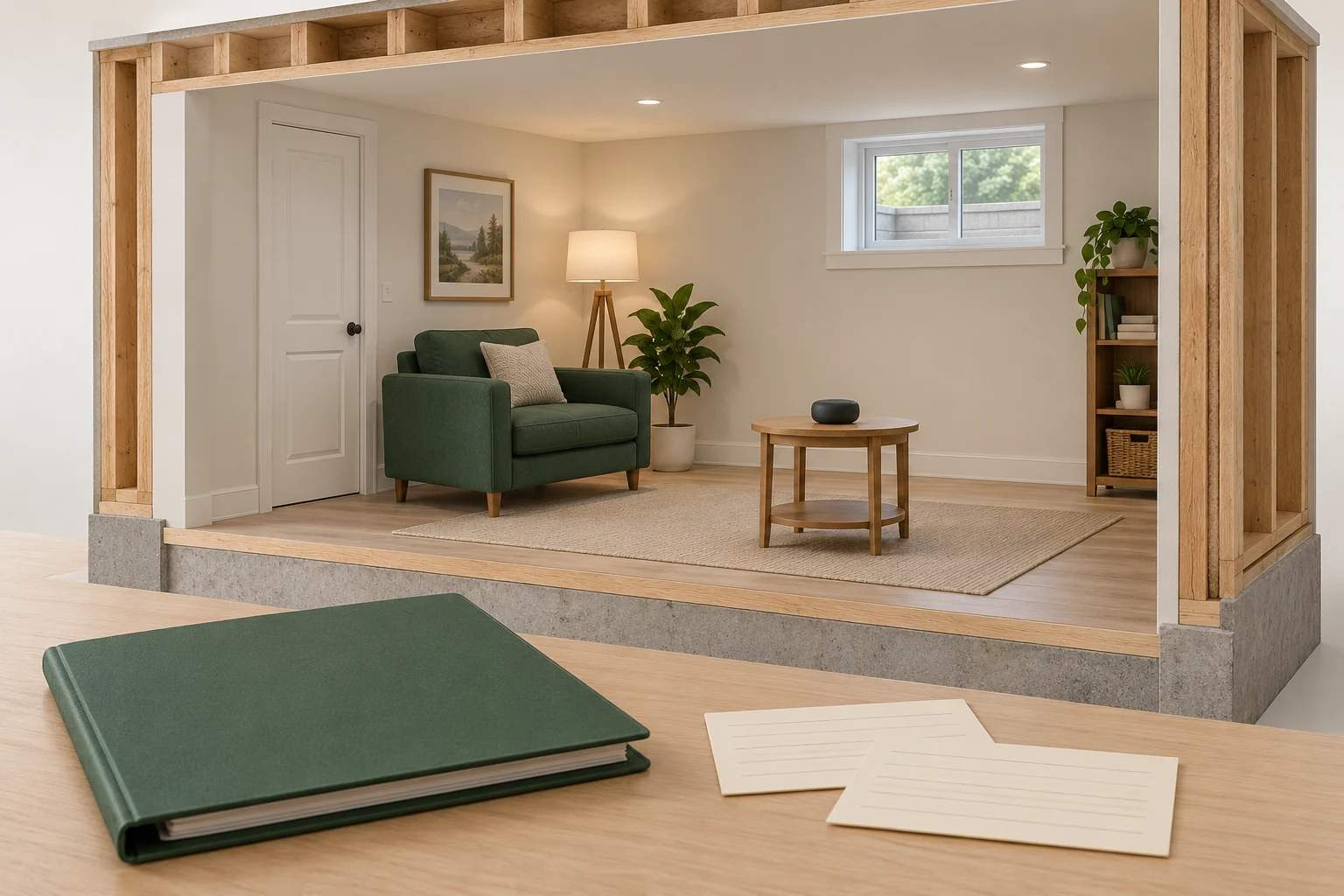
- Identify the actual method
The closed rounded case has no display or label. Match the actual device and method to its instructions and retained measurement history; the model does not identify an approved product or show a reading.
- Keep the measurement context
The lined cards and folder are placeholders. The actual dates, averaging period, device history, room and seasonal/operating context must accompany the real result; no date or finding can be read from this artwork.
- Name the occupied space
The chair illustrates a room-use question. It does not prove how this room is occupied, which level it represents or whether the pictured case meets placement guidance. Intended future room use needs its own clearly described context.
What does this illustration leave out?
The case does not identify a detector type, model, method or calibration. Actual placement distances, regularly occupied level, occupancy, measured interval, averaging period, heating-season coverage, data availability and ordinary operating conditions remain unknown. The depicted table position is not a validated placement. Furniture and a closed-looking window do not establish representative test conditions or safe room use. This illustration explains an idea. It is not an installation guide.
Which actual device, location, dates, averaging period and ordinary-use conditions support the radon result I have, and which fields still need to be recovered?
Explore this with HomeAI ↗Opens an editable question. Nothing is sent until you choose to send it.What evidence should a professional request name?
Prepare the specific question, device manual, channel definitions, original time record, room position and relevant ordinary events. Explain whether the intended decision is a ventilation review, a smoke plan, an unresolved odour or a purchase/handover concern. A qualified indoor-air professional can decide whether walkthrough, source assessment, building information or targeted sampling is likely to be useful. Buying more generic sensors is not automatically the next step.
Ask any proposed assessment to name its contaminants or system questions, method, locations, duration, operating conditions and exclusions. An HRV balancing record, a laboratory result and a consumer screenshot provide different evidence. A buyer or seller should preserve those distinctions instead of marketing one dashboard as a whole-home air certificate.
Ask your realtor how they will obtain the relevant documents and coordinate specialist questions. The responsible professionals establish technical findings and their limits.
If someone is described as HAUSE-trained, confirm their actual training, any required licence, agreed role and current availability.
What does a fictional green dashboard leave unanswered?
Explicitly fictional learning example: an owner sees a green app score after a portable cleaner operates in the living room. A particle channel falls there, while the bedroom feels stuffy later that evening. The manual identifies the carbon-dioxide-looking channel as equivalent output, not direct CO2. The device was moved between rooms, and the time periods differ. The green colour therefore cannot establish bedroom ventilation, identify a pollutant or certify the home’s air.
The owner keeps the manual, locations, times and cleaner setting, labels the channels correctly and formulates separate questions: local particle behaviour and occupied-bedroom ventilation. They request an appropriately scoped review where it can change the plan, without generating smoke or changing ventilation to chase a score. Any CO alarm still requires immediate evacuation, and radon still follows its own measurement framework. The useful outcome is an interpretable record and a justified next question, with unsupported whole-home and health claims removed.
Keep learning about the connected parts
Practice the distinction.
A green score and a different bedroom question
Explicitly fictional owner, device record and room comparison: a living-room particle trend improves while a later bedroom concern remains.
Reported observations
- The monitor is moved and the observed periods differ.
- The manual describes the carbon-dioxide-looking channel as equivalent output.
- A vendor score turns green while the particle channel changes locally.
Compare the explanations
Expand each possibility to see the evidence needed to distinguish it. Similar symptoms can have different mechanisms.
Local particle-pattern change
One channel may describe a local trend under the recorded conditions without a whole-home outcome.
Correct channel definition, device instructions and consistent location/time context.
A separate ventilation or indoor-condition question
The bedroom concern is not resolved by the particle display or inferred gas channel.
Appropriately scoped ventilation or indoor-air review where it affects the next decision.
A useful next question
Separate the questions, recover the measurement context and request the professional scope that can change the plan.
No actual measurements, healthy-air score, exposure experiment, medical diagnosis, ventilation-flow calculation or alarm/radon substitute is represented.
Know what the words mean.
- Measurement channel
- One named quantity or processed output of a device, with its own definition, method and units.
- CO2-equivalent output
- An inferred output labelled by a manufacturer; it must not be assumed to be a direct measurement of carbon dioxide.
- Optical particle estimate
- Particle information inferred from interaction with light and converted using stated assumptions.
- Averaging window
- The time interval and included data used to produce a reported average.
- Calibration context
- The reference, conditions and method supporting a stated measurement relationship.
- Resolution
- The displayed or reported increment, which does not by itself establish accuracy.
- Total VOC
- A method-dependent combined result that does not independently identify every compound or establish its health risk.
Questions to bring
to the conversation.
- Which exact channel and units are displayed, and is its quantity measured or inferred?
- What device model, sensing method and operating limits are documented?
- What location, time interval and data coverage does the result represent?
- What ordinary occupancy, household activity, ventilation and outdoor context changed?
- Which pollutant or decision remains outside this channel?
- Would device support, a ventilation assessment or a qualified indoor-air professional answer the next question?
Separate a showing observation, an existing record and a new professional assessment. Unknown means a question remains; it does not automatically mean a defect.
Use the evidence planner ↗Go to the source.
Original HomeAI explanation informed by these public references. Sources support the underlying guidance; they have not reviewed or endorsed HomeAI. Diagrams are conceptual, and calculator outputs depend on your inputs.
Publication & source review
First published .
Sources reviewed .
- Health Canada · Guidance for indoor air quality professionals
Where this reference applies
Jurisdiction: Canada; professional assessment and sampling guidance
Publisher publication date: 2025-09-19
Publisher modification date: 2025-09-23
Bounded passages on CO2 indicator context, total VOC interpretation, sampling limitations, location/duration, measurement methods, calibration and immediate CO response. A household trend log is not a professional exposure assessment; no single reading, score or total VOC result certifies healthy air.
- Health Canada · Residential indoor air quality guidelines: carbon dioxide
Where this reference applies
Jurisdiction: Canada; residential CO2 guideline with a specified averaging period and evidence limitations
Publisher publication date: 2021-03-19
Publisher modification date: 2021-04-23
Guideline summary, long-term-limit table and attribution limitation: the CO2 guideline uses a 24-hour average. A spot display is not a matching average, a ventilation-flow test or an all-pollutant clearance. Numeric mass-concentration figures and a universal display threshold are not reproduced.
- Vasilatou and coauthors · Aerosol physical characterization, NRC Publications Archive
Where this reference applies
Jurisdiction: Research review with Canadian participation; measurement explanation, not a residential code or product certification
Publisher publication date: 2024-10-30
PDF pages 1–2 and 13–14, section 4.2: online publication October 30, 2024; journal volume 183 (2025). Light-scattering estimates depend on particle properties, assumed conversion and calibration context. No specific home-device error percentage, universal correction, current standards forecast or household validation is inferred.
- Health Canada / Science.gc.ca · Tiny tech, big impact: monitoring air quality with low-cost sensors
Where this reference applies
Jurisdiction: Canada; federal explanation of outdoor particulate monitoring and research
Publisher publication date: 2024-06-04
Publisher modification date: 2024-06-06
Low-cost particle measurements can add local information but do not represent the complete outdoor AQHI. Outdoor-network context is not an indoor score or proof of a specific consumer monitor’s accuracy; dated network counts are excluded.
- Sensirion · SGP30 datasheet, version 1.0, May 2020
Where this reference applies
Jurisdiction: Manufacturer component example; no unidentified consumer device is assumed to contain this part
PDF pages 1 and 3–4: this component calculates TVOC and CO2-equivalent outputs from ethanol and hydrogen signals with conversion and baseline processing. Exact publication day is unknown. An equivalent output is not direct CO2 measurement. No component recommendation, universal VOC chemistry, operating recipe or claimed whole-device accuracy is provided.
- Health Canada · Carbon monoxide: preventing exposure
Where this reference applies
Jurisdiction: Canada; immediate CO response and Canadian-certified alarm guidance
Publisher publication date: 2024-11-12
Publisher modification date: 2024-11-12
CO-alarm evacuation, outside emergency contact, professional resolution before return and certification/manufacturer instructions. Consumer indoor-air trend readings cannot override an alarm or authorize re-entry. No alarm-law claim for every province or combustion testing procedure is supplied.
- Health Canada · Using an electronic radon monitor or a long-term detector
Where this reference applies
Jurisdiction: Canada; radon-specific device, placement and long-term measurement guidance
Publisher publication date: 2026-02-09
Publisher modification date: 2026-09-14
Device-specific radon testing is separate from a generic indoor-air display; short readings do not replace a planned representative long-term test. The canonical HomeAI radon guide retains duration, heating-season coverage, result interpretation and mitigation. No air-quality score or unspecified combined monitor establishes a radon result.
Have a question about your home?
Start with the symptom, timing and what you have observed.
Ask HomeAI