Jump to a question in this guide
- What is a drinking-water cross-connection?
- How can reduced supply pressure reverse the concern?
- How is backpressure a different route to reverse flow?
- Why does an air gap do a different job from a valve?
- Which household connections deserve a specific question?
- Does a device at the property entrance protect every internal connection?
- What can an owner safely observe and record?
- What should an assessment and test report establish?
- How should changes, seasons and local requirements enter the file?
- Fictional example: does a passed irrigation test clear a submerged hose?
- What should a clear household protection plan leave you able to explain?
- An outward-flowing hose can still create a connection that matters when pressure changes.
- Drinking-water backflow protection differs from a sewer backwater valve.
- A named device test and a wider connection survey have different scopes.
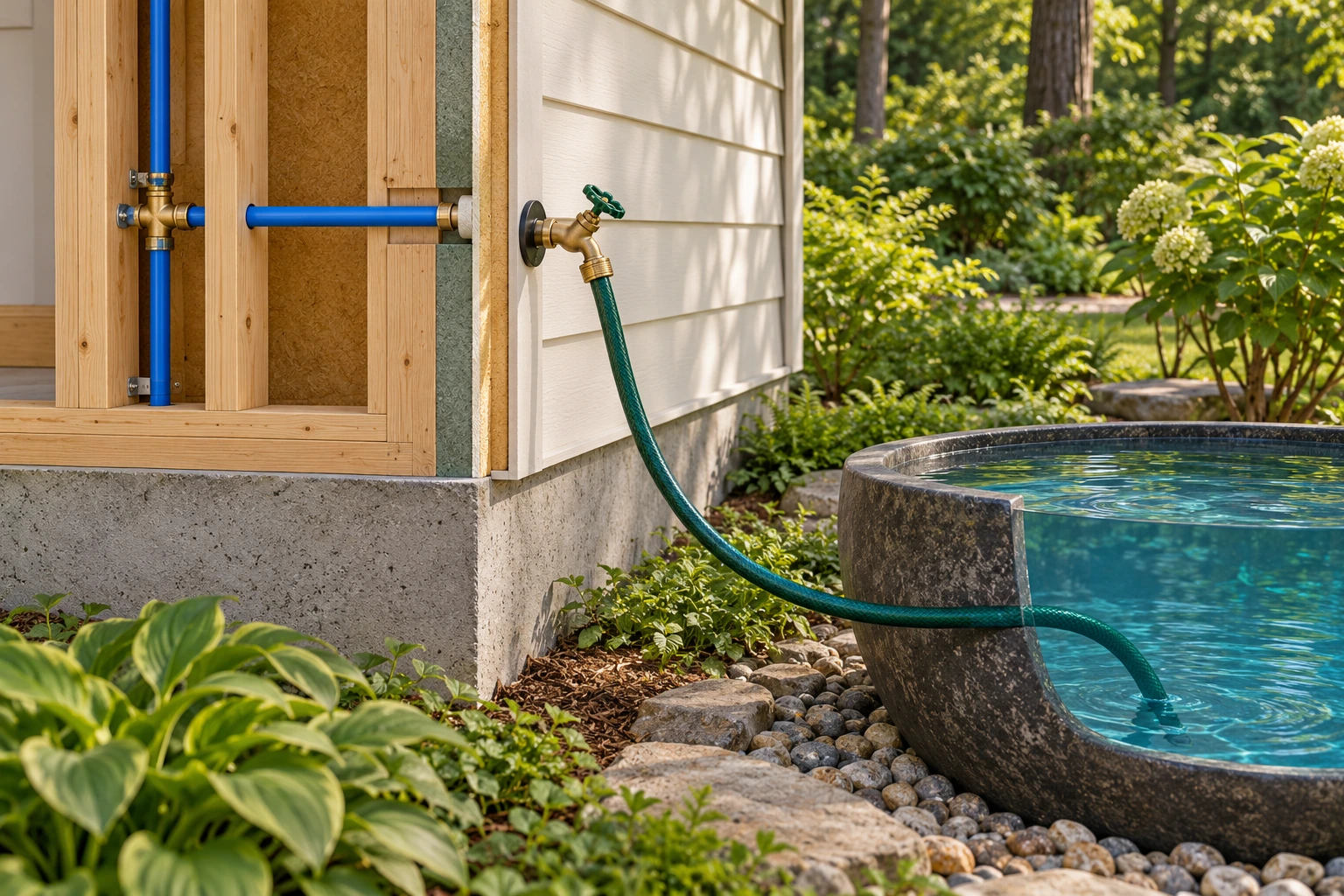
The outside faucet and hose lead to a submerged end in the pictured container. That cautionary connection explains why receiving water can become a supply-protection concern when pressure changes. Upstream blue pipe is shown in a sectioned wall; gaps at the cutaway do not establish a complete installed route. No flow direction or contamination is visible.
About this illustration
Actual pressure, contaminants, protective devices, continuity through omitted wall sections and water-quality results are unknown. Do not reproduce the depicted arrangement. This is a conceptual teaching model, not an assessment of your home.
6 picture lessons appear beside the questions in this guide. Use them to understand the explanation, then consider what it means for your home.
What is a drinking-water cross-connection?
A cross-connection is a link through which drinking-water plumbing could communicate with another water source or potential contaminant. The link can be permanent equipment or a temporary hose arrangement. Water normally travelling outward does not remove the underlying connection. Understanding what the outlet touches is therefore part of protecting the supply, even when a tap appears to work normally.
Imagine a garden hose still connected to the house, with its end submerged in an ornamental container. The hose has created a continuous route between supply plumbing and the container’s water. That is the teaching hazard in the cutaway, not an arrangement to demonstrate. No contaminant is visible in the picture, and the picture cannot establish what actually entered any real supply.
Backflow means movement opposite the intended normal direction. Pressure conditions can change, making the connected route important. The municipal examples explain why prevention concerns the household and potentially the wider distribution system. This guide teaches the relationship and the professional questions; it does not provide a device-selection table, installation method or homeowner pressure test.
This is a different subject from a sewer backwater valve. That valve addresses reverse movement in a drainage route, while this guide concerns drinking-water supply protection. A water filter has another job again. Keeping those names and routes separate helps an owner ask for the appropriate help instead of assuming that one device protects every part of the home.
A submerged connected hose creates a supply-protection question
The outside faucet and hose lead to a submerged end in the pictured container. That cautionary connection explains why receiving water can become a supply-protection concern when pressure changes. Upstream blue pipe is shown in a sectioned wall; gaps at the cutaway do not establish a complete installed route. No flow direction or contamination is visible.
Numbers identify the parts explained below.
- Outside faucet
Connects the conceptual household outlet to the hose.
- Connected hose
Bridges the outlet and receiving container in the cautionary example.
- Submerged end
Keeps the end in receiving water rather than physically separated through open air.
- Supply context
The visible blue segments identify supply context, not all concealed connections or protection.
What does this illustration leave out?
Actual pressure, contaminants, protective devices, continuity through omitted wall sections and water-quality results are unknown. Do not reproduce the depicted arrangement. This illustration explains an idea. It is not an installation guide.
What actual connection and suitable protection should the responsible water or plumbing professional assess?
Explore this with HomeAI ↗Opens an editable question. Nothing is sent until you choose to send it.How can reduced supply pressure reverse the concern?
In the normal conceptual picture, the supply-side pressure supports outward water movement. If that pressure falls, an unprotected connected route can allow water from the receiving side to move toward the supply. This is the backsiphonage question. A submerged hose is a useful example because the continuous link is easy to see without exposing any equipment.
The historical Calgary brochure explains supply interruption as one situation associated with backsiphonage. EPCOR’s current Edmonton page also identifies submerged hoses as a household hazard when pressure drops. These sources support the mechanism, not a prediction that a particular main repair or low-pressure episode contaminated your house. An actual event needs the water provider’s assessment.
The native pressure figure uses two labelled conceptual states and an explicit reverse-flow arrow. It does not show a measured vacuum or numerical threshold. It keeps the receiving container, connected hose and supply boundary visible at the same time. That is enough to explain why an apparently ordinary outward-flow arrangement cannot be judged only while the tap is running.
Never reduce pressure, immerse a hose or operate valves to reproduce the drawing. Do not sample an uncertain container or run water to see whether the route clears. If a suspected contamination event or unusual supply condition is present, contact the water provider or appropriate public-health authority promptly and follow its current directions for the address.
A pressure change can reverse a connected route
Two conceptual states keep the same supply, hose and receiving container visible. Outward flow in one state does not remove the connection that matters if supply pressure falls.
Numbers identify the parts explained below.
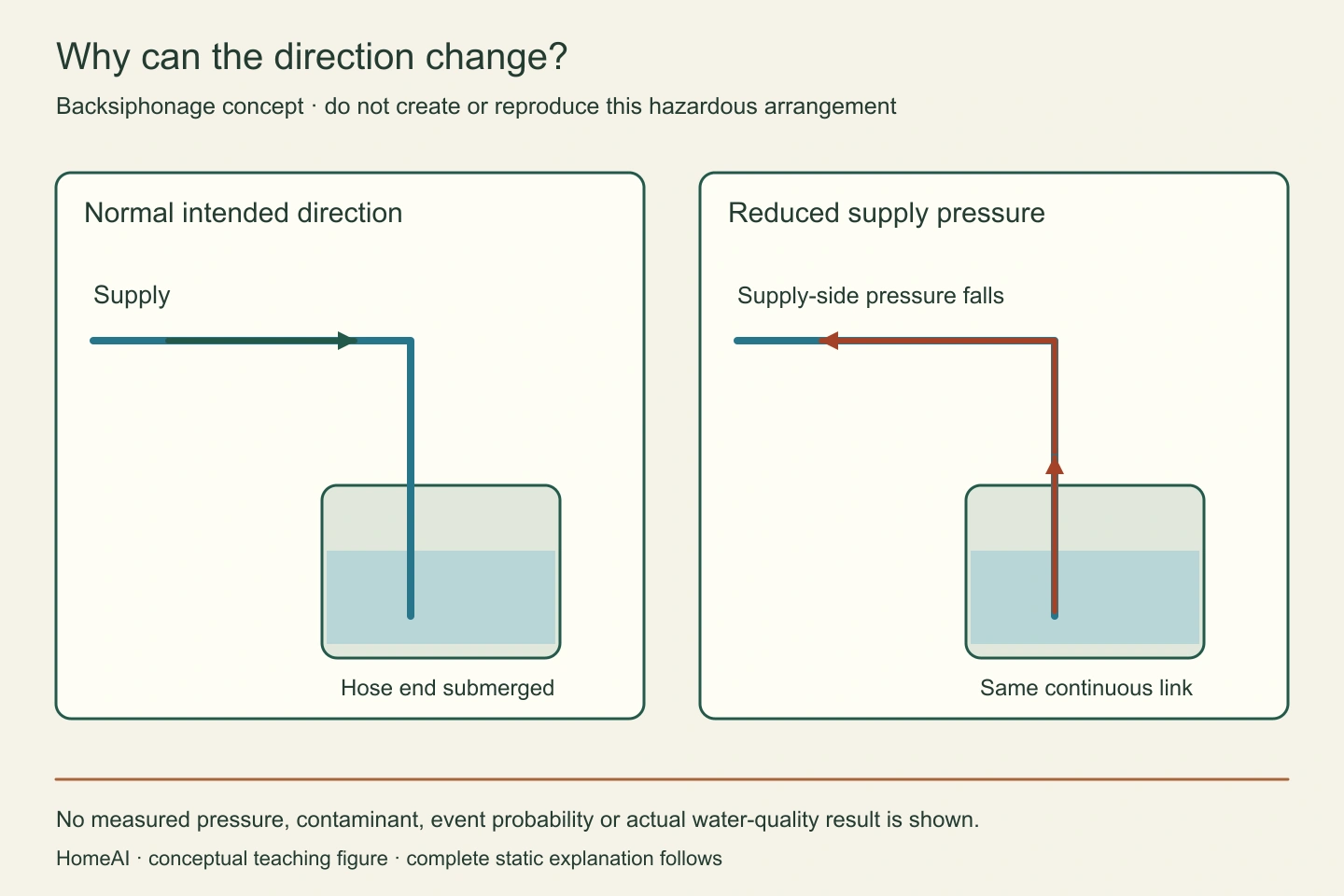
- Outward state
Normal intended movement is from supply toward use.
- Reduced supply pressure
An unprotected connected receiving side can become a reverse-flow concern.
- Receiving container
Submerging a connected hose creates the continuous route used in this cautionary example.
- Cautionary arrangement
Do not create the depicted connection or reduce pressure to reproduce reverse flow.
What does this illustration leave out?
Conceptual relationships only; no actual property finding, measured performance or installation/owner testing procedure. This illustration explains an idea. It is not an installation guide.
Which actual connection and pressure-reversal concern require assessment?
Explore this with HomeAI ↗Opens an editable question. Nothing is sent until you choose to send it.A pressure change can reverse a connected route
Two conceptual states keep the same supply, hose and receiving container visible. Outward flow in one state does not remove the connection that matters if supply pressure falls.
- Outward state
- Normal intended movement is from supply toward use.
- Reduced supply pressure
- An unprotected connected receiving side can become a reverse-flow concern.
- Receiving container
- Submerging a connected hose creates the continuous route used in this cautionary example.
- Cautionary arrangement
- Do not create the depicted connection or reduce pressure to reproduce reverse flow.
Figure scope: Conceptual relationships only; no actual property finding, measured performance or installation/owner testing procedure.
A useful question: Which actual connection and pressure-reversal concern require assessment?
Full wording shown in this figure
- Why can the direction change?
- Backsiphonage concept · do not create or reproduce this hazardous arrangement
- Normal intended direction
- Reduced supply pressure
- Supply
- Hose end submerged
- Supply-side pressure falls
- Same continuous link
- No measured pressure, contaminant, event probability or actual water-quality result is shown.
- HomeAI · conceptual teaching figure · complete static explanation follows
How is backpressure a different route to reverse flow?
Backpressure concerns a connected downstream system operating at a higher pressure than the supplying side. The historical Calgary mechanism brochure gives heating systems as an example. The useful distinction is the relationship across a connection: reduced supply-side pressure and higher receiving-side pressure can raise different assessment questions, even though the undesired direction is toward the drinking-water side.
Do not infer a pressure condition from equipment size, pipe colour or the presence of a pump. A boiler or irrigation system has its own operating arrangement. Its connection, protection and actual pressure conditions need appropriate identification. The educational diagram uses separate labelled systems rather than implying that every item pictured beside potable plumbing has been connected or assessed.
A device intended for one hazard or operating condition is not automatically suitable for another. The owner’s question is which connection and conditions were assessed, which protection is appropriate and who established that selection. Reading a product name or seeing a small attachment at a tap cannot substitute for a complete hazard and compatibility assessment.
Keep a professional’s explanation in functional language: this is the protected connection, this is the potential reverse-flow concern, this is the selected protection and this is its documented scope. The guide supplies no spring, valve, vent or test-port procedure. It also offers no assurance that a particular check valve, pressure regulator or shutoff device performs the required protection.
Why does an air gap do a different job from a valve?
An air gap physically separates the supply outlet from the receiving water by open air. That separation interrupts the continuous water connection in the intended arrangement. A mechanical protection device instead performs its function within a connected plumbing arrangement. These are different concepts, so a drawing should not represent an open space as if it were simply another closed valve.
EPCOR’s household guidance describes air separation and a hose connection vacuum breaker as prevention approaches. Their actual suitability and dimensions need the relevant product and local requirements. This guide deliberately supplies no distance to copy. A small visible gap in a photograph is not a measured or approved air-gap assessment, especially if the receiving water level can change.
The native figure contrasts a continuous submerged-hose route with an outlet separated from a receiving container. It omits scales and installation details. Its job is to teach continuity: where water can remain connected, and where open air interrupts that connection. The full text supplies the explanation even when an image label is too small or motion is unavailable.
Do not redesign fixtures, shorten hoses or add a component solely to resemble the picture. Ask a qualified plumbing or cross-connection professional how the actual connection should be protected. Retain the chosen arrangement and its conditions in the work record. Ordinary household practice should also avoid creating the submerged-hose hazard described by the water provider.
Open air interrupts a continuous connection
One frame shows a submerged connected end. The other shows open air between a supply outlet and a receiving container. The concept is separation, not a dimensioned approved air gap.
Numbers identify the parts explained below.
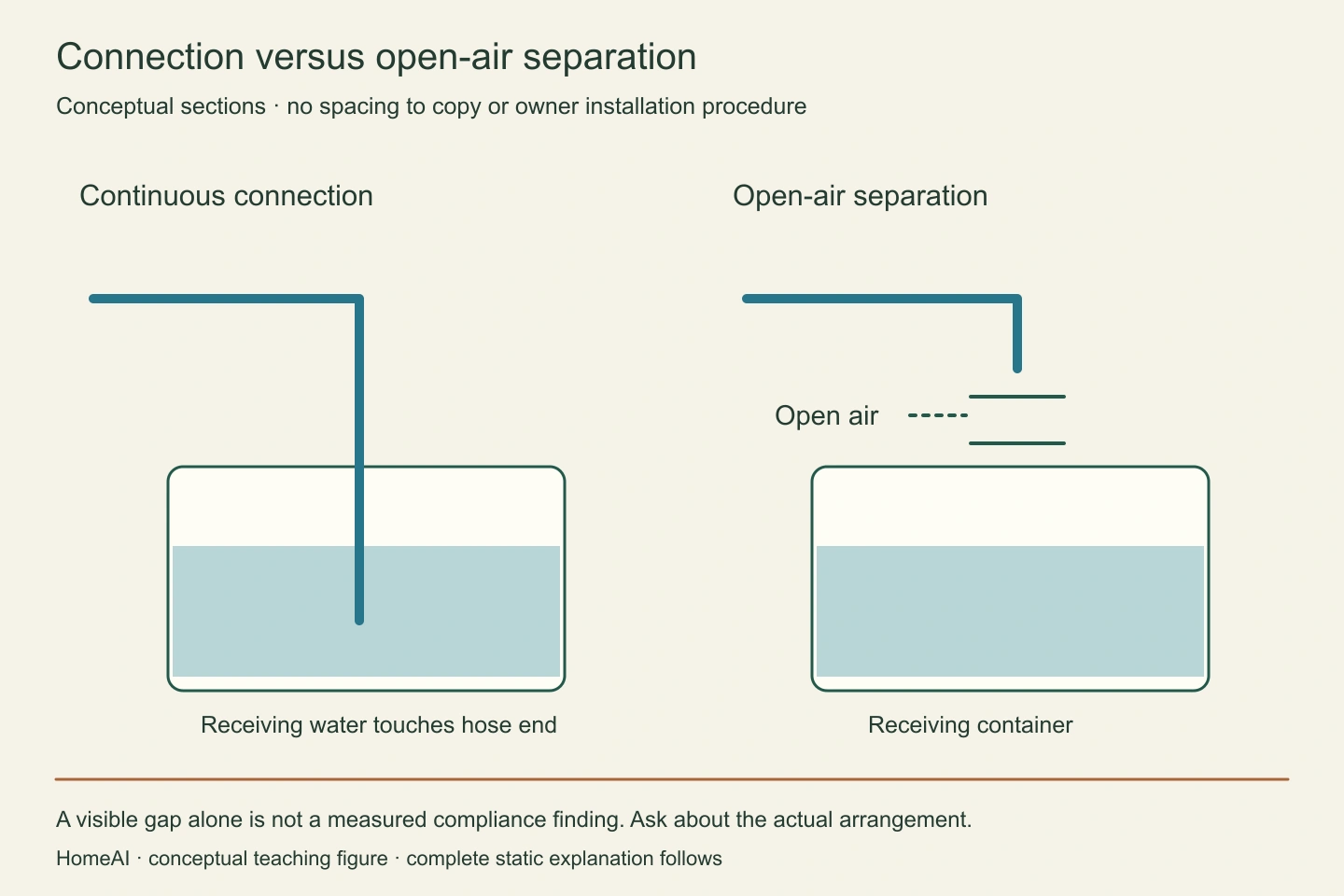
- Continuous connection
A submerged end keeps supply plumbing connected to receiving water.
- Open-air separation
An air gap breaks the continuous water connection in its intended arrangement.
- Actual selection
Dimensions, hazard and product/local requirements belong to the professional assessment.
- Actual separation
The drawing supplies no dimension or compliance finding for a real outlet.
What does this illustration leave out?
Conceptual relationships only; no actual property finding, measured performance or installation/owner testing procedure. This illustration explains an idea. It is not an installation guide.
Which actual separation or protection is suitable for this connection?
Explore this with HomeAI ↗Opens an editable question. Nothing is sent until you choose to send it.Open air interrupts a continuous connection
One frame shows a submerged connected end. The other shows open air between a supply outlet and a receiving container. The concept is separation, not a dimensioned approved air gap.
- Continuous connection
- A submerged end keeps supply plumbing connected to receiving water.
- Open-air separation
- An air gap breaks the continuous water connection in its intended arrangement.
- Actual selection
- Dimensions, hazard and product/local requirements belong to the professional assessment.
- Actual separation
- The drawing supplies no dimension or compliance finding for a real outlet.
Figure scope: Conceptual relationships only; no actual property finding, measured performance or installation/owner testing procedure.
A useful question: Which actual separation or protection is suitable for this connection?
Full wording shown in this figure
- Connection versus open-air separation
- Conceptual sections · no spacing to copy or owner installation procedure
- Continuous connection
- Open-air separation
- Receiving water touches hose end
- Receiving container
- Open air
- A visible gap alone is not a measured compliance finding. Ask about the actual arrangement.
- HomeAI · conceptual teaching figure · complete static explanation follows
Which household connections deserve a specific question?
Begin with equipment that links the household supply to another use or receiving water. Existing irrigation, a heating-system fill, a hose attachment or water-treatment equipment can raise different questions. Calgary’s current programme page also names several fixture and appliance examples. That is a prompt for appropriate identification, not a finding that every listed item in your home is defective.
An owner can make a document-based inventory without taking equipment apart. List the known item, its location, the existing manual or work account and the responsible service contact. Mark an unknown connection as unknown. A visible pipe entering a box cannot establish the complete concealed route, the appropriate hazard classification or the presence and condition of every required protective part.
For a garden or landscape project, ask how the potable supply will remain protected when the irrigation system is installed, serviced, seasonal or changed. The irrigation guide explains zones and watering, while this guide owns the supply-protection boundary. A sprinkler head moving water onto plants is not itself a demonstration of backflow protection.
For a pool, boiler or shared-building system, ask the responsible provider or manager about the connection before arranging changes. Different specialists can own equipment operation, potable-water protection and shared approvals. Put those responsibilities in the proposal. Do not open a fill valve or operate an unfamiliar device to complete the inventory or determine whether a branch is active.
Does a device at the property entrance protect every internal connection?
Protection at a property or system boundary and protection at an individual connection answer different questions. The historical Calgary brochure distinguishes premises isolation from other cross-connections within a site. A boundary device should therefore not be treated as a complete map of every internal hazard, nor as evidence that an unassessed fixture has suitable protection.
Ask the assessor to define the protected boundary in words and on the route account. Is the assessment about the incoming service, a particular appliance or a wider hazard survey? Which branches are included? A report that identifies one device may be entirely valid for that device while leaving another connection outside the assignment. Preserve that scope without inflating or dismissing it.
The house-boundary picture separates supply, one equipment branch and drainage. Its closed protective assembly is conceptual. The actual internal valve arrangement, device type and testability are not visible. The native scope map adds the distinction between incoming boundary, internal branch and receiving equipment, rather than inventing parts that the raster does not show.
In shared buildings, confirm management responsibility and access before commissioning private work. The unit owner, building operator, water provider and qualified tester can hold different records. A unit-level plumbing invoice and a central service report should remain linked but separate. Neither a unit’s clean appearance nor a general building inspection certifies every potable-water connection.
The entrance device and internal connections have different scopes
The incoming boundary, an internal protected branch and a separate unassessed branch are shown as different questions. A named boundary device is not a survey of all downstream connections.
Numbers identify the parts explained below.
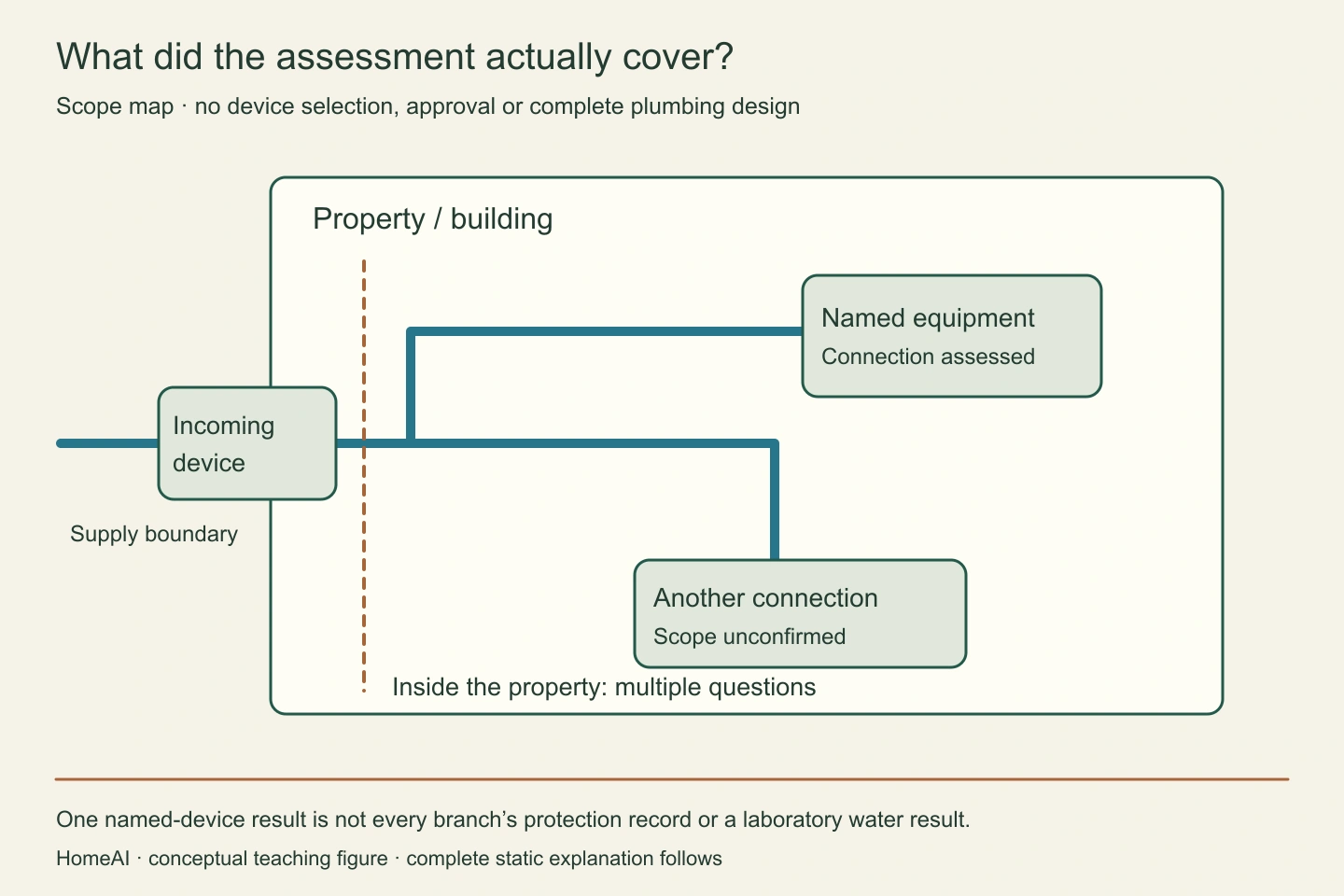
- Incoming boundary
A premises device has a defined incoming-system scope.
- Internal connection
An equipment connection can require its own hazard and protection assessment.
- Unassessed branch
A drawing or device report should identify what remains outside its scope.
- Assessment scope
Read the covered boundaries and excluded branches rather than inferring whole-property protection.
What does this illustration leave out?
Conceptual relationships only; no actual property finding, measured performance or installation/owner testing procedure. This illustration explains an idea. It is not an installation guide.
Which exact boundary and branches does the current assessment cover?
Explore this with HomeAI ↗Opens an editable question. Nothing is sent until you choose to send it.Supply protection and wastewater drainage belong to separate routes
The blue supply context includes a branch toward the closed green irrigation box; its internal equipment is not visible. A separate grey drainage route appears below without joining that branch. These different routes help distinguish drinking-water protection from sewer backwater questions. Household fixtures and piping are deliberately simplified, not a complete plumbing layout.
Numbers identify the parts explained below.
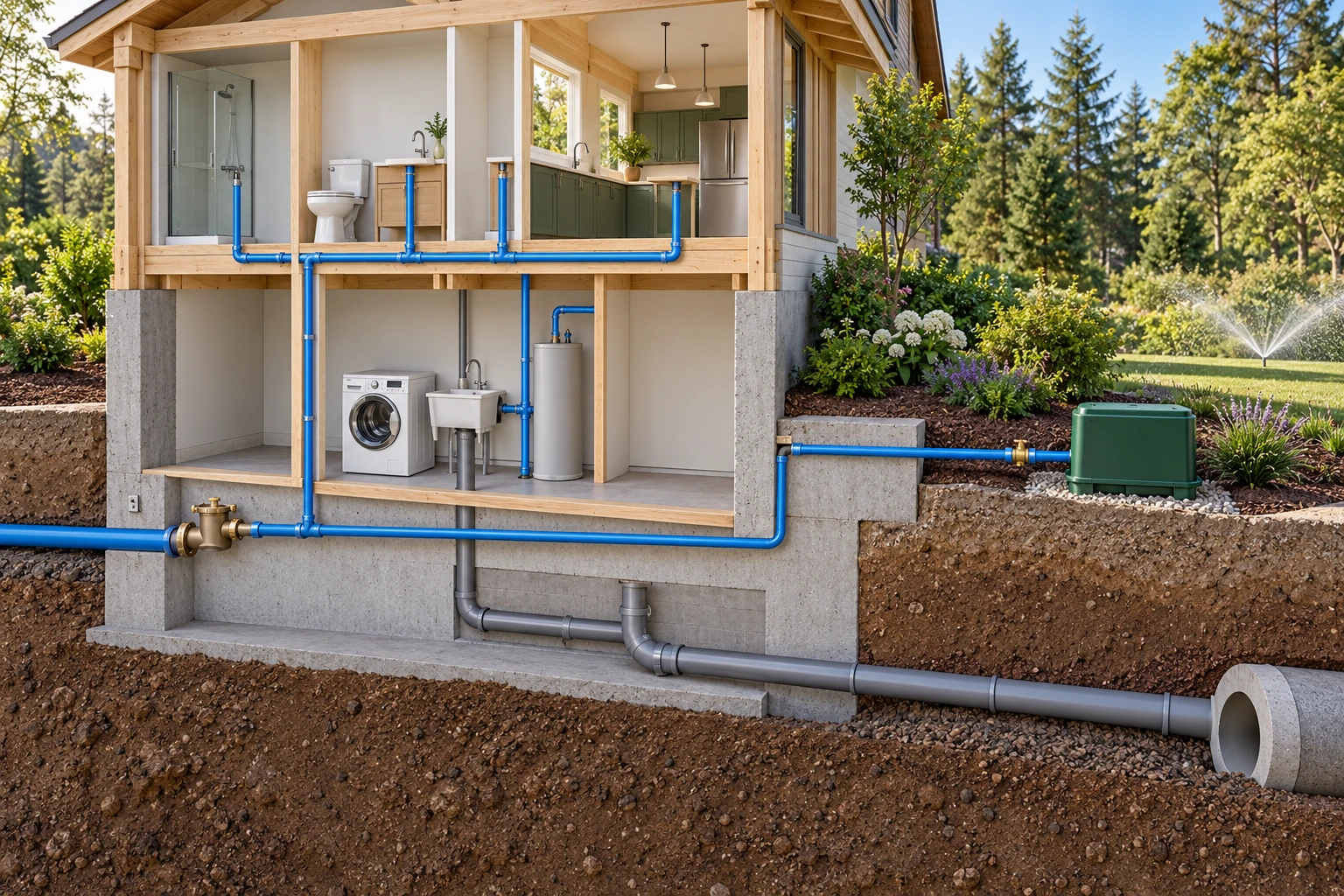
- Incoming supply context
Introduces the drinking-water side; the brass body is not an identified certified device.
- Equipment branch
The visible blue branch approaches the closed irrigation box.
- Closed box
Its concealed parts and protection scope need real identification and records.
- Separate drainage
The grey route below serves a different teaching boundary from the blue supply.
What does this illustration leave out?
The brass body and closed box do not identify or approve an actual device type, protection scope, test result or internal valve arrangement. Complete fixture supply, hot water, drainage and venting are omitted. This illustration explains an idea. It is not an installation guide.
Does the report cover the incoming boundary, the actual equipment connection or a wider survey?
Explore this with HomeAI ↗Opens an editable question. Nothing is sent until you choose to send it.The entrance device and internal connections have different scopes
The incoming boundary, an internal protected branch and a separate unassessed branch are shown as different questions. A named boundary device is not a survey of all downstream connections.
- Incoming boundary
- A premises device has a defined incoming-system scope.
- Internal connection
- An equipment connection can require its own hazard and protection assessment.
- Unassessed branch
- A drawing or device report should identify what remains outside its scope.
- Assessment scope
- Read the covered boundaries and excluded branches rather than inferring whole-property protection.
Figure scope: Conceptual relationships only; no actual property finding, measured performance or installation/owner testing procedure.
A useful question: Which exact boundary and branches does the current assessment cover?
Full wording shown in this figure
- What did the assessment actually cover?
- Scope map · no device selection, approval or complete plumbing design
- Property / building
- Incoming
- device
- Supply boundary
- Named equipment
- Connection assessed
- Another connection
- Scope unconfirmed
- Inside the property: multiple questions
- One named-device result is not every branch’s protection record or a laboratory water result.
- HomeAI · conceptual teaching figure · complete static explanation follows
What can an owner safely observe and record?
Use existing manuals, invoices, notices and safe ordinary access. Record the location and exact identity of a device only when already legible without touching or dismantling it. Keep a photograph with date and context if it can be taken safely. The goal is to help the responsible professional locate the item and understand the question, not to perform its test.
Record whether a report names the device, connection and service address. A serial number in a file is useful only if it has been matched to the actual equipment by the responsible person. A missing tag does not prove failure, while a recent tag does not explain every internal branch. Ask for clarification when identity or scope is unclear.
Do not operate test cocks, dismantle a preventer, alter bypasses or use a gauge to imitate a professional procedure. Do not remove a device because a tap flows poorly or because it appears inconvenient. A water-pressure concern belongs in its own assessment; it does not authorize defeating protection or diagnosing the device from an ordinary flow impression.
A concerning taste, colour, odour or known event deserves appropriate reporting, but appearance alone does not determine water safety. Equally, apparently clear water does not establish that no contamination occurred. Follow current provider or public-health directions rather than using taste, an improvised flush or a home sensor as a clearance method. The drinking-water advisory guide explains how to carry an actual instruction through household uses.
What should an assessment and test report establish?
A hazard assessment identifies the relevant connections and considers what protection they require. A device test addresses a named device using an appropriate method and conditions. An installation or repair record describes completed work. These records can support each other, but they do not become interchangeable merely because a single company produced them.
Calgary’s programme directs owners receiving its notice to a registered certified tester and asks them to retain a report and confirm filing. Its current page displays conflicting report-submission wording in different sections, so this guide adopts no deadline. Use the actual notice and confirm requirements with the programme. Do not select the more convenient number from an educational page.
Ask the provider to identify location, device identity, test date, method or applicable record form, result, corrective work and any required follow-up. Where the assignment includes a wider survey, retain its covered areas and exclusions. A passed named-device test is evidence at that scope and time. It is not a laboratory analysis of the household water or a guarantee against future changes.
Confirm the qualifications and registration required by the relevant local programme. Calgary states that its list reflects active registration rather than endorsing business practice or workmanship. Other jurisdictions can use different processes. An AI guide or a HAUSE referral supplies no credential, booking availability or completed assessment; verify the actual provider and responsibility directly.
A hazard survey, device test and water analysis answer different questions
The matrix separates connections reviewed, the named device tested, completed work and water analysis. Read the actual result and exclusions rather than turning one document into all four.
Numbers identify the parts explained below.
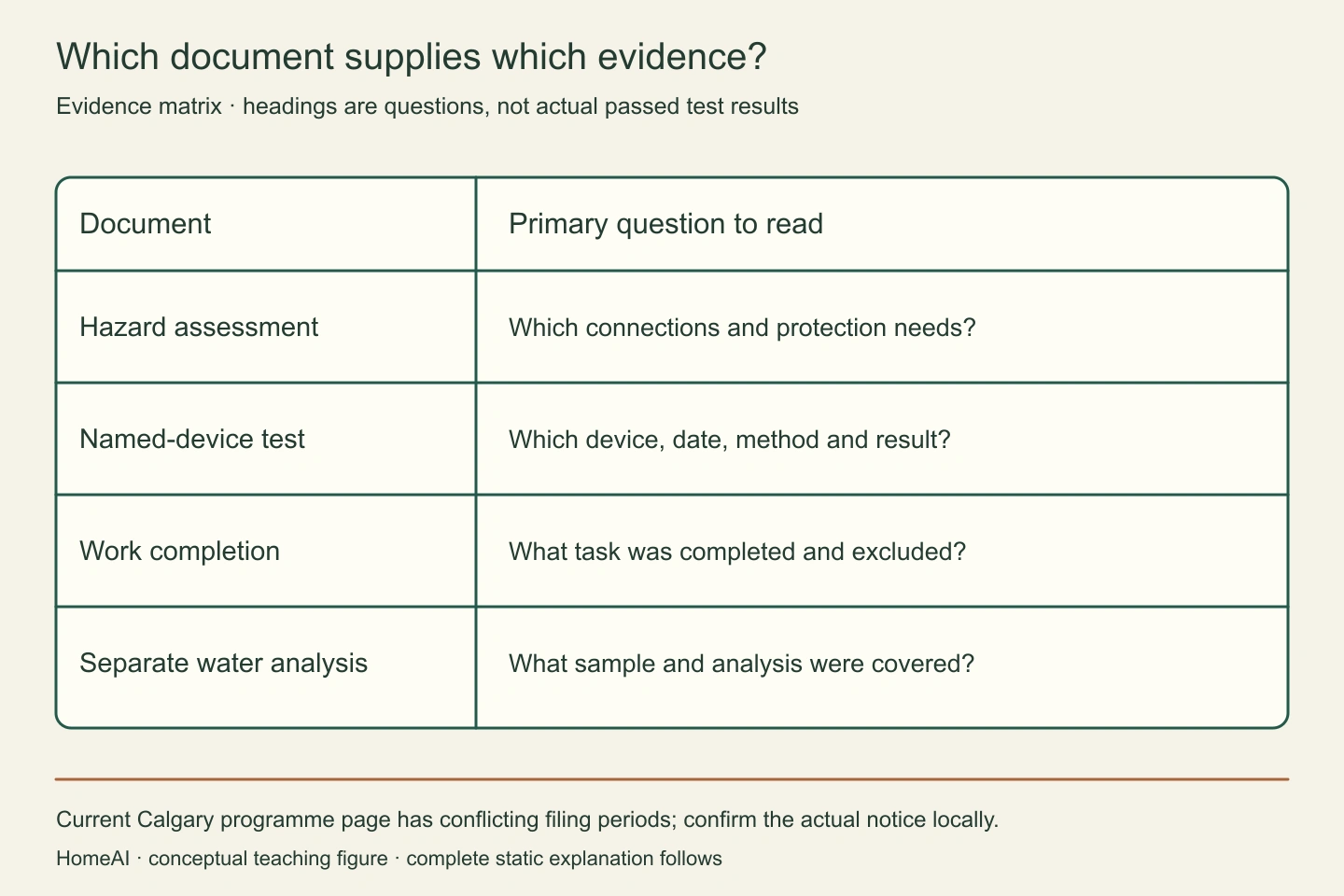
- Hazard assessment
Identifies covered connections and protection questions.
- Device test
Reports an identified device’s bounded result under a stated method and date.
- Work record
Describes completed installation or repair tasks.
- Water analysis
Addresses sampled water within a separately defined analytical scope.
What does this illustration leave out?
Conceptual relationships only; no actual property finding, measured performance or installation/owner testing procedure. This illustration explains an idea. It is not an installation guide.
Which record answers the question you need resolved?
Explore this with HomeAI ↗Opens an editable question. Nothing is sent until you choose to send it.A hazard survey, device test and water analysis answer different questions
The matrix separates connections reviewed, the named device tested, completed work and water analysis. Read the actual result and exclusions rather than turning one document into all four.
- Hazard assessment
- Identifies covered connections and protection questions.
- Device test
- Reports an identified device’s bounded result under a stated method and date.
- Work record
- Describes completed installation or repair tasks.
- Water analysis
- Addresses sampled water within a separately defined analytical scope.
Figure scope: Conceptual relationships only; no actual property finding, measured performance or installation/owner testing procedure.
A useful question: Which record answers the question you need resolved?
Full wording shown in this figure
- Which document supplies which evidence?
- Evidence matrix · headings are questions, not actual passed test results
- Document
- Primary question to read
- Hazard assessment
- Which connections and protection needs?
- Named-device test
- Which device, date, method and result?
- Work completion
- What task was completed and excluded?
- Separate water analysis
- What sample and analysis were covered?
- Current Calgary programme page has conflicting filing periods; confirm the actual notice locally.
- HomeAI · conceptual teaching figure · complete static explanation follows
How should changes, seasons and local requirements enter the file?
A landscape change, new water-using appliance or altered equipment connection can change the question that an earlier record addressed. Keep the old record and add the new scope rather than treating the first device report as permanent coverage for everything later connected. An inventory should be updated when the arrangement changes, with the responsible provider explaining what needs reassessment.
Seasonal irrigation is one example where local directions matter. Calgary’s programme page addresses seasonal start-up alongside its testing responsibilities. That does not create one national schedule for every household component. Follow the actual local programme, matching product instructions and agreed service scope. This guide gives no winterizing, activation or valve-turning procedure.
Product instructions, local permits, programme registration and water-quality directions serve different purposes. A manufacturer document identifies intended use and care; local authorities determine applicable requirements; a provider reports work and findings. Keep them together without substituting one for another. A general statement that a device is approved should identify exactly what that statement covers.
In a sale or handover, give the next responsible person the route account, actual device identities, notices, test and service history and unresolved actions. Avoid describing the entire water supply as certified unless a specific competent assessment truly supports that claim. The useful handover says who does what next, including how to contact the relevant programme when responsibility or filing is unclear.
Fictional example: does a passed irrigation test clear a submerged hose?
This is an invented home. Jules has an irrigation test report naming a device and a past service date. During ordinary garden use, a separate hose end has been left in an ornamental container. The report does not mention that hose connection. The story shows two different boundaries; it supplies no actual pressure measurement or contamination finding.
Jules stops using the hazardous submerged-hose arrangement and contacts the appropriate water or plumbing professional for guidance about the actual connection. No attempt is made to reproduce reverse flow. The existing irrigation report is retained for its named device, while the new question identifies the separate hose use. One valid record is not discarded merely because it does not cover a different arrangement.
A fictional assessor later explains the intended protection for the actual hose connection and records the scope. If a contamination event were suspected, the provider and public-health response would remain separate from that equipment work. A new attachment or passed device result could not retrospectively prove what water contained during an earlier event. The example invents no clearance or repair outcome.
The final fictional file has a simple map: irrigation device and its report; separate hose connection and its assessment; any current authority direction and its household response. That structure makes the next action understandable. It avoids both blanket reassurance and the opposite mistake of declaring the water unsafe solely from an educational drawing.
What should a clear household protection plan leave you able to explain?
You should be able to point to the drinking-water side, identify the connected use or receiving water and explain why a change in pressure can make that connection matter. Then identify the actual protection and the professional record that describes its scope. If a route is concealed or unconfirmed, say so plainly instead of drawing a confident connection.
Keep supply protection separate from drainage backup, treatment, pressure control and leak shutoff. Those systems can all be useful while doing different jobs. The home’s water record should connect their responsibilities without allowing one functioning device to stand in for the others. A whole-home diagram is a navigation aid, not a water-quality or compliance certificate.
The practical next step is often a precise question: which connection was assessed, which protection was selected, what test applies, who keeps the report and what local instruction remains outstanding? A qualified provider can turn that question into a bounded assignment. No owner manipulation or fault demonstration is needed to make the request useful.
Keep the current sources and local contact beside the record. This guide draws on present Calgary and Edmonton education, with an explicitly historical Calgary brochure used only for mechanism context. Canadian locations can differ in programme details and applicable requirements. The conceptual illustrations teach why the boundary matters while leaving actual property findings to the appropriate assessment.
Keep learning about the connected parts
- How home plumbing works: supply, drains, vents and pipe materials
- Sump pumps and backwater valves: know each part’s job
- In-ground irrigation: understand zones, sprinklers and watering changes
- Drinking-water advisories: a complete household response
- Build a water-system evidence file
Canadian context and authorities · Visual atlas · Learning labs
Practice the distinction.
Jules’s fictional irrigation record and hose
An invented irrigation report does not mention a separate submerged-hose arrangement.
Reported observations
- A named irrigation device has a dated report.
- A separate hose use creates a different connection question.
- No pressure or water-quality result is supplied.
Compare the explanations
Expand each possibility to see the evidence needed to distinguish it. Similar symptoms can have different mechanisms.
The earlier report retains its named scope
A valid device result need not cover every other connection.
Exact device and report identification.
The separate hose use needs appropriate guidance
A working irrigation device cannot answer a different boundary question.
Qualified assessment and any current provider direction.
A useful next question
Stop the hazardous submerged-hose use and request guidance on the actual connection, without reproducing reverse flow.
Fictional people and events; no contamination, approval or clearance finding.
Know what the words mean.
- Cross-connection
- A permanent, temporary or potential link between drinking-water plumbing and another source or potential contaminant.
- Backflow
- Water movement opposite the intended normal direction.
- Backsiphonage
- A reverse-flow concern associated with reduced pressure on the supplying side of a connected arrangement.
- Backpressure
- A reverse-flow concern when a connected downstream system has higher pressure than its supplying side.
- Air gap
- Physical separation through open air between a supply outlet and the receiving water arrangement.
- Device test
- A bounded assessment of an identified protective device, distinct from water analysis or an entire hazard survey.
Questions to bring
to the conversation.
- Which supply and receiving use are connected?
- Which pressure-reversal concern and protection were assessed?
- What device, date, result and exclusions does the report identify?
- Which current local instruction or responsibility remains?
Separate a showing observation, an existing record and a new professional assessment. Unknown means a question remains; it does not automatically mean a defect.
Use the evidence planner ↗Go to the source.
Original HomeAI explanation informed by these public references. Sources support the underlying guidance; they have not reviewed or endorsed HomeAI. Diagrams are conceptual, and calculator outputs depend on your inputs.
Sources were read October19,2026 in America/Edmonton (October20UTC). Present Calgary and EPCOR Edmonton education have local programme scopes. The Calgary2010-0585 brochure supplies historical mechanism context only. Calgary’s current page contains conflicting report-filing periods; no deadline is adopted here. Device testing, connection surveys and water analysis remain separate. No actual water-quality or property finding is supplied, and the worked household is fictional.
Publication & source review
First published .
Sources reviewed .
Have a question about your home?
Start with the symptom, timing and what you have observed.
Ask HomeAI