Jump to a question in this guide
- What should I read first when an advisory arrives?
- How do boil-water, do-not-consume and do-not-use notices differ?
- Why can a broken main affect water that still looks normal?
- Where does affected water reach the kitchen besides the tap?
- Can the same water still be used for bathing, dishes or laundry?
- How should the plan account for infants, health needs and pets?
- What changes in a shared building or on a private supply?
- What evidence allows the responsible authority to lift a notice?
- Why might pipes, filters and appliances need different return steps?
- How would a fictional household work through an unclear message?
- Read five things in the current official notice: issuer, notice type, issue or update time, affected supply or boundary, and required actions for each household use.
- Boil-water, do-not-consume and do-not-use instructions are different; a household filter or hot appliance does not override them.
- A lifted notice and the directed household return steps are connected but separate tasks.

The public main and smaller service branch illustrate water reaching the home. Indoor branches then carry it toward different destinations, including a refrigerator connection as well as ordinary taps. This is why an advisory response must follow the named supply and uses throughout the household. A normal stream at one tap does not itself establish permission to use that supply.
About this illustration
Conceptual routes are simplified. Hot-water production, valves, drains, full fixture connections and real public/private responsibility boundaries are omitted; blue conveys route, not water quality. This is a conceptual teaching model, not an assessment of your home.
6 picture lessons appear beside the questions in this guide. Use them to understand the explanation, then consider what it means for your home.
What should I read first when an advisory arrives?
Start with the actual notice from the responsible water supplier or health authority. Find its type, affected area, issue time, required actions and update contact. A drinking-water advisory changes how water may be used while an identified concern is addressed. It is not simply a report about whether the tap runs, tastes normal or looks clear.
Match the notice to your address and supply. A boundary may cover one building, part of a community or an entire system. The nearest street, postal area or news headline may not describe that boundary precisely. If the map or address description is unclear, contact the named issuer promptly rather than deciding that the notice probably excludes the home.
Check the date and status at the official source. A forwarded screenshot can omit a later amendment, and an old lifted notice can appear in search beside a new incident. Keep the relevant official link and its issue or update time with your household plan. This guide does not check or declare the current status of any Canadian address.
Read actions before looking for a cause or shopping for equipment. An advisory can be precautionary, for example while a distribution interruption is investigated. Precautionary does not mean optional. Equally, a notice is not proof that every person has been exposed or that every household pipe is defective. The immediate task is to follow its restrictions and obtain any missing clarification.
Make the instruction usable by everyone who uses the home: household members, visitors, caregivers and someone arriving later. Name the affected supply and the actions, rather than leaving a vague warning beside one tap. Keep accessibility and language needs in mind. Do not delay essential precautions while creating a perfect record or waiting for HomeAI to interpret the wording.
If someone has a health concern, contact an appropriate healthcare professional or the local health service identified in the notice. Medical assessment and water-system information answer different questions. This guide helps organize the household response; it cannot assess symptoms, confirm exposure or grant permission to disregard an official restriction.
How do boil-water, do-not-consume and do-not-use notices differ?
A boil-water advisory addresses suspected or confirmed microbial concerns using the precaution specified by the responsible authority. Microbes include bacteria, viruses and parasites. Under such a notice, consumption uses need the directed safe-water arrangement, commonly boiled water prepared as instructed or an appropriate alternative supply. Read the actual notice for its method, affected uses and any additional restrictions.
A do-not-consume notice, also called do-not-drink in some places, is a different instruction. It may address contaminants that boiling does not remove. Do not use the affected tap water for drinking, food and drink preparation, ice or other restricted consumption uses. Obtain the issuer’s allowed alternative. Do not convert the notice into a boil-water instruction because boiling is the response you remember.
A do-not-use notice is broader: the affected tap water should not be used for any purpose covered by the notice. Contact with the water may itself be relevant, not only swallowing. The issuing authority must explain the restriction and alternative arrangements. A generic table about bathing or laundry during a boil-water advisory cannot be carried over to this notice.
The mechanism matters. Boiling can inactivate disease-causing microorganisms when carried out as directed; it does not generally remove chemical or radiological contamination. Health Canada explains that some non-volatile substances can become more concentrated as water is lost through boiling, and volatile chemicals can create an inhalation concern. An unfamiliar chemical incident therefore needs the actual avoidance advice.
ISC’s explanatory page distinguishes the three categories, while Health Canada notes that terminology and instructions depend on jurisdiction and incident. Use these categories to read the notice, not to issue your own. If two official messages appear inconsistent, seek current clarification from the named authority. Preserve the restriction while obtaining that answer rather than combining incompatible instructions.
For a confirmed boil-water situation, follow the issuer’s boiling and cooling directions and its suitable alternatives. Hot water, a kettle that has merely warmed, and a beverage appliance are not interchangeable evidence that the directed treatment occurred. Handle hot water with care and keep children away from scald hazards. This guide supplies no improvised chemical disinfection recipe.
Read the notice type before choosing a response
Boil-water, do-not-consume and do-not-use notices have different purposes and restrictions. A microbial boiling precaution cannot simply be substituted for an avoidance notice. Match the current official message to the supply, area and affected uses, then obtain the authority’s suitable alternative where required. These category names organize the reading; they do not issue or lift an advisory.
Numbers identify the parts explained below.
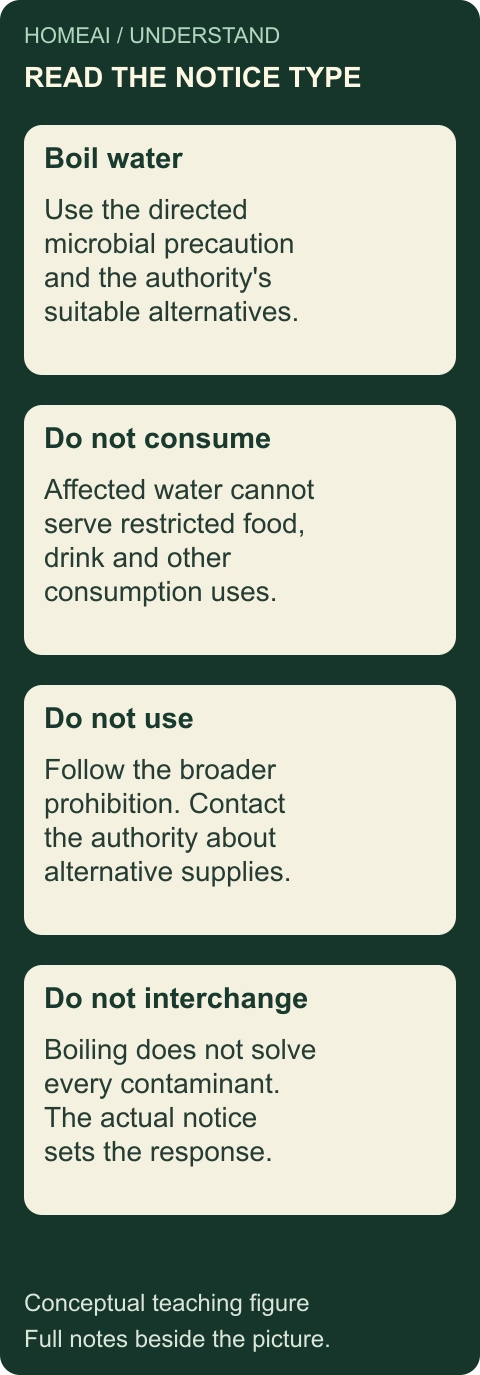
- Boil water
Follow the directed microbial precaution and suitable alternatives for the current incident. Read its affected consumption and other uses.
- Do not consume
Affected water cannot serve the restricted consumption uses. Boiling is not a general answer to chemical or radiological contamination.
- Do not use
Follow the broader prohibition, including contact uses covered by the notice, and obtain the authority’s alternative arrangements.
- Do not interchange
Check the notice’s date, issuer, area and exact instructions. If messages conflict, seek prompt current clarification rather than blend different recipes.
What does this illustration leave out?
No current address status, boiling duration, chemical recipe or universal permission for any household use is supplied. The actual responsible authority’s notice governs. This illustration explains an idea. It is not an installation guide.
Which notice type, supply and uses are affected, and where does the issuer provide current instructions?
Explore this with HomeAI ↗Opens an editable question. Nothing is sent until you choose to send it.Read the type before choosing a response
- Boil waterUse the current authority’s directed microbial precaution and suitable alternatives.
- Do not consumeDo not use affected water for restricted consumption uses; boiling is not a substitute.
- Do not useFollow the broader prohibition and obtain the authority’s alternative arrangement.
General category education; the actual current notice sets the affected supply, uses and directions.
Further reading: Indigenous Services Canada · About drinking water advisories; Health Canada · Guidance for issuing and rescinding boil water advisories.
Why can a broken main affect water that still looks normal?
A community supply is a connected system: source water, treatment, storage and distribution pipes bring water toward homes. Indoor plumbing continues that route to taps and appliances. The protective work is shared across those stages. A treatment plant operating normally does not independently answer what happened at every downstream break or pressure interruption.
Pressure normally supports delivery through the network. A break or significant pressure change can compromise the system’s integrity and prompt precautionary action. Health Canada includes line breaks, maintenance and operational changes among reasons authorities may issue an advisory. This explains why the concern can be about an opportunity for contamination rather than something a household can see in a glass.
A restored stream at the tap demonstrates delivery at that moment. It does not establish that the responsible authority has completed corrective actions, appropriate system checks and clearance. Conversely, a household with no visible change may still be within an affected area. Do not use pressure, colour, taste or a neighbour’s experience to decide whether the notice applies.
Keep water availability and permission to use it as separate questions. A supply interruption can end before an advisory is lifted; a water restriction can remain after a quality advisory ends. Read each notice’s scope and time. The January 2026 Calgary lifting example shows why remaining household instructions and ongoing conservation requirements can appear together.
If only one fixture has a separate flow issue, report it as a household observation without assuming it caused or disproves the community event. The water-pressure guide explains ordinary delivery records. The authority manages the supply incident; a qualified plumbing provider may assess an independent building issue when authorized and appropriate.
A useful question to the issuer is concrete: does this address and supply fall within the current affected boundary, and which restrictions remain while service is restored? It is more useful than asking whether running water looks safe. No household pressure test, pipe opening or unauthorized valve manipulation is needed to ask that question.
One supply can reach several household destinations
The public main and smaller service branch illustrate water reaching the home. Indoor branches then carry it toward different destinations, including a refrigerator connection as well as ordinary taps. This is why an advisory response must follow the named supply and uses throughout the household. A normal stream at one tap does not itself establish permission to use that supply.
Numbers identify the parts explained below.
- Main and service branch
The larger street route feeds the smaller drawn home connection. Ask whether the actual address and supply lie within the official affected boundary.
- Indoor branches
The drawn split reaches several destinations. A community quality restriction and a separate household flow observation answer different questions.
- Connected appliance
The refrigerator is another water destination. Ask about the current notice and matched appliance instructions rather than assume ice or a dispenser is exempt.
What does this illustration leave out?
Conceptual routes are simplified. Hot-water production, valves, drains, full fixture connections and real public/private responsibility boundaries are omitted; blue conveys route, not water quality. This illustration explains an idea. It is not an installation guide.
Which taps and connected devices use the supply named in the current advisory?
Explore this with HomeAI ↗Opens an editable question. Nothing is sent until you choose to send it.Where does affected water reach the kitchen besides the tap?
The kitchen can have several connected destinations: the ordinary sink tap, a dedicated treated-water tap, refrigerator dispenser, ice maker and appliances supplied from plumbing. A branch may be concealed, so the appliance’s location does not show its source. Use existing manuals or a qualified provider to identify uncertain connections without disconnecting hoses or opening equipment.
Under a boil-water advisory, think in terms of consumption. Drinking, brushing teeth, preparing food and beverages, washing produce and making ice are among the uses addressed by official guidance. A household plan must reach those uses even when no one drinks directly from the kitchen faucet. Follow the incident instructions for previously prepared food, drinks and ice as well.
An ice maker stores water in another form. Freezing does not substitute for the directed response to a microbial advisory. A dispenser or filter label is also not an exemption. Ask what the current notice says about automatic ice production and existing ice, and follow the matched appliance instructions for any required action. Do not improvise a disconnection or service procedure.
Home treatment devices have different claims. A carbon cartridge, a membrane and a UV unit do not automatically address the same contaminant or every operating condition. Health Canada recommends checking the exact certified claim. During an advisory, the responsible authority’s instructions still govern whether any identified treatment is acceptable for the situation; ordinary equipment ownership cannot grant that permission.
Heat from a coffee maker or another appliance is not a household verification method. Ask the authority about its permitted use rather than assume that a hot drink satisfies the notice. Likewise, an appliance’s sanitizing or heating feature has a specified task that may not match the question being asked. A familiar button name is not a water-clearance finding.
Keep the kitchen plan practical: which supply is affected, what approved water arrangement will serve consumption uses, and which connected devices need the authority’s and manufacturer’s directions. The water-treatment and refrigerator guides explain those equipment jobs in depth. Here, the new task is ensuring that a water-use restriction reaches every relevant destination.
A consumption plan must include connected appliances
The visible T supplies the ordinary faucet and the refrigerator route. Water can therefore become a drink, food-preparation water or ice without being taken directly from the same spout. A household consumption plan needs to reach those uses. Follow the current authority’s instructions and the matched appliance directions instead of relying on normal appearance, freezing or appliance ownership.
Numbers identify the parts explained below.
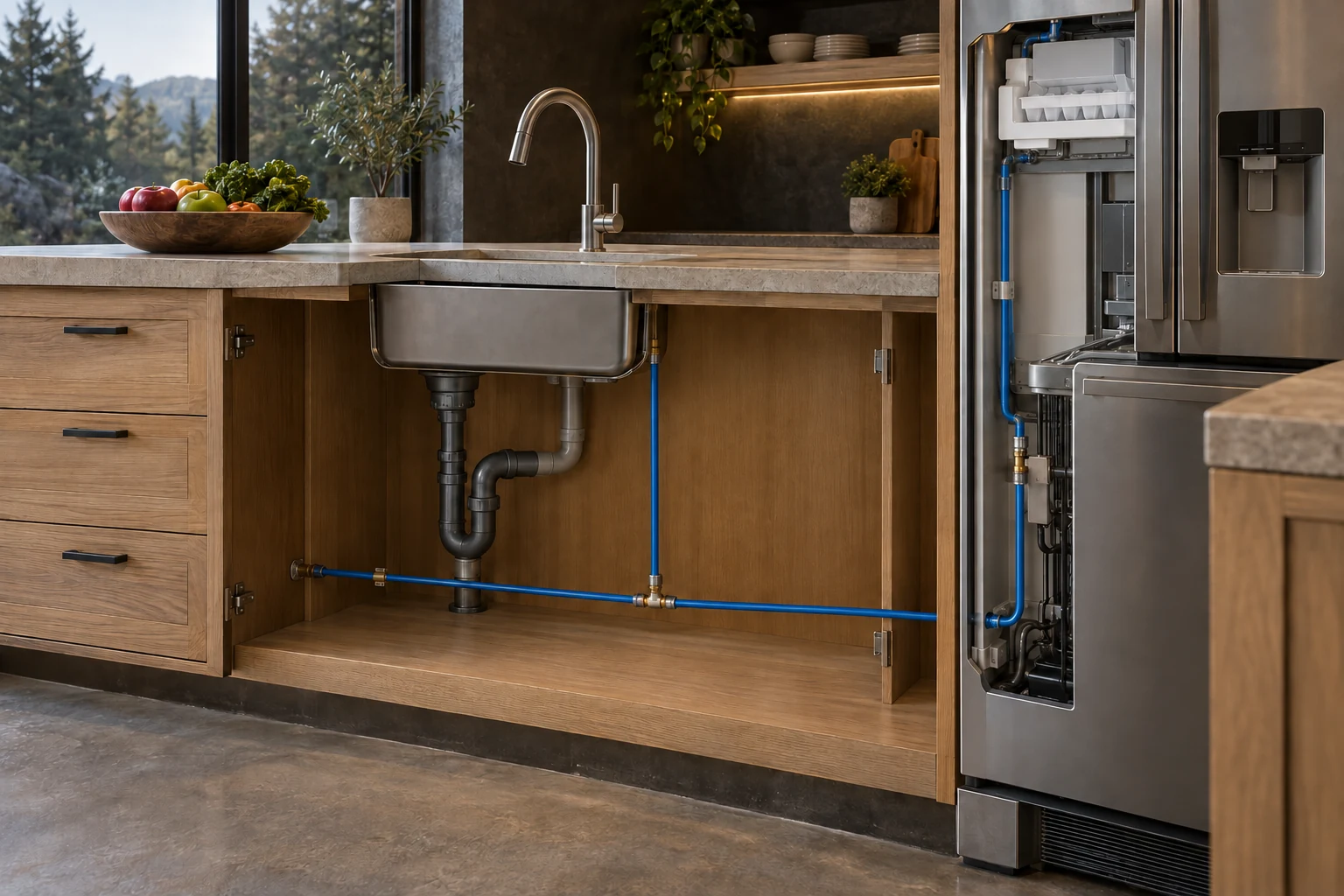
- Ordinary faucet
The faucet serves several kitchen activities. Include food and beverage preparation and relevant produce washing under the current instructions, not only a drinking glass.
- Shared T branch
The simple split makes a separate appliance destination visible. It is not a plumbing design, shutoff procedure or complete list of the home’s branches.
- Ice-making and dispenser area
Ice and dispenser uses need the actual notice and manufacturer directions. The image supplies no disinfection, flushing or restart procedure.
What does this illustration leave out?
Conceptual kitchen example. Hot/cold mixing, complete reservoir/dispenser internals, electrical parts and actual appliance procedures are not established. This illustration explains an idea. It is not an installation guide.
Which refrigerator or other connected-appliance actions does the current notice actually require, using this exact model’s instructions?
Explore this with HomeAI ↗Opens an editable question. Nothing is sent until you choose to send it.Follow consumption beyond a drinking glass
- Food and beveragesRead instructions for preparation, produce and previously prepared items.
- Teeth and dental appliancesUse the directed water arrangement for relevant oral uses.
- Ice and dispensersFollow the current notice and matched connected-appliance instructions.
- Home treatmentExact product claims do not independently grant an advisory exemption.
A household use map, not a chemical recipe, appliance service procedure or clearance.
Further reading: Indigenous Services Canada · About drinking water advisories; Alberta Health Services · How to use water safely during a boil water advisory; Health Canada · Drinking water and health: treatment.
Can the same water still be used for bathing, dishes or laundry?
These uses need their own instructions because contact and accidental swallowing differ from drinking a glass. The notice type is the first distinction. Guidance allowing some non-consumption uses in a particular boil-water or do-not-consume situation must never be treated as permission under a do-not-use notice. Start with the exact current restrictions.
Bathing an adult, bathing a toddler and supporting someone with specific health needs are different situations. ISC and federal guidance specifically address the likelihood that young children may swallow bathwater. Contact the responsible health service about the appropriate arrangement for the household and incident. Do not use a general adult-use statement to decide a child’s or medically vulnerable person’s care.
Dishwashing raises another distinction: cleaning visible food from a dish and achieving an appropriate sanitizing process are different tasks. A hot-water connection alone does not prove a machine cycle meets the needed instruction. Ask which cycle or alternative the current authority accepts for the incident and whether the actual appliance matches it. No bleach mixture or universal dishwasher temperature is supplied here.
Handwashing guidance can also vary with incident circumstances and local instructions. The sources read for this guide do not give identical generic directions, so their recipes should not be blended into a new national procedure. Use the current responsible authority’s advice and ask promptly if unclear. A household still needs an effective hygiene arrangement during an interruption.
Laundry and cleaning uses may be permitted in some advisories and restricted in others. Identify the activity and who may contact the water before applying a remembered answer. A garment wash, a child’s play activity and washing food are not the same exposure. The ordinary purpose of a room or appliance cannot replace the actual use instruction.
Write down any clarification with the issuer, date and context. Share it with everyone performing that task so the household does not maintain several conflicting versions. If a family member cannot safely carry out the directed method, ask the authority or care provider for a suitable alternative. Practical access to the instruction is part of the response.
How should the plan account for infants, health needs and pets?
Begin with the household’s real needs and the notice’s contact for advice. A family preparing infant feeds, a person with a weakened immune system and an adult who can independently follow water instructions may need different support. Do not infer medical vulnerability or choose treatment from age alone. The relevant healthcare professional can advise on individual needs alongside the public-health restriction.
Infant feeding has product and health instructions beyond the general advisory category. Obtain current advice for the actual feeding arrangement rather than copying a formula recipe from an old emergency article. Keep its water source, preparation and equipment questions together. The fact that a product is intended for infants does not decide every water-use step during the incident.
Ask about dental appliances, medications prepared with water and other less obvious consumption routes where relevant. The goal is to identify the activity for the adviser, not to alter care independently. A household member may also depend on equipment with its own water requirements. Contact the treating team and equipment provider rather than substitute household tap or boiled water without direction.
Pets can share household water and food-preparation routines. Federal boil-water guidance includes pets in its use considerations; the actual notice and a veterinarian can address relevant species or health needs. Do not assume that water prohibited for people is automatically suitable for an animal. Keep animal bowls and human food preparation from creating confusion about which supply was used.
Plan for the physical work as well as the written rule. Handling hot containers, carrying an alternative supply and remembering changes at several fixtures can be difficult. Ask for support or an approved alternative when needed. A short accessible instruction at the point of use is useful if it accurately reflects the current notice and does not obscure a later update.
For persistent or worsening symptoms, obtain medical advice through the appropriate local service; urgent situations need urgent care. HomeAI cannot diagnose a waterborne illness or determine that one person’s symptoms came from the supply. Keep the official water information available to the clinician without turning a suspected exposure into a confirmed cause.
Make the water plan work for this household
A household response extends beyond drinking glasses. Include food preparation, oral uses, infant feeding, relevant medical equipment and animal needs when seeking the appropriate advice. The purpose is to identify activities for the authority or care provider, not to improvise a universal safe-water method. Everyone carrying out the activity needs the same current instruction.
Numbers identify the parts explained below.
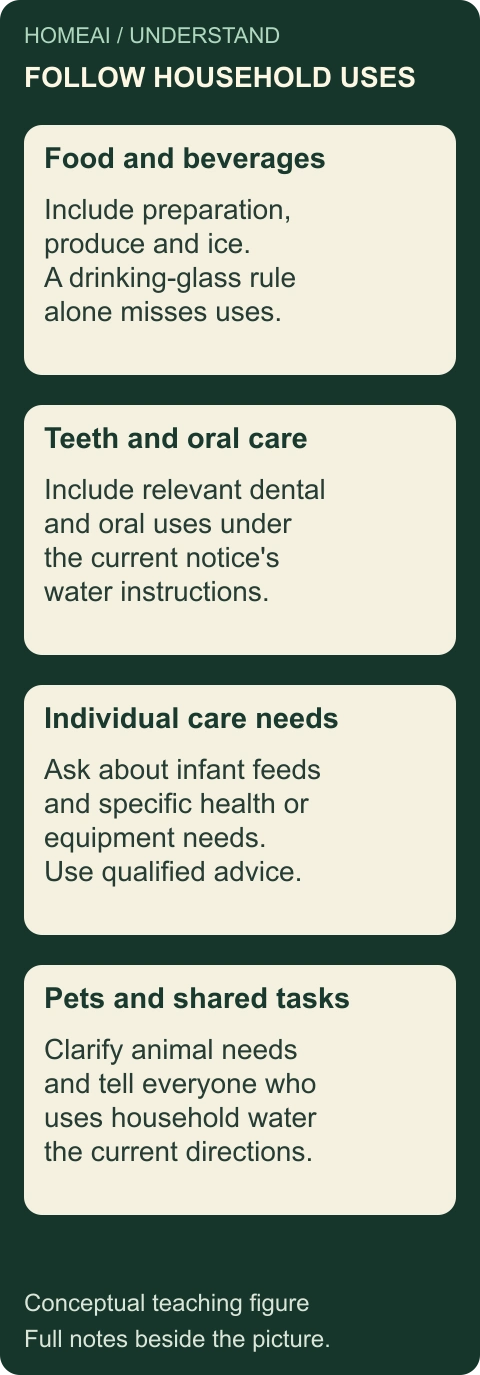
- Food and beverages
Include preparation, produce and ice under the actual notice. Check instructions about previously prepared items rather than infer safety from appearance.
- Teeth and oral care
Include the relevant dental and oral uses in the consumption plan. Follow the current notice’s specified water arrangement.
- Individual care needs
Ask the appropriate health professional about infant feeding and specific health or equipment needs. Do not independently change care or substitute a water type.
- Pets and shared tasks
Ask about relevant animal needs and share current directions with household members, visitors and caregivers. Ensure the plan is practical for people who must carry it out.
What does this illustration leave out?
No personal medical advice, infant-feed recipe, animal treatment or equipment-water substitution is supplied. Individual needs require the relevant qualified advice. This illustration explains an idea. It is not an installation guide.
Which activity or care need is missing from a plan that only mentions water from the kitchen tap?
Explore this with HomeAI ↗Opens an editable question. Nothing is sent until you choose to send it.What changes in a shared building or on a private supply?
In a shared building, the apartment tap may connect through communal storage, treatment, hot-water equipment or distribution. Ask the authorized building operator which supply and building areas are affected and who is coordinating the response. A neighbour’s separate tap or another building’s notice does not establish the status of the actual route serving your unit.
Keep public-supply status and building-specific instructions together. An operator may need to communicate coordinated actions for shared equipment, with individual households following their own permitted steps. Do not independently open shared equipment, turn communal valves or commission alterations to it. Clarify responsibility through the organization and applicable local arrangements.
A private well is another context. A municipal advisory is not a test of a nearby private well, and the absence of a municipal notice does not establish private-source quality. Suspected contamination, a concerning result or an event affecting the source needs local health advice and a safe water arrangement. The existing well guide owns source protection and appropriate testing questions.
An installed treatment system should be identified with its actual source and destinations. Its service history and laboratory verification matter, but they are not interchangeable with a public authority’s incident decision. A pump repair improves a delivery component; it does not supply a chemical or microbial result. Have the relevant providers explain their separate roles.
Issuer arrangements vary across Canada. ISC explains that First Nations generally issue advisories in their communities with environmental public-health support, while provincial, territorial or local authorities issue advisories off-reserve. In British Columbia, First Nations Health Authority provides the described services. Follow the actual community’s communication and authority rather than assume a single nationwide issuer.
For a seasonal home, absence adds a coordination question: who receives notices, checks the relevant current source and follows return instructions before use? Keep the owner, operator and caretaker contacts clear. Do not make reopening an unoccupied building into a universal flushing or disinfection procedure; the incident, supply and equipment determine the required plan.
The notice belongs to the identified supply
The apartment example shares one incoming supply and a vertical distribution route. The separate detached-home example draws from its own well. These layouts teach why proximity alone does not establish whether the same advisory applies. Match the actual supply, community or building instruction, then identify who coordinates shared equipment and who seeks private-source health advice.
Numbers identify the parts explained below.

- Shared building supply
Ask the authorized operator which building areas and equipment are affected and how communal actions are coordinated. An individual apartment should not manipulate shared equipment.
- Separate private supply
A nearby public notice does not test a private well. A concerning private-source result or event needs local health advice and the appropriate safe-water arrangement.
- Actual advisory boundary
The issuing arrangements and supply boundaries must be confirmed for the real community and address. The pictured gap is conceptual, not a regulated separation or geographic map.
What does this illustration leave out?
Separate imaginary layouts, not neighbouring-property evidence. Well pumping, treatment, complete apartment branches and real jurisdiction or ownership boundaries are omitted; no water quality is inferred. This illustration explains an idea. It is not an installation guide.
Which official or building-specific instructions apply to this actual route, and who coordinates its response?
Explore this with HomeAI ↗Opens an editable question. Nothing is sent until you choose to send it.What evidence allows the responsible authority to lift a notice?
Lifting an advisory is an authority decision connected to the incident and its corrective actions. Health Canada’s historical guidance distinguishes bacteriological conditions, operational failures and outbreaks when describing clearance considerations. A completed pipe repair, a favourable sample and health surveillance have different roles. The current responsible authority determines what is required in its jurisdiction.
A repair crew leaving the street is therefore not a lifting notice. Nor is a restored stream, clear glass, household filter display or unofficial statement that a sample was good. These may be pieces of context, but they do not establish that the decision process is complete. Continue the restrictions until the responsible authority communicates the applicable change.
A laboratory report describes the submitted sample, measured parameters, method and circumstances. It is not a universal report on every fixture, appliance reservoir or future day. If the authority requests household sampling, use its and the laboratory’s actual instructions. Do not collect an improvised bottle and use a single result to declare that a community notice no longer applies.
Read the lifting notice with the same care as the original. Which area and supply does it cover? When does it take effect? Does another notice or restriction remain? What household actions are requested before normal use? A headline that the advisory has ended may leave those useful details out, even when the underlying official page contains them.
The January 4, 2026 AHS notice is a historical example for named northwest Calgary communities. It lifted that particular boil-water advisory while discussing household flushing for an identified circumstance and continuing water restrictions. The example teaches how to read a notice’s remaining actions. It makes no statement about present conditions at those addresses or anywhere else.
Preserve the official lifting or amendment beside the original notice and any household instructions. Record what was actually completed and by whom when shared or specialist work is involved. This gives the next household member a clear reason for the change in routine without implying that the guide has independently certified the water system.
Why might pipes, filters and appliances need different return steps?
The public supply and the household contain different water locations. Fresh water at the service connection does not itself describe water already retained in a branch, filter housing, appliance line or storage compartment. This is why the actual lifting notice and equipment instructions may include actions beyond simply reopening the ordinary kitchen tap.
Begin with the authority’s return-to-use directions. Identify which household and shared-system tasks they require and any conditions attached. Then match those tasks to the equipment actually present. A kitchen filter, refrigerator ice maker and communal storage system have different construction and owner-access limits. One general flushing duration cannot be assumed to complete every one of those tasks.
For treatment equipment, ask the manufacturer or qualified provider how the identified device should be handled after the particular advisory. AHS’s household FAQ explicitly directs users toward manufacturer or local-health advice about treatment equipment after a boil-water advisory. The exact response can depend on the device and incident; this guide supplies no backwashing, cartridge-opening or chemical procedure.
For an appliance, retain the model and matching manual with the task. Ask about connected water routes, existing ice or stored water and any required service before use. Do not disconnect plumbing, open electrical compartments or improvise a cleaning mixture. An instruction for one refrigerator or dispenser is not automatically applicable to another product or to a building’s shared equipment.
Keep tasks distinguishable: authority instructions received, building work coordinated, appliance instructions confirmed and named actions completed. A request for service is not completed service. A new cartridge invoice names a component change, not an independent finding about every contaminant. If a task cannot be performed safely or the instructions conflict, obtain clarification before relying on the affected use.
A later taste, odour, colour or delivery change should be reported to the relevant supplier or provider. Do not treat normal appearance as the only success test or use a generic home meter as health clearance. Return-to-use is a coordinated response to an actual notice, followed by ordinary reporting and the ongoing care appropriate to the supply.
A lifting notice and equipment tasks are separate steps
First read the official change for the identified supply and area. Then read remaining restrictions and household actions in the whole message. Pipes, treatment devices and appliances may require different incident and manufacturer directions. Record the actions actually completed, keeping requested work separate from completed work and both separate from a water-quality result.
Numbers identify the parts explained below.
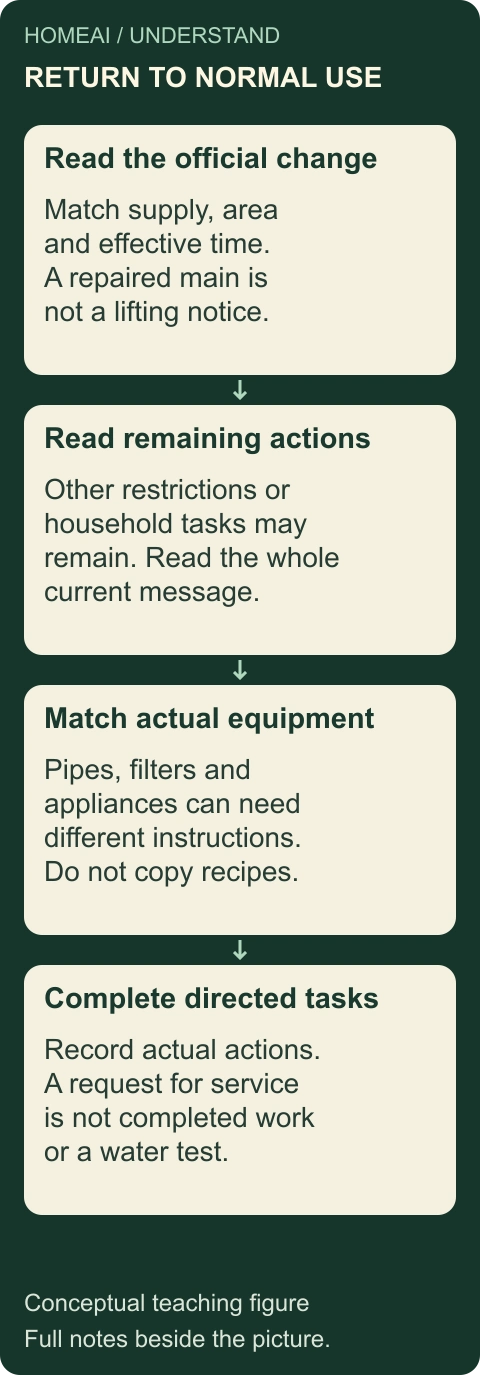
- Read the official change
Match the supply, affected area and effective time. A repair message or restored tap flow does not independently lift an advisory.
- Read remaining actions
Check whether other restrictions, shared-building work or household instructions remain. A headline may omit useful directions in the full notice.
- Match actual equipment
Obtain the authority, operator and manufacturer guidance for the actual pipes, filters and appliances. Avoid combining instructions from unrelated products or incidents.
- Complete directed tasks
Record what was done, when and by whom. Seek clarification if access is unsafe or instructions conflict; do not convert a component change into universal clearance.
What does this illustration leave out?
No current lifting decision, universal flushing time, disinfection recipe, sampling clearance or appliance restart procedure is supplied. This illustration explains an idea. It is not an installation guide.
Which directed return-to-use actions remain for this home and its actual equipment?
Explore this with HomeAI ↗Opens an editable question. Nothing is sent until you choose to send it.Separate the authority decision from equipment tasks
- Current noticeMatch address, supply, type and time.
- Official lifting or amendmentRead the whole message and remaining restrictions.
- Household and shared equipmentObtain actual authority, operator and manufacturer directions.
- Completed actionsRecord the task and date without promoting it into a universal water-quality result.
No universal flushing duration, sampling clearance or equipment disinfection sequence is provided.
Further reading: Health Canada · Guidance for issuing and rescinding boil water advisories; Alberta Health Services · January 4, 2026 Calgary boil-water order lifted; Alberta Health Services · How to use water safely during a boil water advisory.
How would a fictional household work through an unclear message?
Fictional household Mina and Jules receive a screenshot saying a nearby main has been repaired. Their official supplier page still shows a boil-water advisory for the area that includes their address. The home has a sink filter and a refrigerator ice maker. This invented case contains no actual contamination, laboratory result or present Canadian incident.
They keep following the official advisory rather than interpret repair completion as clearance. They verify the affected boundary and find the issue time and update contact. Their consumption plan includes food, drinks, teeth and ice, rather than only a glass from the main tap. They ask for any household-specific health clarification through the appropriate service.
The filter remains an identified device with an unconfirmed role in this incident. Its ordinary taste claim does not replace the authority’s instruction. The refrigerator is added as a connected destination needing the actual appliance and notice directions. Mina and Jules do not open a cartridge, alter a valve or assume that freezing deals with the advisory.
Later, a fictional official update lifts the advisory for the named area and provides remaining household instructions. They read the whole update, check whether separate restrictions remain and obtain matched equipment advice where necessary. They record instructions received and tasks completed without inventing a universal flushing time or a successful water test.
The outcome is a clearer household process: identify the notice, match the supply and uses, follow appropriate precautions, wait for the official change and complete the directed return steps. The same process can support a buyer or seller reviewing dated incident records, but a historical advisory does not itself establish present property condition or a permanent quality guarantee.
Keep learning about the connected parts
- Home water filters and UV treatment: understand what each part does
- Know what your private well is supplying
- Low water pressure: build a useful observation log
- Water-service lines and lead: understand the evidence before buying
- Refrigerators and freezers: follow heat, air and water
- How home plumbing works: supply, drains, vents and pipe materials
- Build a home-care record that the next person can understand
Canadian context and authorities · Visual atlas · Learning labs
Practice the distinction.
A repaired main is not yet an official lifting notice
Fictional Mina and Jules have a forwarded repair message, a current official boil-water advisory, a sink filter and an ice maker.
Reported observations
- The official boundary includes the invented address.
- The repair message contains no authority lifting decision.
- The filter and refrigerator have separate equipment instructions.
Compare the explanations
Expand each possibility to see the evidence needed to distinguish it. Similar symptoms can have different mechanisms.
Repair is complete while the advisory remains
Restored delivery and incident clearance are different steps.
The current official update and responsible authority’s clarification.
Equipment instructions remain after a lifting notice
Stored water and device-specific tasks may require an instructed household response.
The actual lifting notice and matched manufacturer/provider guidance.
A useful next question
Follow the current restrictions, clarify affected uses and complete the directed household actions only after the official change.
Fictional only; no current incident, contamination result, successful test, approved treatment or health diagnosis is supplied.
Know what the words mean.
- Drinking-water advisory
- An official public-health message restricting water use while a real or potential concern is addressed.
- Boil-water advisory
- A notice directing the specified boiling or alternative-water response to a microbial concern.
- Do-not-consume advisory
- A notice prohibiting consumption uses; boiling does not make it equivalent to a boil-water notice.
- Do-not-use advisory
- A broader notice restricting affected tap water from use, including contact where the incident requires it.
- Precautionary advisory
- A protective notice issued while a potential risk or compromised operating condition is assessed; its instructions still apply.
- Distribution system
- The connected route carrying treated water toward users; indoor plumbing continues that route.
- Lifting notice
- The responsible authority’s message that an identified advisory has ended or changed, including any remaining actions.
- Return-to-use directions
- The actual incident and equipment instructions for resuming household water uses after restrictions change.
Questions to bring
to the conversation.
- Which current official notice and affected boundary apply to this supply?
- Which consumption, contact and connected-appliance uses are restricted?
- What approved alternative is practical for the household’s needs?
- Who communicates the authority decision and any shared-building actions?
- Which actual return instructions apply to pipes, treatment and appliances?
Separate a showing observation, an existing record and a new professional assessment. Unknown means a question remains; it does not automatically mean a defect.
Use the evidence planner ↗Go to the source.
Original HomeAI explanation informed by these public references. Sources support the underlying guidance; they have not reviewed or endorsed HomeAI. Diagrams are conceptual, and calculator outputs depend on your inputs.
Sources were read October 13, 2026. ISC’s page is dated September 18, 2025; Health Canada’s overview and treatment pages show December 5, 2025. The 2015 boil-water document remains a historical federal reference, with page details January 12, 2021. AHS’s FAQ has no established substantive revision date; its handwashing, chemical and coffee instructions are not blended with different federal guidance. The January 4, 2026 Calgary lifting notice is a dated named-area example only. No current address status, universal boiling/flushing time, bleach recipe, sampling clearance, medical advice or device exemption is supplied. Current responsible-authority directions and matched equipment instructions govern the actual incident.
Publication & source review
First published .
Sources reviewed .
- Indigenous Services Canada · About drinking water advisories
Where this reference applies
Jurisdiction: First Nations community advisory education; issuer arrangements vary
Edition: Date modified September 18, 2025.
Source reviewed: 2026-10-13 · America/Edmonton
Reading scope: Complete substantive ordinary HTML/text body captured and read October 13 in owner/iscAdvisories.*.
Three advisory types, affected buildings or areas, household uses and First Nations/local authority distinction. This page is not a live status check for any community.
- Health Canada · Guidance for issuing and rescinding boil water advisories
Where this reference applies
Jurisdiction: Canada; federal guidance for responsible drinking-water authorities, with household-use context
Edition: Published January 2015; page details January 12, 2021; current reachable historical guidance.
Source reviewed: 2026-10-13 · America/Edmonton
Reading scope: Complete substantive A–C body and text equivalents read October 13 via web and ordinary capture. Raw HTML/full text retained in owner/hcBoil.*; references are retained, not claimed independently read.
Precautionary versus confirmed incidents, microbial versus chemical mechanisms, notice content, authority-led lifting and remaining household actions. Historical statistics, detailed sampling rules and disinfection recipes are not transferred to a household.
- Health Canada · Drinking water and health: overview
Where this reference applies
Jurisdiction: Canada; national source-to-tap and responsibility education
Edition: Page details December 5, 2025.
Source reviewed: 2026-10-13 · America/Edmonton
Reading scope: Complete substantive web body and ordinary HTML/text captured and read October 13 in owner/hcOverview.*.
Source, treatment and distribution as different protective parts; indoor plumbing extends distribution. No actual contamination, responsibility assignment or system clearance inferred.
- Health Canada · Drinking water and health: treatment
Where this reference applies
Jurisdiction: Canada; consumer treatment guidance
Edition: Page details December 5, 2025.
Source reviewed: 2026-10-13 · America/Edmonton
Reading scope: Complete substantive web body and ordinary HTML/text captured and read October 13 in owner/hcTreatment.*.
Exact contaminant-specific certified claims and distinct treatment functions; no installed device approval or exemption from an advisory.
- Alberta Health Services · How to use water safely during a boil water advisory
Where this reference applies
Jurisdiction: Alberta; provincial household FAQ for boil-water situations
Edition: Undated substantive FAQ; site copyright is not a revision date.
Source reviewed: 2026-10-13 · America/Edmonton
Reading scope: Complete substantive ordinary/web body captured and read October 13 in owner/ahsFaq.*. Differences from federal generic instructions are explicitly retained as a reason not to combine recipes.
Consumption uses, ice, filter limitation, appliance questions and local health contact. Its handwashing, chemical and coffee instructions are not generalized; use actual current incident directions.
- Alberta Health Services · January 4, 2026 Calgary boil-water order lifted
Where this reference applies
Jurisdiction: Named northwest Calgary communities; historical incident only
Edition: Published January 4, 2026; retained under inactive health advisories.
Source reviewed: 2026-10-13 · America/Edmonton
Reading scope: Complete substantive ordinary body captured and read October 13 in owner/ahsLifted.*.
A dated lifting notice can contain remaining household instructions alongside continuing water restrictions. No current Calgary advisory status or national flushing rule inferred.
Have a question about your home?
Start with the symptom, timing and what you have observed.
Ask HomeAI