- Match records and instructions to the actual installed component; leave unknown identification and dates explicit.
- Keep routine care, investigation, improvement and emergency response in their own roles.
- Preserve the original concern, assessment, proposal, completed work and follow-up without turning a small task into a whole-home guarantee.
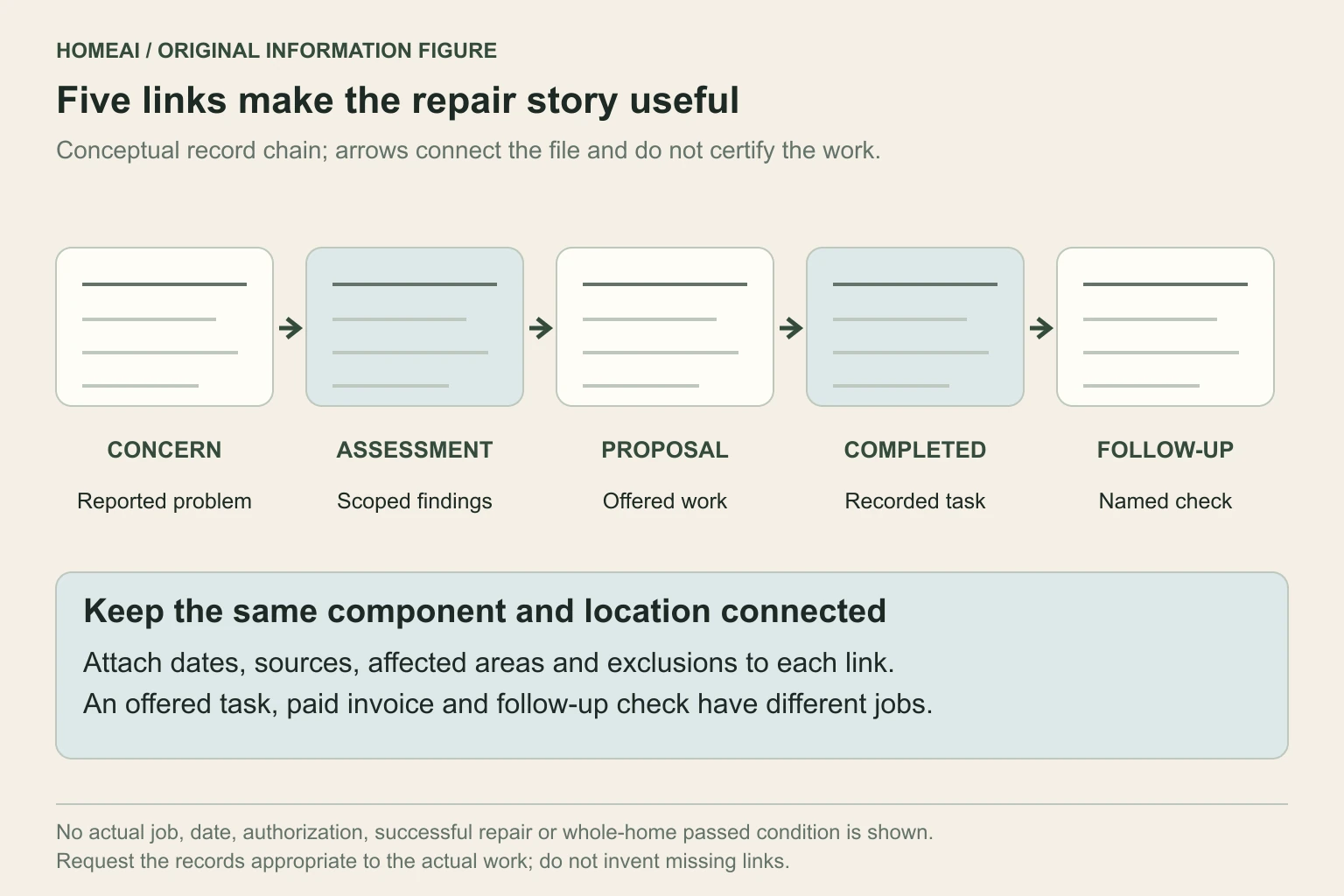
Five labelled stages and distinct record roles; scope and locations remain attached throughout.
About this illustration
No actual dates, approved task, completed work, successful repair or whole-home passed condition is represented. This is a conceptual teaching model, not an assessment of your home.
4 picture lessons appear beside the questions in this guide. Use them to understand the explanation, then consider what it means for your home.
What should I record about the equipment actually in this home?
A useful home-care file begins with the installed parts: what they are, where they are and which instructions belong to them. Record a safely visible manufacturer and model label, the manual and the service contact. Keep installation dates only when a matched record or reliable account establishes them.
A familiar-looking appliance is not enough to identify its maintenance instructions. Match the model and, where relevant, the installation arrangement or revision. If a label is inaccessible without opening equipment or climbing, mark identification as unresolved and ask the appropriate provider to establish it.
Include the home’s service arrangements: municipal water or a well, private or shared equipment, and who is responsible for the relevant work. A shared-building manager or contract may hold records an individual owner does not. Keep those responsibility questions with the component rather than guessing from its location.
Calgary’s maintenance page provides local examples, while manufacturer instructions and actual professional scope govern the equipment question. Health Canada’s well guidance adds source protection and local water-authority questions for well owners. Do not turn a generic calendar into one national service interval or treat the inventory as a condition certificate.
Give each installed component a matched record
A conceptual component and its record fields, with model matching and unresolved information labelled.
Numbers identify the parts explained below.
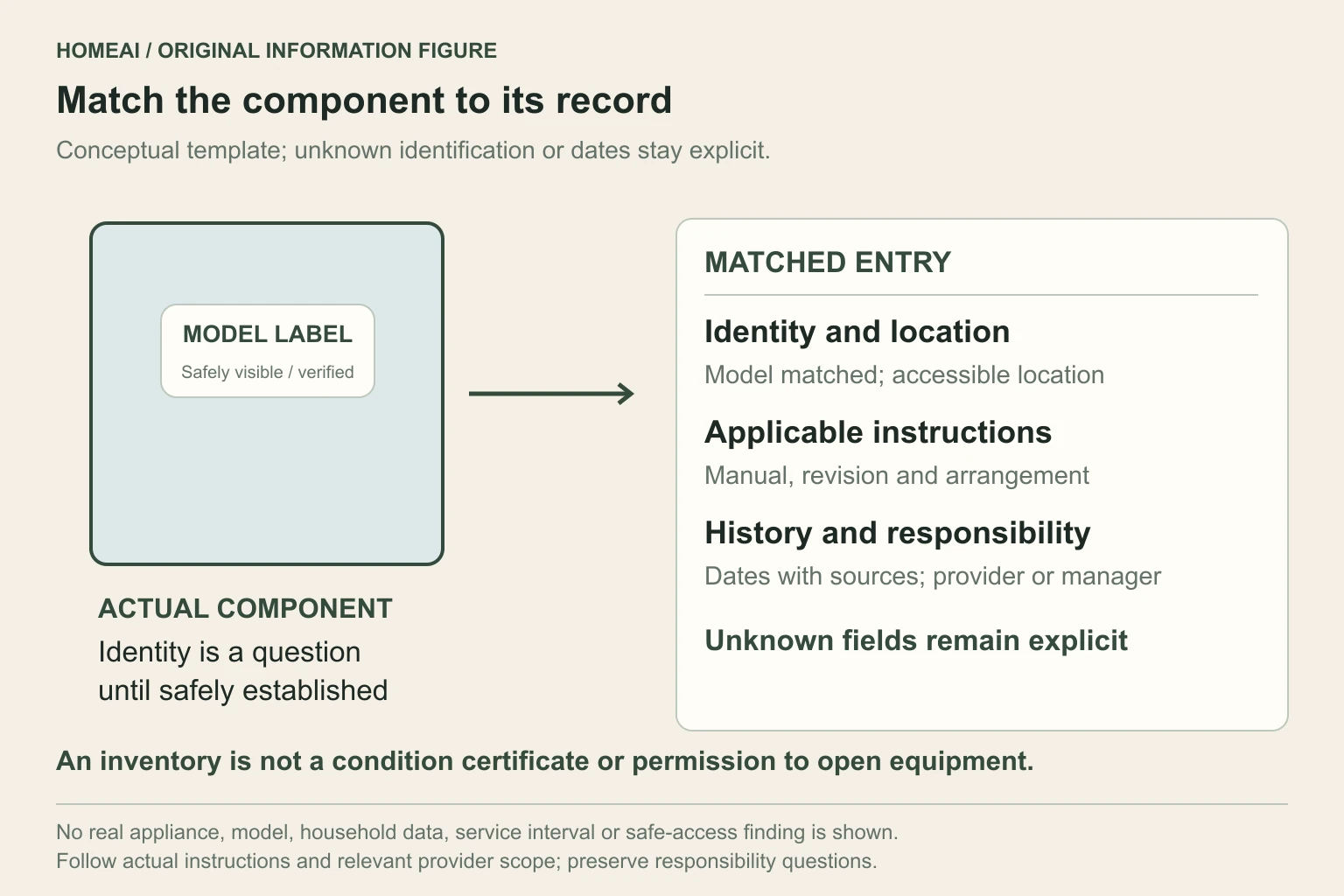
- Identity and location
Use a safely visible label or an appropriate provider’s identification; match the actual component.
- Applicable manual
Match the model and relevant revision or arrangement instead of selecting by appearance.
- History and responsibility
Keep documented dates and the actual provider, owner or shared-system responsibility.
- Unknown stays unknown
If identity or date is unresolved, record that question without opening equipment or guessing.
What does this illustration leave out?
No installed appliance, readable actual model, installation date, safe-access finding or service entitlement is shown. Conceptual record template, not equipment-operation instructions.
Does this manual and service history belong to the actual installed component?
Explore this with HomeAI ↗Opens an editable question. Nothing is sent until you choose to send it.Give each installed component a matched record
A matched component entry makes the manual and work history usable. Leave inaccessible identification or uncertain dates explicit.
- Component and location
- Name the actual item and area. Use a safely visible label or appropriate provider identification; do not open equipment or climb to obtain it.
- Manufacturer and model
- Record the matched identifiers where established. Appearance is not a reliable substitute for the exact applicable model.
- Manual and revision
- Retain the correct manual and any relevant installation-arrangement or revision information. A general web schedule is not the installed equipment’s instruction.
- Date and source
- State whether a date comes from an invoice, other matched document or a reported account. Do not guess an installation date from age or appearance.
- Responsibility and contact
- Keep the actual service contact and relevant owner, manager or shared-system responsibility. A visible location does not settle responsibility.
- Unresolved fields
- Use clear entries such as identification not yet established or date not supplied. An inventory is not an assessment of condition or safe access.
Conceptual template only; no real model, household contact, installation date or credentials are supplied. Calgary examples remain local; manufacturer and appropriately qualified advice must fit the actual component. Well care additionally needs local water-authority and qualified well-provider context.
Is this routine care, a new problem or a proposed improvement?
Routine care follows the appropriate instructions for a known component. Investigation answers a reported symptom or changed condition. Improvement changes what the home can do or how it performs. Giving each task its own label makes the reason for the work understandable later.
Age or a scheduled appointment does not itself establish failure. A service visit may identify a problem, and that finding can justify a separate repair proposal. Preserve that transition: the original scheduled task, the finding and the work that was actually authorized and completed.
A proposed improvement needs its own objective and scope. Replacing heating equipment for comfort, for example, asks how the selected system and distribution address the home’s needs. An EnerGuide recommendation can inform planning while leaving equipment repair and particular condition questions for other qualified assessment.
Record the next action without assigning an unsupported diagnosis. “Ask the provider about repeated noise” is different from “replace the failed motor.” The three-lane figure keeps care, investigation and improvement connected without suggesting that every observation must become a replacement project.
Care, investigation and improvement have different purposes
Three task lanes with distinct starting questions and outputs; a hazard note places emergency response before the routine file.
Numbers identify the parts explained below.
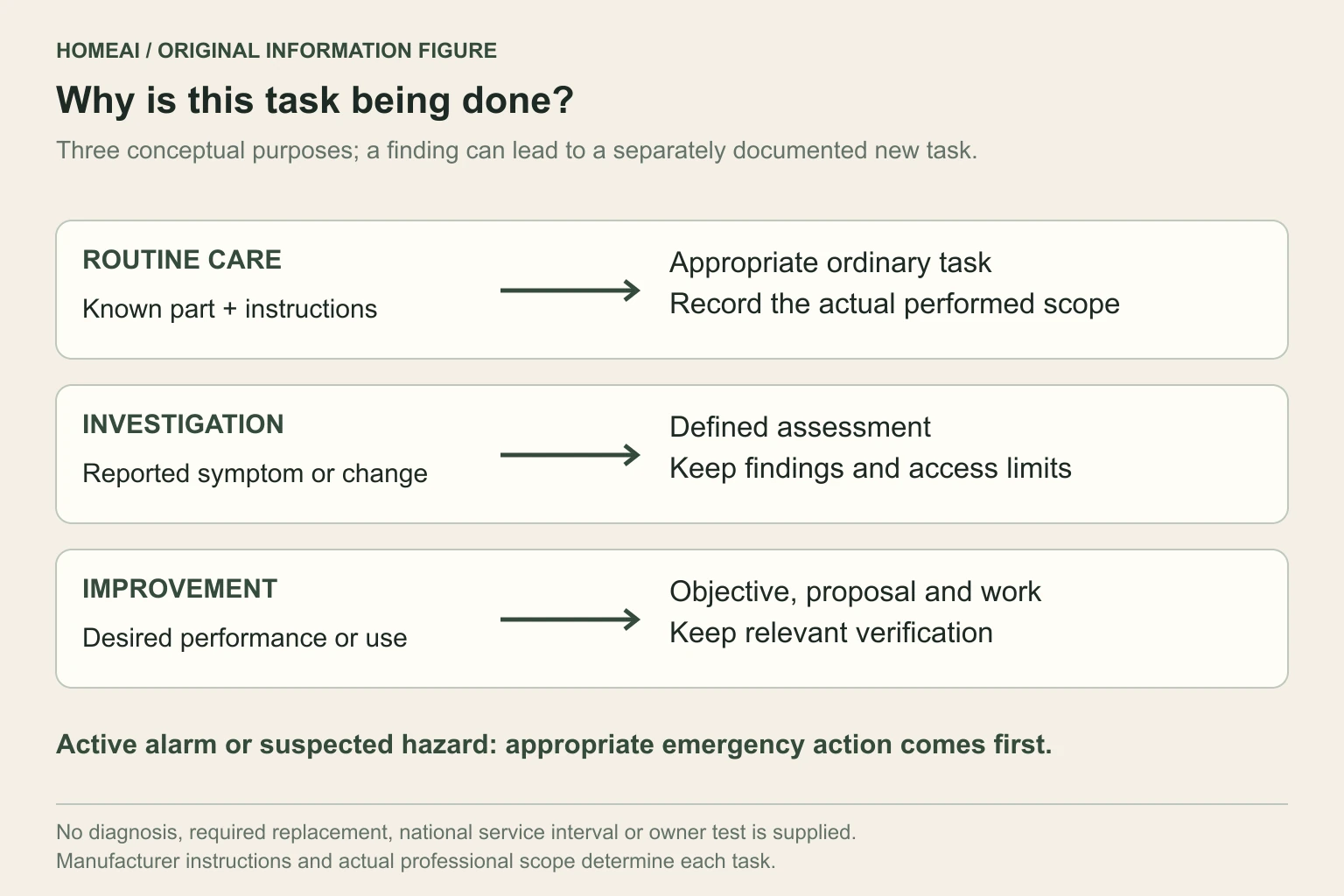
- Routine care
Known component and appropriate instructions define the ordinary task.
- Investigation
A symptom leads to defined assessment before a cause or repair is claimed.
- Improvement
A desired change needs a stated objective, suitable scope and relevant verification.
- Emergency first
An active alarm or suspected hazard needs appropriate immediate action before the care record.
What does this illustration leave out?
No diagnosis, required replacement, maintenance interval, actual project or safe-access clearance is established. Conceptual task paths only; no service interval or DIY procedure.
Why is this task being done, and what should its record establish?
Explore this with HomeAI ↗Opens an editable question. Nothing is sent until you choose to send it.Care, investigation and improvement have different purposes
The purpose of a task helps explain why it happened and what its record should contain. A finding can lead to a new task without erasing the original purpose.
- Routine care
- A known component and its appropriate instructions define the care task. Record the actual performed scope and source of the guidance; no generic service interval is supplied here.
- Investigation
- A reported symptom or changed condition leads to a defined assessment. Preserve who observed it, the conditions, the provider’s findings and access limits.
- Improvement
- A desired comfort, performance or use change leads to a defined objective and proposal. Keep appropriate assumptions, completion information and verification.
- Transitions
- A scheduled service can identify a problem. Record the original task, the new finding and any separately authorized and completed work instead of marking all of it routine.
- Emergency response
- An active alarm or suspected hazard needs immediate appropriate action before routine logging, testing or service planning. The complete guide supplies the specific CO and suspected-gas response.
Conceptual task lanes only. The figure diagnoses no failed part, sets no national interval and authorizes no owner experiment. Actual manufacturer instructions, relevant local guidance and professional scope determine the task.
Give each care task the right purpose
- Routine careAppropriate instructions for a known installed component; use its actual manual and relevant provider guidance.
- InvestigationA reported symptom or changed condition needs defined assessment before its cause is claimed.
- ImprovementA stated performance or use objective needs a suitable proposal and appropriate verification.
- Emergency responseAn active alarm or suspected hazard needs immediate appropriate action before routine records or service planning.
How can I keep a short observation log that is useful?
Use a small set of repeatable fields: date, location, ordinary conditions, what you observed and what changed. A photograph from the same safe viewpoint can help compare an accessible area. Keep the original image and describe what it shows before adding any interpretation.
For wetness, record whether it appeared after rain, snowmelt, a reported fixture use or another event. For comfort, record weather and normal occupancy alongside the location. These details help a specialist compare possibilities. They do not establish a concealed route or prove causation from timing alone.
Write “dark mark visible beside the window” separately from a provider’s later material or moisture finding. Attach the provider’s name, date, method, scope and access limits to their conclusion. Keep an earlier note intact so the file shows how understanding changed.
Observe from normal safe positions. Do not create leaks, remove electrical covers, enter confined spaces or run fuel-powered equipment indoors to obtain a record. An active alarm, suspected gas leak or other hazard needs its immediate response; completing the log can wait.
What belongs in the complete repair story?
Keep the original concern, the assessment, the agreed proposal, the completed-work record and any follow-up. They answer different questions: what prompted the visit, what was found, what was offered, what was done and what was subsequently checked.
Match each record to the same component and location. A broad folder title such as plumbing can hide that one invoice concerns a single valve. Preserve affected locations, quantities where stated and exclusions, so a small completed task is not described as a whole-system renewal.
Distinguish dates and statuses too. A quotation date is not a completion date, and a paid invoice does not automatically contain all commissioning or authority records. Ask the provider which completion and verification documents apply to the actual work and retain them with their stated scope.
A later dry observation can be useful without proving every wet-weather condition has been resolved. Agree on relevant follow-up with the provider and record what was checked. The repair-chain figure keeps the five jobs readable rather than giving the whole home an unsupported passed label.
Keep the concern, findings, work and follow-up together
Five labelled stages and distinct record roles; scope and locations remain attached throughout.
Numbers identify the parts explained below.
- Concern and assessment
Keep the original symptom, then the provider’s named findings, methods and access limits.
- Proposal
Identify offered locations, work, assumptions, exclusions and applicable records.
- Completed work
Retain the actual scope and completion date where documented, separately from the offer.
- Follow-up
Keep the relevant documented check and conditions; do not extend it to every future event.
What does this illustration leave out?
No actual dates, approved task, completed work, successful repair or whole-home passed condition is represented. Conceptual record chain; arrows do not certify work or its result.
Which link in this repair story is missing or covers a different location?
Explore this with HomeAI ↗Opens an editable question. Nothing is sent until you choose to send it.Keep the concern, findings, work and follow-up together
These five records may sit in one folder, but their roles are different. Arrows connect the story rather than certifying each event or its success.
| Stage | Keep | Do not infer |
|---|---|---|
| Concern | Original reported symptom, affected location and ordinary conditions. | That the suspected cause was confirmed. |
| Assessment | Named provider, findings, methods, access limits and scope. | That unrelated or inaccessible systems were assessed. |
| Proposal | Offered work, actual equipment, locations, assumptions and exclusions. | That offered work was completed. |
| Completed work | Actual recorded scope and documented completion context. | That an invoice contains every permit or commissioning record. |
| Follow-up | Relevant documented check, locations, conditions and remaining questions. | That every future condition or the whole home passed. |
This original chain supplies no actual authorization, installation, inspection or repair result. Preserve complete originals and request the particular records that apply; the figure creates no universal paperwork requirement or owner test.
Which emergency information should be easy to find?
Keep practical household emergency information accessible: exits, a meeting place, useful contacts and arrangements for people or pets needing assistance. The federal planning page explains the household-planning role. Follow current local emergency advice and adapt the plan to the people who actually live here.
A component-location note can help explain the home to a qualified responder. It is not an instruction for an owner to operate unfamiliar gas, electrical or other equipment. Keep any appropriate professional instructions in context instead of creating a universal shutoff sequence from a photograph.
If a CO alarm sounds, leave immediately for fresh air and call 911 or the fire or emergency service from outside. Do not search for the source. Do not return until the problem has been fixed by a professional. Calgary also advises leaving and calling for help when CO exposure is suspected, including symptoms even without an alarm.
A suspected indoor gas leak needs its own immediate response: leave, leave lights and appliances alone, and call the gas utility or emergency help from outside. A CO alarm is not a gas-leak detector. Emergency action comes before collecting labels, opening equipment or completing the care file.
How does the file help when I buy or sell?
A matched file helps the next owner understand the equipment, known work and remaining questions. Share complete relevant documents through an appropriate authorized route. A tidy index improves continuity; it does not guarantee a defect-free home or settle the legal disclosure obligations for a transaction.
Identify originals, reported history and summaries. If a document is missing, say which one could not be supplied rather than declaring the underlying work unlawful or the component failed. Appropriate technical and transaction advisors explain what consequential gaps require for this particular decision.
Separate sensitive household details from the technical handover. Emergency contacts, access codes, account identifiers and private contracts may need different handling. Do not paste them into a public chat or publish them merely because they appear in the same ownership folder.
A realtor can coordinate authorized questions and access to specialists. For a HAUSE-trained team or HAUSE-routed professional, confirm actual training, relevant licensing, scope and local availability. The named professionals assess their own assignments; HomeAI explains records and questions without certifying work or promising an available service.
How do I show what a record proves and what is still unknown?
Attach a source to important statements: who supplied it, when, which component or area it concerns and what it establishes. An owner’s observation, a professional finding, a proposed task and a completed-work record should remain recognizably different in the index.
Availability and condition are separate. “Report supplied but not reviewed” describes a document’s status. “Area inaccessible during inspection” describes an assessment limit. Neither means the component passed, failed or was absent. Keep the actual conclusion and limitations with the record.
Use specific handover descriptions. “A service invoice records work on the kitchen valve” is more useful than “plumbing updated.” Ask what was assessed elsewhere rather than extending that invoice to concealed pipes. The same rule applies to heating service, window work and energy recommendations.
Preserve dates, revisions and later corrections without erasing the earlier account. When records disagree, retain both and ask the responsible provider to clarify their scope or sequence. A clear unresolved item is more useful than a confident story assembled from documents that do not support it.
Keep record status separate from condition
- Available, not reviewedThe document exists in the file; its findings have not yet been interpreted.
- Reported observationNames who saw what, where and when; it does not automatically identify cause.
- Finding with an access limitPreserve both the conclusion and the area or question that remains unassessed.
- Proposed versus completedAn offered task and a recorded completed task describe different events; neither certifies unrelated systems.
What if a repair, renovation photo and permit do not line up?
Fictional owner Jules has a valve-repair invoice dated May 2030, an undated renovation photograph and a permit document describing proposed work. The dates and home are invented. Only the invoice supplies a confirmed event date in the example; the photograph’s position in the sequence remains unknown.
Jules preserves each original and labels what it describes. The invoice records its stated valve work. The photograph shows its visible scene without an established date. The permit document has its own status and scope; it is not automatically a completion or concealed-work inspection record.
Jules asks for the missing dates, locations and relevant completed-work documents. Independent work and overlapping work remain possibilities until the records clarify them. The diagram deliberately leaves the undated photograph off the dated sequence instead of implying that the renovation caused or concealed a problem.
A buyer or seller can give the unresolved question to the appropriate technical and transaction advisors. If seeking HAUSE coordination, verify the actual person’s training, licensing, scope and availability. This example supplies no defect diagnosis, legal conclusion, inspection result or guarantee about the fictional home.
An undated photograph cannot be placed on a dated timeline
One invented dated task and two separately labelled records whose event sequence is unresolved.
Numbers identify the parts explained below.
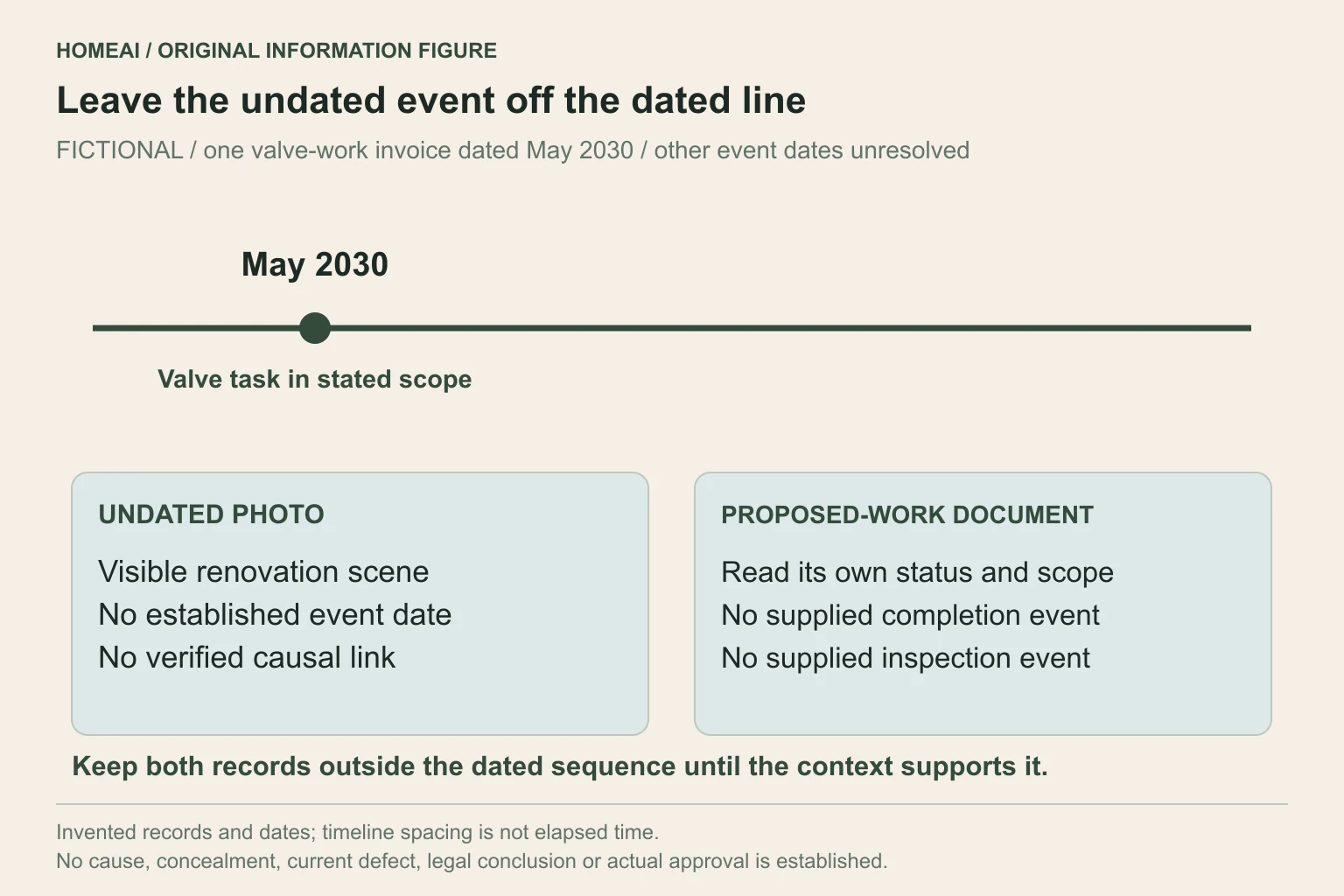
- Dated task
The fictional invoice names valve work in May 2030 within its own stated scope.
- Undated image
The photograph’s visible scene is not an established event date or causal link.
- Proposed-work document
Its own status and scope need reading; completion or inspection is not supplied.
- Preserve the gap
Request the consequential dates and scopes instead of inventing a repair-and-renovation narrative.
What does this illustration leave out?
No actual home, renovation date, completed permitted work, causal relationship, concealment or inspection result is shown. All records and dates are fictional; the uncertain sequence stays open.
Which date or scope would actually resolve the sequence question?
Explore this with HomeAI ↗Opens an editable question. Nothing is sent until you choose to send it.An undated photograph cannot be placed on a dated timeline
The example is fictional. One record supplies an invented event date; the other records do not supply a verified position in that event sequence.
- Fictional dated invoice
- Valve work is recorded in May 2030 within the invoice’s stated scope. This is the only established event date in the example.
- Fictional undated photograph
- The visible renovation scene has no confirmed date. Its position before or after the valve task remains unknown.
- Fictional proposed-work document
- Read its own status and scope. This example does not supply a confirmed completion or inspection event.
- Unresolved relationship
- Independent events and relevant overlap remain possibilities. Neither cause nor concealment is established from the three records.
- Next record question
- Ask for consequential missing dates, matched locations, complete scopes and appropriate completion information. Preserve the originals and the remaining gap.
All records, dates and people are invented, prepared and reviewed October 5, 2026. The line is conceptual, with no elapsed-time scale; no current condition, legal duty, approval, inspection or transaction outcome is established.
Keep learning about the connected parts
Keep learning about the connected parts
- Rodent signs at home: understand entry, food, shelter and the work that helps
- Home water filters and UV treatment: understand what each part does
- Buying a home with a pool or hot tub: understand the system and handover
- Skylights and roof windows: follow light, water, heat and air
- Drinking-water advisories: a complete household response
- Sewage ejectors: how a lower bathroom drains
- Buying a home with a standby generator: engine, switching and handover
- Well pumps and pressure tanks: follow the water and the pressure cycle
- Leak sensors and automatic shutoff: understand detection, valve action and response
- Understanding mortgage structure: payments, balance and flexibility
- Cash required for closing: deposit, advance, adjustments and deadlines
- After a home flood: understand the recovery before the room looks finished
- Rainwater collection: follow the roof, the store and the overflow
- Electric heated floors: understand the heater, sensor and response
- Window and portable air conditioners: follow the heat out of the room
- Portable space heaters: follow the heat, controls and supply
- Power bars, surge protection and UPS: understand the different jobs
- How home internet works: follow the service, router and room connection
- Smart-home automations: follow the sensor, rule and physical result
- Bedbugs: understand identification, treatment and follow-up
- Wood-destroying insects: separate the pest, moisture and structural questions
- Wildlife entering roofs and attics: identify the route before repair
- Trees beside a house: understand roots, canopy and the site before deciding
- Living through renovation: understand work zones, air routes and handover
- Cabinets and worktops: understand support, seams and everyday use
- Microwaves explained: cooking energy, doors, controls and cooling
- Kitchen waste disposers: follow grinding, water and the receiving drain
- Adapting your home for changing mobility: connect activities, routes and phases
- Child safety throughout the home: understand access and the actual protection
- Leaving a home vacant: connect water, heat, attendance and return
- Hiring a repair contractor: carry evidence into scope, changes and completion

Several climate questions. Different evidence.
An open timber frame above a visible foundation and soil section. Illustrative rain, roof runoff, a gutter and an above-ground downspout discharge. Roof solar panels, exterior window shading and a closed indoor air-cleaner cabinet.
The evidence the illustration cannot supply
Actual ground slope, drainage connections, foundation moisture and flood performance. Solar output, overheating performance and suitable shading for a particular climate. Filter compatibility, achieved clean-air delivery and an appropriate site-specific design. This is a separate conceptual teaching house, not another view of a surveyed property.
Practice the distinction.
Three records that do not yet form a timeline
Fictional owner Jules has a valve-work invoice dated May 2030, an undated renovation photograph and a permit document describing proposed work. People, dates and records are invented.
Reported observations
- The invoice names a dated task within its stated scope.
- The photo has no established date or verified connection to the task.
- The proposed-work document does not automatically establish completion or inspection.
Compare the explanations
Expand each possibility to see the evidence needed to distinguish it. Similar symptoms can have different mechanisms.
Independent work
The records may describe different areas or times.
Matched locations, complete scopes and actual event dates where recoverable.
Relevant overlap
The events could overlap, but the available documents do not establish a cause or concealment.
Appropriate additional chronology, completed-work records and professional findings.
A useful next question
Preserve the originals, request the consequential missing dates or scopes and give the unresolved question to the appropriate advisors.
No current defect, legal duty, approval, inspection result or transaction outcome is established.
Know what the words mean.
- Provenance
- Who supplied a record, when, which place or component it concerns and the context needed to interpret it.
- Evidence status
- The availability or review status of a record; it is separate from whether a component is sound, failed or assessed.
- Chronology gap
- An event’s date or relationship to other events is unknown; preserve that gap rather than inventing a sequence.
Questions to bring
to the conversation.
- Which equipment, location, manual and responsibility does this entry concern?
- Is this an observation, finding, proposed task or completed-work record?
- Which dates, source, exclusions and follow-up belong with the statement?
- What remains unresolved, and which actual qualified scope can answer it?
Separate a showing observation, an existing record and a new professional assessment. Unknown means a question remains; it does not automatically mean a defect.
Use the evidence planner ↗Go to the source.
Original HomeAI explanation informed by these public references. Sources support the underlying guidance; they have not reviewed or endorsed HomeAI. Diagrams are conceptual, and calculator outputs depend on your inputs.
References read for this refresh on October 5, 2026. Current full federal emergency, Health Canada CO/well and NRCan energy-report guidance, plus Calgary municipal maintenance examples, read October 5, 2026. Calgary examples are local; actual manuals, service arrangements and qualified scope govern the component question. No national maintenance interval or condition certificate is supplied.
Publication & source review
First published .
Sources reviewed .
Have a question about your home?
Start with the symptom, timing and what you have observed.
Ask HomeAI