- A fan brings air across a cooled surface, where some invisible water vapour becomes liquid. The filter, cold surface and water destination have separate jobs.
- A selected target, a current air sample and an operating state are different information. Fan sound and outgoing warmth do not establish successful water removal.
- Capacity and efficiency ratings have stated conditions. Water collection does not identify the moisture source, prove a wall is dry or establish whole-home results.
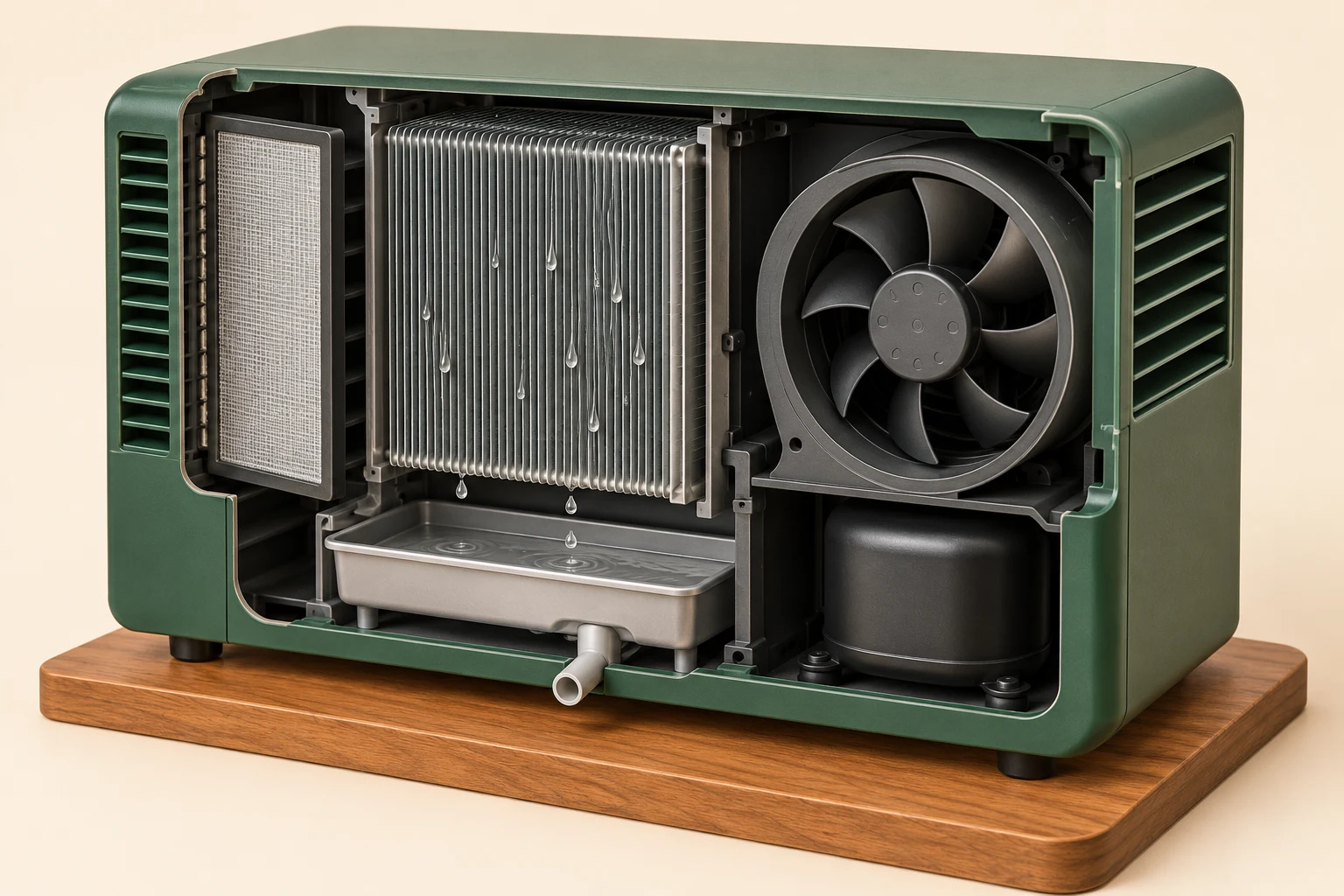
The mesh represents a particle filter, the finned surface illustrates where some moisture can condense, the fan represents air movement and the pan collects liquid. The closed cylinder is a conceptual compressor-shaped part; it is not a drawing of a named manufacturer model.
About this illustration
The picture establishes no actual airflow direction, complete heat-transfer or refrigerant route, installed model, component condition, measured water removal, outlet temperature or safe access. This is a conceptual teaching model, not an assessment of your home.
6 picture lessons appear beside the questions in this guide. Use them to understand the explanation, then consider what it means for your home.
What does a dehumidifier remove from the room?
A refrigerated dehumidifier takes some water vapour out of the air passing through it. Water vapour is invisible water in air. A fan brings air across a cooled surface, where some vapour becomes liquid droplets. The appliance collects that liquid or sends it to an installed drain, then returns the outgoing air.
That gives you three useful questions: what air reaches the appliance, what happens inside it, and where does the collected water go? A running fan, water in a bucket and warm outgoing air describe different parts of the process. Start with their jobs before interpreting a noise, a display number or an amount of water.
This guide uses two Canadian-market examples: the Danby DDR050BJP2WDB portable model and the GeneralAire DH75/DH100 manual linked by its Canadian supplier. Their drainage choices and controls differ. They illustrate refrigerated equipment, not every device sold as a dehumidifier. Keep the exact model and its matching instructions with any service record.
The appliance works on air that reaches it. It does not directly sample water inside a wall, discover a leak or prove that a building is dry. Those are separate moisture questions.
How do the fan, filter and cold surface collect water?
The GeneralAire manual describes a fan drawing air through a filter and across cooled coils. The filter catches airborne particles to help protect internal parts. The coils provide the cold surface where some airborne moisture condenses into liquid. A pan catches the droplets, and its drain port gives that liquid a separate way out.
These parts cooperate, but they do different jobs. The filter is not what turns vapour into water. The cooled surface performs that job in this example. The pan does not dry incoming air by itself; it catches water already formed.
The Danby manual labels a rear intake with a filter, a top air outlet and a bucket. The picture beside this chapter is a conceptual cutaway with a mesh, finned surface, fan and pan. Visible drops illustrate liquid; it is not a reconstruction of either manufacturer’s complete cabinet.
Ask a provider to identify the actual model, intended air passage and water destination. The answer should distinguish an exterior observation from an internal assessment performed within their scope. Keep covers closed and avoid reaching into openings. Neither this explanation nor an illustration supplies an owner procedure for inspecting cooled coils, electrical parts or refrigerant equipment.
A cold surface turns some airborne moisture into droplets
The mesh represents a particle filter, the finned surface illustrates where some moisture can condense, the fan represents air movement and the pan collects liquid. The closed cylinder is a conceptual compressor-shaped part; it is not a drawing of a named manufacturer model.
Numbers identify the parts explained below.
- Filter and cold surface
The filter catches particles; the separate cooled surface is where droplets form in the documented process. The visible drops represent liquid.
- Fan
Represents the air-moving job. The actual direction, speed and full served air path are not shown.
- Pan and outlet
Collect liquid and illustrate its separate drainage job; the receiving destination remains unknown.
- Closed compressor-shaped part
Represents a refrigeration component concept. This closed illustration supplies no operating state or complete loop.
What does this illustration leave out?
The picture establishes no actual airflow direction, complete heat-transfer or refrigerant route, installed model, component condition, measured water removal, outlet temperature or safe access. Read the part names and their jobs below the picture.
Which exact model, intended air passage and receiving water route does the provider identify?
Explore this with HomeAI ↗Opens an editable question. Nothing is sent until you choose to send it.Why can air leave warmer even though the coil is cold?
A cold surface inside a dehumidifier does not mean the appliance supplies cool room air. Danby describes warm air leaving its outlet. Frigidaire’s Canadian support explanation points to compressor and fan operation and heat released during condensation. The place where droplets form is one part of a process that also produces outgoing warmth.
A compressor supports the appliance’s refrigeration process; a fan moves air through it. Their operation and the transfer of heat as vapour becomes liquid help explain why removing moisture and returning warmer air can occur together.
Warm air alone cannot tell you how much water was removed, whether the intended air passage is clear or whether drainage works. It also cannot establish electrical safety or a normal outlet temperature. Frigidaire’s explanation is general support information, not a temperature test for the two named models or a diagnosis of your particular unit.
If unusual warmth is already part of the concern, keep the existing model and ordinary-use account and ask the responsible provider to interpret them. Do not touch hot parts, open the cabinet or force the unit to run for comparison. The useful question is what the actual model’s assessment found, rather than whether warmth by itself proves success or failure.
Cold droplets and warmer outgoing air can occur together
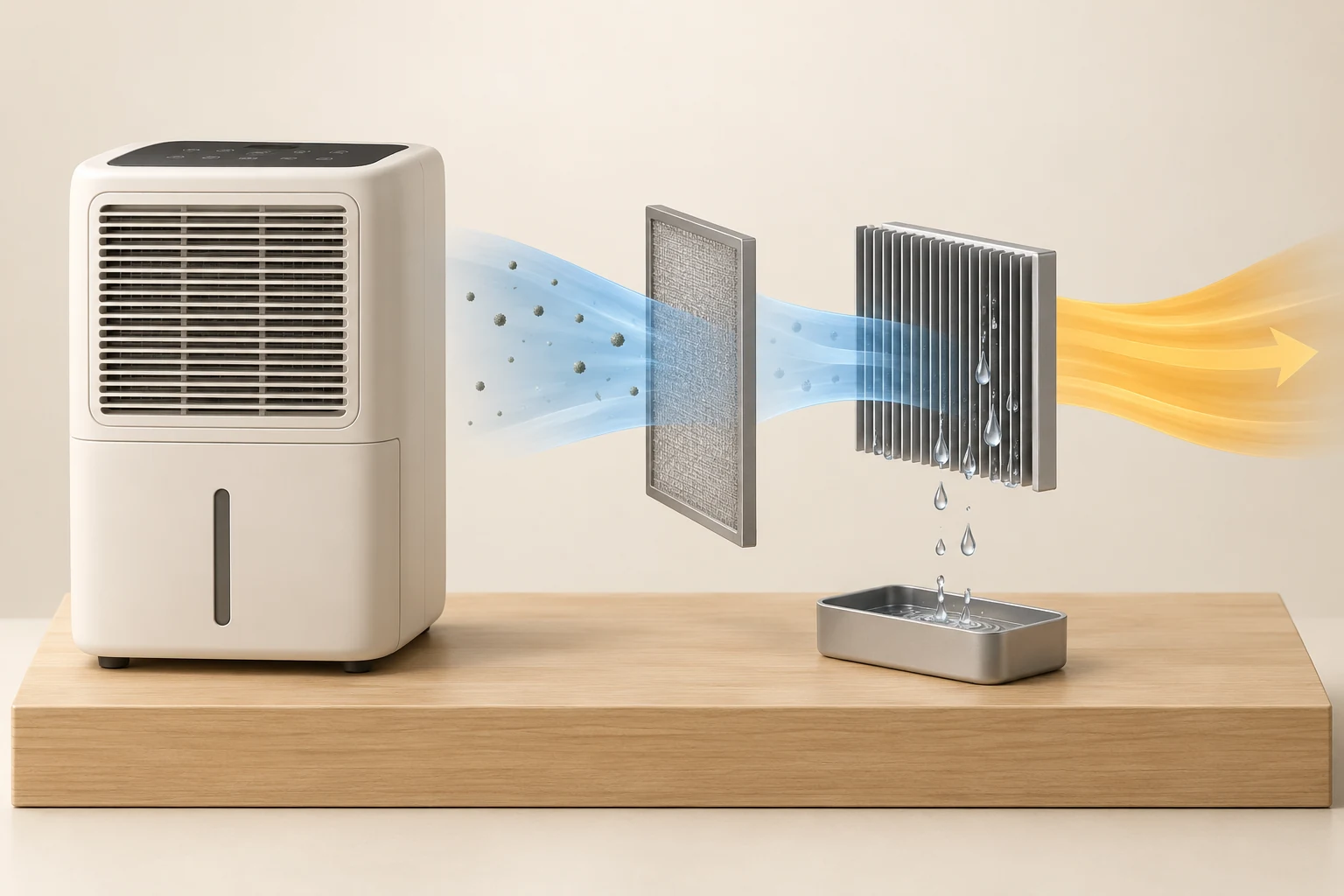
The filter represents particle capture. The finned surface illustrates moisture becoming droplets, and the tray represents collection. The right-pointing warm-coloured band helps explain outgoing warmth as a separate part of the appliance process.
Numbers identify the parts explained below.
- Filter
Catches particles rather than turning vapour into water; it is shown separately from the closed cabinet.
- Cold surface and tray
Illustrate condensation into liquid and its collection. Droplets do not quantify removal or establish installed drainage.
- Outgoing warmth
The right-hand arrow is conceptual. The documented process can return warm air; no actual temperature is supplied.
What does this illustration leave out?
The colours and arrow supply no measured air temperature, speed, humidity or water amount. The independent forms establish no real assembled route, actual product construction, heat balance or safety result. Read the part names and their jobs below the picture.
What model-matched assessment explains the actual warmth concern without treating it as proof of success?
Explore this with HomeAI ↗Opens an editable question. Nothing is sent until you choose to send it.What air can a portable or ducted unit actually serve?
A portable dehumidifier usually serves a room or space. A whole-home category uses ducts to serve one or more rooms, as Natural Resources Canada explains. A category name is only a starting point: the actual room arrangement, duct connections and equipment operation determine what air can reach the unit and receive its outgoing air.
The GeneralAire manual includes several duct arrangements and an optional outdoor-air arrangement. That means a generic room-air drawing cannot establish that every installed system only recirculates indoor air. A duct label or product brochure also cannot establish that all rooms are represented at the appliance’s humidity sensor.
This matters when an owner reports that one room feels damp while another reading seems lower. Different locations may not be represented by the same sample or served in the same way.
Keep safe, existing room notes and installation documents together. A qualified equipment provider can explain the actual air arrangement and any limits on the assessment. Ventilation, source control and concealed-material concerns may require separate building expertise. Do not move a running unit, open ducts or create an airflow experiment to complete a missing record.
Where does the collected liquid go?
Once airborne moisture becomes liquid, it needs its own destination. The named Danby manual distinguishes bucket collection, continuous gravity drainage and pump-assisted drainage. Bucket collection holds the water inside the appliance. A gravity route carries it along an installed drain path. A pump adds a water-moving function. These are explanations of jobs, not connection instructions.
In this Danby pump arrangement, the bucket fills first and the pump then moves water out. Seeing the bucket does not prove that bucket-only operation is selected. Its contents also do not account for water already pumped away. The exact model and documented arrangement therefore matter when interpreting an owner’s collection account or a photograph.
The GeneralAire example collects condensation in a pan and sends it through a drain port. The installed receiving route still needs identification. A port, hose or pipe visible near equipment does not establish where it ends, that it is connected correctly or that it drains successfully.
An amount only makes sense with a known period, water route and ordinary-use context. Missing details can stay missing. Do not disconnect a hose, clear a port, empty a bucket to stage a measurement or change pumping settings for this guide. Ask the provider what the actual route is and what their drainage assessment did and did not establish.
Where the liquid goes after it collects
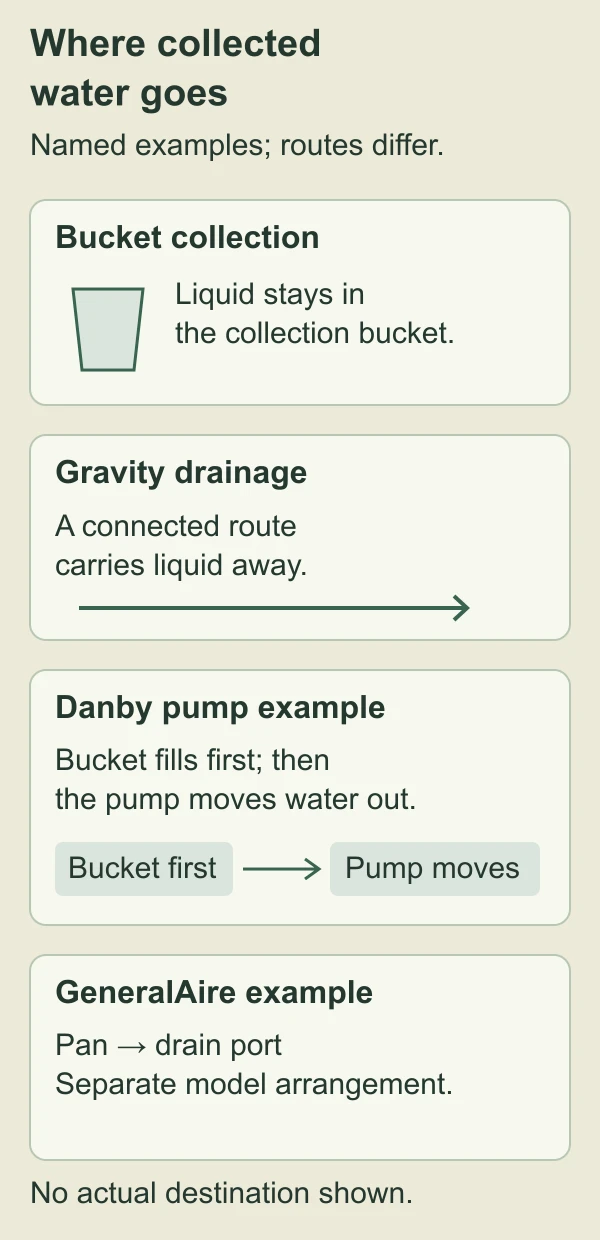
The bucket stores liquid; a gravity route carries it away; a pump adds a water-moving job. The named Danby pump example fills its bucket first. The GeneralAire pan-and-drain arrangement is shown as a separate explanation.
Numbers identify the parts explained below.
- Bucket
Stores the condensed liquid in the named portable example.
- Gravity or pump
These are different ways of moving collected liquid. The actual route still needs identification.
- Keep the models separate
GeneralAire uses its documented pan and drain account; Danby’s bucket-first pump operation belongs to that model.
What does this illustration leave out?
The drawing does not identify a fitted pump, actual hose, receiving drain, working flow or approved connection in your home. Read the matching model and installation records. This is an explanation, not a drain connection or service procedure.
Which route actually carries water away from my identified dehumidifier, and what did the assessment verify?
Explore this with HomeAI ↗Opens an editable question. Nothing is sent until you choose to send it.A bucket, a gravity drain and a pump do different jobs
- Bucket collectionThe named Danby model can retain collected liquid in its bucket.
- Gravity drainageA connected gravity route carries liquid away; its actual connection and destination need to be identified.
- Danby pump exampleFor DDR050BJP2WDB, the bucket fills first and the pump then moves water out. A bucket photograph does not show water already pumped away.
- GeneralAire exampleThe DH75/DH100 manual describes liquid falling to a pan and leaving a drain port. Its gravity or optional-pump arrangements are separate from the Danby example.
Use existing model and installation records, then ask what route and drainage function were assessed. Do not disconnect, clear or test a hose for this lesson.
Conceptual comparison of named manuals. No fitted pump, hose slope, receiving drain, working flow, approved connection or installation procedure is shown.
Further reading: Danby Products Limited · DDR050BJP2WDB Owner’s Manual; General Filters / Canadian General Filters · GeneralAire DH75 & DH100 Installation & Owner’s Manual, Form 300-8105 REV B. Original source dates, model and Canadian limits remain below.
Different water destinations in the named examples
- Danby bucketWater job: Holds collected condensate inside the appliance.Question still to answer: What period and known operating context does the existing account cover?
- Danby gravity routeWater job: Uses its installed gravity drainage route.Question still to answer: What actual receiving route and assessed drainage scope are documented?
- Danby pump routeWater job: The named model fills the bucket first, then pumps water out.Question still to answer: What water already pumped away is outside a bucket photograph?
- GeneralAire pan and drainWater job: Collects coil condensation in a pan and sends it through a drain port.Question still to answer: What receiving route and actual installed assessment are recorded?
Separate named examples, not hose assembly, elevation, clearing or testing instructions.
Why might a fan run without collecting new water?
A fan’s job is moving air. Hearing it does not prove that the refrigerated water-removal process is active at that moment. The actual model’s control request, circulation choice and protective conditions determine which components run. A period with no visible new water therefore needs interpretation rather than an immediate judgement that the appliance has failed.
In the GeneralAire manual, an automatic fan choice follows a dehumidification call, while its Cycling choice can circulate air without continuous dehumidification. That is a named control example.
The Danby manual gives another example: during automatic defrost, the compressor can stop while the fan continues. A full or incorrectly positioned bucket stops both the compressor and fan in that model. These separate descriptions explain control and protective jobs. They are not a combined troubleshooting sequence or a reason to manipulate a bucket or control.
Keep an already-known mode or message with the model and observation time. If its meaning is unclear, ask for the exact manual interpretation and scoped assessment. Amount collected, air conditions and the known water route can be relevant, but no single sound or photograph identifies the operating state.
Is that number a target, a current reading or a mode?
A humidity target is the result the control is asked to seek. A current reading describes air represented at the sensor’s location and time. An operating mode describes what the equipment is asked or allowed to do. Keep these separate: a selected target is not proof that the room achieved it, and neither number measures water hidden in a wall.
A humidistat is a humidity control that uses sensed air conditions and the chosen target to request dehumidification. The name explains the control’s job, not a recommended setting. The appropriate interpretation depends on the exact model, served space and separate moisture concern.
The Danby example shows why a photograph needs context. Its display normally shows room relative humidity, while changes to settings show the selected humidity value or a timer value. The same field can therefore mean different things. A saved number without its already-known display context may leave the meaning unresolved rather than document an actual air reading.
The GeneralAire control also distinguishes current sampled conditions from the selected humidity setting. Preserve the known label, device, location, time and ordinary context. Ask the provider which meaning the record supports. A nearby sample does not prove that every room is represented, that the sensor is accurate or that concealed materials are dry.
A target, a reading and a state mean different things
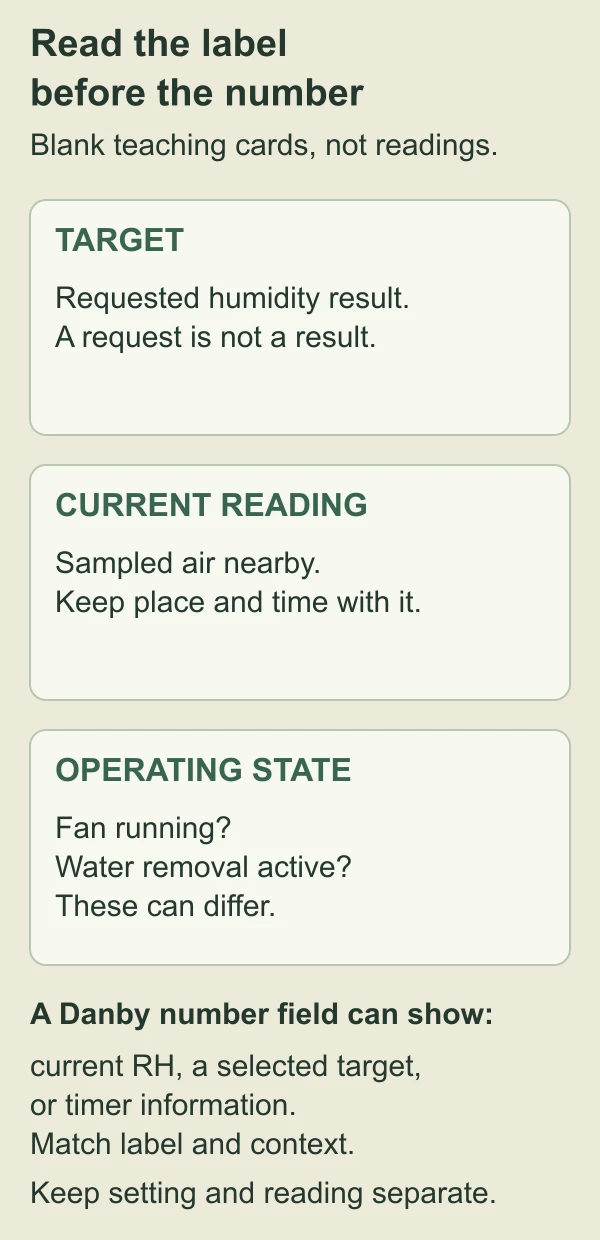
The target is a request. The current reading describes sampled air. The operating state describes what the appliance is doing or being asked to do. The blank cards contain no measurement.
Numbers identify the parts explained below.
- Target
Names the humidity result the control seeks.
- Current reading
Describes sampled air at a place and time.
- Operating state
Needs the matching manual; hearing a fan does not establish continuous water removal.
What does this illustration leave out?
No actual display, humidity value, sensing location, calibration, selected mode, material condition or whole-home result is established. Keep an already-visible label and its context; do not change settings for this lesson.
Does this existing number describe a target, current air reading or timer, and what operating state applied?
Explore this with HomeAI ↗Opens an editable question. Nothing is sent until you choose to send it.Read the label and context before interpreting the number
- TargetThe selected humidity result the control seeks. It is not proof that the result has been reached.
- Current readingRelative humidity of sampled air at a particular place and time. It does not measure water inside a wall.
- Operating stateWhat the controls presently allow or request. A fan can run during a state without continuous water removal.
- Display contextThe Danby model can use its number field for current room RH, a selected humidity value or a timer value. A photograph needs its already-known label and setting context.
The GeneralAire control separately identifies current sampled conditions and a humidity setting; its Cycling fan option differs from a continuous dehumidification call. Keep the two models separate.
Blank teaching cards, with no actual number, recommended target, calibration, room result or instruction to change a setting or stage a test.
Further reading: Danby Products Limited · DDR050BJP2WDB Owner’s Manual; General Filters / Canadian General Filters · GeneralAire DH75 & DH100 Installation & Owner’s Manual, Form 300-8105 REV B. Original source dates, model and Canadian limits remain below.
Three meanings to keep separate
- Humidity targetWhat it means: A requested control result.What it cannot establish alone: That the result was achieved or that this is a suitable setting.
- Current air readingWhat it means: A sample represented at the sensor’s location and time.What it cannot establish alone: Every room’s humidity, sensor accuracy or hidden-material dryness.
- Mode or operating stateWhat it means: A model-specific request or protective condition affecting component operation.What it cannot establish alone: Active water removal merely because a fan is heard.
- Saved Danby displayWhat it means: Its known context can be current RH, selected humidity or timer information.What it cannot establish alone: The field’s meaning when its past context was not recorded.
No target, owner sequence or universal operating-state chart is supplied.
What do capacity and efficiency ratings actually mean?
Water-removal capacity describes an amount removed over a stated period under rating conditions. It answers a different question from what one home collected during ordinary use. The GeneralAire manual attaches its figures to named air conditions. That pairing belongs to this manual; it is neither a suggested room condition nor a promise of the same result elsewhere.
Natural Resources Canada describes capacity as water removed per day. Its integrated energy factor describes rated water removal per energy consumed, in litres per kilowatt-hour. Capacity is an amount over time; integrated energy factor is a water-and-energy relationship. Those units help explain two different rating questions without turning either into a household performance guarantee.
The current NRCan regulatory page describes a regulated product and testing context. A label or database entry must be matched to the exact product and applicable record. No linked testing standard is interpreted here, and no national adoption or installation claim follows from the database. The manufacturer examples and regulatory description retain their separate dates and purposes.
A remembered runtime or an unexplained bucket photograph cannot establish either rating. Air reaching the unit, incoming moisture, water already drained away and the observation period affect the ordinary-use account. A large amount does not by itself prove correct sizing; a small amount does not prove a dry home. Ask what product, conditions and scope support each claim.
Water per day and water per energy answer different questions
Capacity uses water per time. Integrated energy factor uses water per energy. The collection card asks for the actual interval and room context; it contains no quantity or rating result.
Numbers identify the parts explained below.
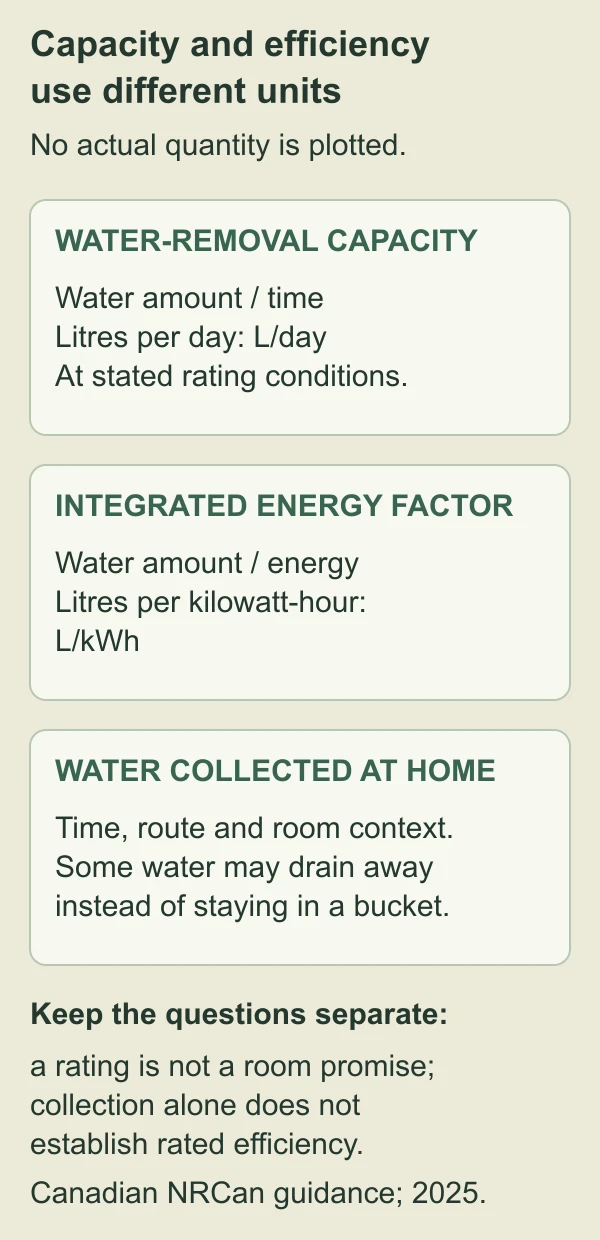
- Capacity / L per day
A rated water-removal amount per time under stated conditions.
- IEF / L per kWh
A rated water-and-energy relationship, not a larger-capacity label.
- Collection record
The water route and time period matter; bucket contents may omit water already drained.
What does this illustration leave out?
No capacity selection, room efficiency, energy saving, actual collected volume or current universal rating conditions are supplied. The units explain what information means. No appliance operating test is requested.
Which conditions belong to this capacity and IEF rating, and how does my existing collection record differ?
Explore this with HomeAI ↗Opens an editable question. Nothing is sent until you choose to send it.Capacity and efficiency use different units
- Water-removal capacityWater amount removed per stated time under the applicable rating conditions; Canadian product guidance expresses capacity in litres per day (L/day).
- Integrated energy factor (IEF)Water removed per energy consumed in the applicable rating process, expressed in litres per kilowatt-hour (L/kWh).
- An actual collection accountNeeds its time period, model, water route and room context. Bucket contents can omit water drained or pumped away.
- Different questionsA capacity rating is not a room-specific removal promise, and a collection account alone cannot establish rated efficiency or correct sizing.
Units label the information; this diagram supplies no number, selected capacity, efficiency estimate, energy saving or capacity-selection table.
NRCan consumer page modified July 23, 2025 and product-regulation guidance modified November 5, 2025 retain their Canadian scope. Named manufacturer ratings retain their own conditions; no current universal test condition is inferred.
Further reading: Natural Resources Canada · Dehumidifiers; Natural Resources Canada · Dehumidifiers (portable and whole-home); Danby Products Limited · DDR050BJP2WDB Owner’s Manual; General Filters / Canadian General Filters · GeneralAire DH75 & DH100 Installation & Owner’s Manual, Form 300-8105 REV B. Original source dates, model and Canadian limits remain below.
A rating, a collection account and a wall concern do different jobs
- Capacity ratingIts useful job: Water amount per stated period at the applicable rating conditions.Its boundary: Not a promise of collection in this home.
- Integrated energy factorIts useful job: Rated water removal per energy consumed, in L/kWh.Its boundary: Not a household efficiency result from a bucket photograph.
- Existing collection accountIts useful job: Water observation with period, route and ordinary-use context.Its boundary: Does not identify every input, drained amount or moisture source.
- Wall concernIts useful job: Description of recurrence and already-observed location.Its boundary: Needs separate source and affected-material assessment.
Units describe different questions; no rating calculation, sizing recommendation or building diagnosis.
Does collecting water prove that the wall is dry?
Water known to come from the appliance’s condensation process supports a limited conclusion: some moisture in the air reaching its cooled surface became liquid. It does not identify where that moisture originally came from. Health Canada describes contributions from household activities, water entry, plumbing, condensation and ventilation conditions. More than one can occur together.
A bucket cannot distinguish those contributions or identify a hidden route through the building. It also cannot establish that a recurring source has stopped. For example, an air-moisture concern and a rain-linked wall patch can coexist without the bucket proving the patch’s cause. Keep the timing as context for an assessment rather than treat it as a diagnosis.
Air conditions and material conditions remain separate questions. A lower local air reading does not establish the dryness of concealed materials. Appliance water collection does not establish the affected extent, a completed repair or a health clearance. The moisture-and-mould guide owns source, affected-material and professional-scope questions; use it when those match the concern.
A service provider may assess the appliance while a building specialist addresses recurring water and affected materials. Ask each to explain what was actually examined, how their findings answer the question and what remains unknown.
Air treatment and a wall patch need separate answers
The appliance represents work on the air reaching it. The separate wall patch represents a location needing its own source and affected-material question. Keeping the two questions separate prevents a collection account from becoming a wall diagnosis.
Numbers identify the parts explained below.
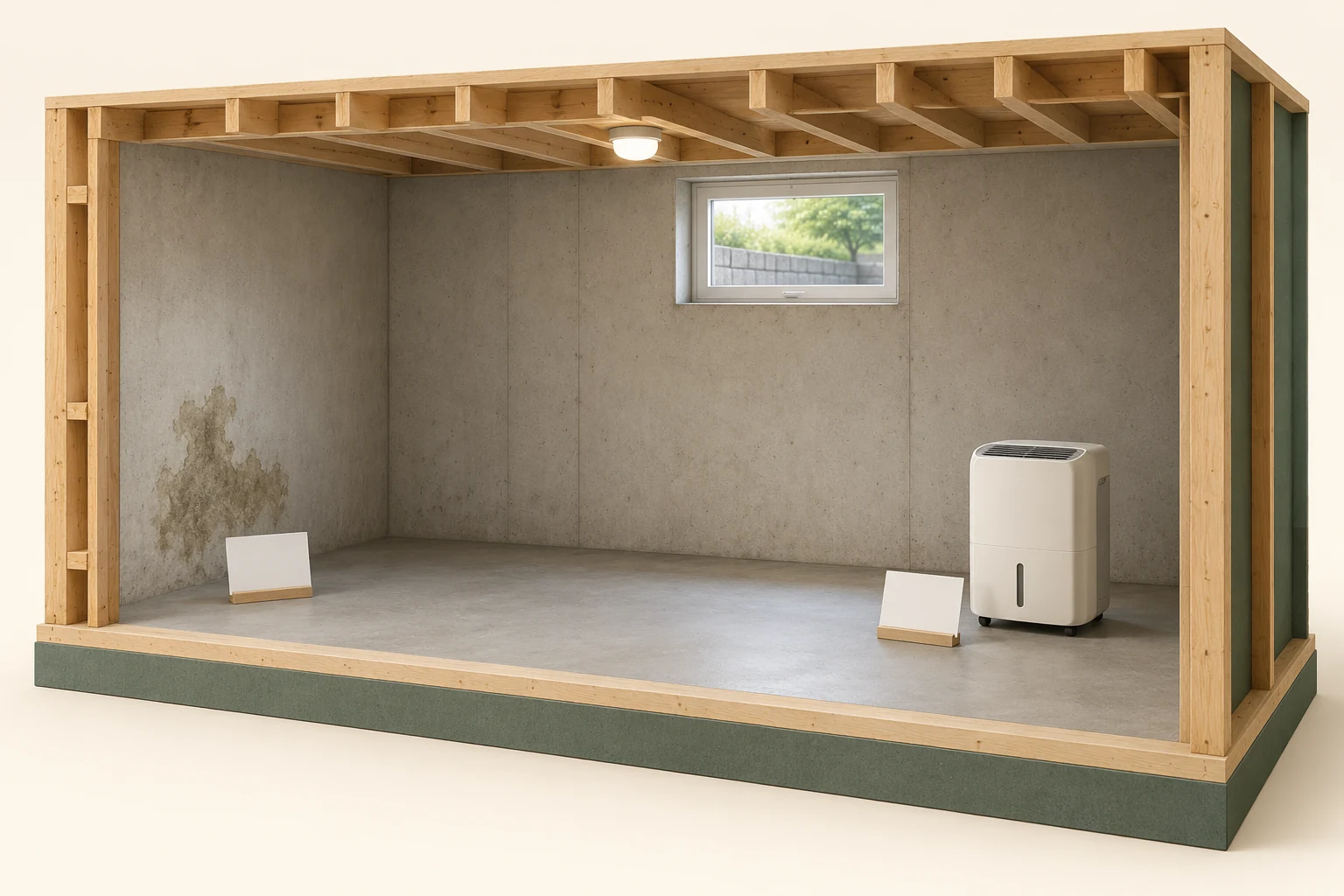
- Closed appliance
Represents air treatment; its actual model, state, water destination and collection amount are unknown.
- Wall patch
An illustrated surface change prompts a separate source and affected-area question. Appearance alone does not identify the cause.
- Room and window
Provide context only; the picture cannot establish which air is represented at a sensor or what caused the patch.
What does this illustration leave out?
The artwork identifies no actual moisture source, mould, leak route, material dryness, appliance performance, sensor reading, inspection result or successful repair. Read the part names and their jobs below the picture.
What evidence addresses the appliance, and what separate assessment addresses recurring wall moisture?
Explore this with HomeAI ↗Opens an editable question. Nothing is sent until you choose to send it.What can you safely note before a service visit?
From a dry, safe position, existing documents and photographs can preserve the model, room, already-visible display, known mode and ordinary-use context. Keep any previously documented water route with them. State when a display meaning or destination is unknown. A useful record does not require filling every gap with a new measurement or a guessed explanation.
Do not open a cabinet, reach through openings, move an energized or wet appliance, manipulate drains or force operation for this guide. Model-specific instructions and qualified assessment determine maintenance and access; this page supplies no cleaning mixture, interval or repair procedure.
Water near electrical equipment changes the immediate priority. Keep clear of wet electrical areas and obtain appropriate local utility or qualified electrical help. Ontario’s Electrical Safety Authority warns against using electrical devices that contacted floodwater. Its advice is an Ontario safety example; actual emergency and electrical help depend on your location and circumstances.
Do not enter water or operate wet equipment to preserve a photograph or identify a model. Once the area is safe, existing records can support a later assessment. Keep the wet-equipment question separate from whether the appliance previously collected water. Successful collection on an earlier day cannot establish present electrical safety after water contact.
A fictional owner has bucket water and a rain-linked wall patch
Explicitly fictional Canadian owner example: an existing account says a portable unit collected water during summer. Separately, a wall patch was reported to recur after rain. No volume, humidity value, failed component or diagnosis is supplied. The owner also has a saved display photograph whose target, current-reading or timer meaning was not recorded.
The appliance question is what model, known water destination and ordinary operating context applied. A provider can explain what the matching manual says and what their actual assessment establishes. They cannot recover an unrecorded past mode merely because the photograph contains a number. That missing information remains part of the record’s limit.
The wall question is what assessment can explain the recurring source and affected extent. Rain timing helps describe the account but proves no entrance route or link to the bucket’s contents. A building specialist may need different evidence from the appliance provider. No completed inspection, remedial work or drying result is invented in this example.
The next step is two scoped questions with the existing records, not one claim that the appliance solved the wall problem. If wet electrical conditions arise, keep clear and address them first. This fictional example offers no setting, capacity choice, performance judgement, material-dryness finding, health conclusion or recommendation to replace equipment.
What should an assessment and care record explain?
A useful appliance report identifies the model, matching instructions, date, concern, assessed components and access limits. Ask how it addressed air movement, water removal, control meaning and drainage. Keep those questions available for follow-up.
An assessment should distinguish recorded observations from explanations and remaining uncertainty. It may clarify the known water route and a current operating state while leaving a past photograph unresolved. Ask whether the report covers the installed air arrangement and receiving drain, or only the appliance.
Canadian climate, room conditions, equipment and provincial electrical responsibilities vary. Federal consumer guidance helps explain categories and ratings; Canadian supplier manuals identify named product functions. Neither creates a national installation approval, maintenance calendar or whole-home result. Match current instructions and qualified local scope before relying on advice for a particular property.
An agent can help buyers or sellers assemble records and ask for suitable specialist advice. Confirm the actual provider’s training, licence where applicable, scope and availability; this guide promises no credential or booking.
Keep learning about the connected parts
Practice the distinction.
Bucket water and a separate rain-linked wall patch
Explicitly fictional Canadian owner: previously reported summer water collection, a separate wall patch recurring after rain, and a display photograph with unrecorded context. No measurements or diagnosis are invented.
Reported observations
- An existing account reports ordinary summer collection.
- A separate account reports a wall patch after rain.
- The saved display number lacks a recorded target, current-reading or timer meaning.
- The actual model, water destination and assessed extent need existing records or provider explanation.
Compare the explanations
Expand each possibility to see the evidence needed to distinguish it. Similar symptoms can have different mechanisms.
Clarify what the appliance record actually covers
Model-matched instructions and a scoped assessment can explain current functions and known routes while leaving unrecorded past display meaning unresolved.
Exact model, existing account, matching manual and actual assessed findings; no forced operation or drain manipulation.
Assess the recurring wall concern separately
Rain timing gives context but proves no entry route, source or connection to bucket contents.
A source and affected-material assessment stating findings, access and remaining limits.
A useful next question
Keep the two concerns separate and request scoped answers. If wet electrical conditions occur, keep clear and obtain appropriate help before routine records.
No actual property, water amount, recommended setting, failed component, size verdict, dry-wall result, health clearance, completed repair or service availability is supplied.
Know what the words mean.
- Refrigerated dehumidification
- Removing some airborne water vapour by moving air across cooled surfaces, where droplets form and follow a separate liquid route.
- Condensate
- Liquid water formed when airborne water vapour condenses on a cooled surface.
- Humidistat
- A humidity control that uses sensed air and a selected target to request dehumidification.
- Humidity target
- The result a control is asked to seek. It is separate from a current reading and proof of an achieved result.
- Current sampled RH
- The relative humidity represented at a sensor’s location and time. It is an air sample, not a measurement of water hidden in a wall.
- Operating state
- What the actual model is requested or allowed to do, such as dehumidify, circulate air, defrost or stop for its bucket condition.
- Water destination
- The applicable bucket, gravity-drain or pump-assisted destination for condensed liquid. The actual model and installation determine its route.
- Water-removal capacity
- A rated water amount over a stated period under the applicable rating conditions; not a promised amount for this home.
- Integrated energy factor
- Rated water removal per energy consumed, expressed by NRCan in litres per kilowatt-hour, or L/kWh.
- Served air path
- The actual room or duct route through which air reaches and leaves the appliance; a category name cannot verify every room served.
- Water vapour
- Invisible water in air, different from the liquid droplets visible in a pan or bucket.
- Cooled coil
- A cooled heat-transfer surface where some moisture in passing air can condense into liquid.
- Defrost state
- A model-specific protective operation addressing ice on the cold surface. In the named Danby example the compressor can stop while the fan continues.
- Collection account
- An existing water observation kept with its period, known destination and ordinary context, without inventing missing measurements.
Questions to bring
to the conversation.
- Keep the exact model, existing display context, known water destination and ordinary-use account together. Leave unrecorded meanings unresolved.
- Ask for an appliance assessment that explains air movement, controls, water removal, receiving drainage and its actual scope.
- Recurring wall or building moisture needs its own source and affected-material question. Wet electrical conditions take priority; keep clear rather than inspect.
Separate a showing observation, an existing record and a new professional assessment. Unknown means a question remains; it does not automatically mean a defect.
Use the evidence planner ↗Go to the source.
Original HomeAI explanation informed by these public references. Sources support the underlying guidance; they have not reviewed or endorsed HomeAI. Diagrams are conceptual, and calculator outputs depend on your inputs.
Publication & source review
First published .
Sources reviewed .
- Health Canada · Guide to addressing moisture and mould indoors
Where this reference applies
Jurisdiction: Canadian national public-health guidance
Edition: Published January 2023 in body; page-details field 2020-04-09. Both retained; neither silently substituted.
Source reviewed: 2026-10-04 · UTC
Reading scope: Entire substantive English HTML body: background, health effects, sources, identification, PPE/clean-up, professional assessment, air testing, Appendix A and references.
Moisture source/material and professional-scope boundaries; no remediation instructions or RH prescription.
- Natural Resources Canada · Dehumidifiers
Where this reference applies
Jurisdiction: Canadian national energy-efficiency consumer guidance
Edition: Date modified 2025-07-23 displayed.
Source reviewed: 2026-10-04 · UTC
Reading scope: Entire substantive English HTML body including feature/selection/label text and tables.
Portable versus ducted categories, humidistat, capacity versus IEF; numeric selection table deliberately unused.
- Natural Resources Canada · Dehumidifiers (portable and whole-home)
Where this reference applies
Jurisdiction: Canadian regulatory-administration product guidance, mechanically refrigerated scope
Edition: Date modified 2025-11-05 displayed.
Source reviewed: 2026-10-04 · UTC
Reading scope: Entire substantive English HTML body including scope, testing method, administrative fields and tables.
Named mechanically refrigerated product scope, rating/test existence, distinct capacity/IEF units; no legal/compliance verdict.
- Danby Appliances Canada · Danby 50 Pint Dehumidifier with Pump in White, DDR050BJP2WDB
Where this reference applies
Jurisdiction: Canadian manufacturer product portal; Guelph Ontario manufacturer
Edition: No publication date established. Copyright is not a publication date. Inactive Products tag prevents current-availability claim.
Source reviewed: 2026-10-04 · UTC
Reading scope: Entire substantive English current Canadian product HTML body, including linked manual and FAQs.
Binds exact Canadian model to the current linked manual; generic unrelated and invasive FAQ advice is excluded.
- Danby Products Limited · DDR050BJP2WDB Owner’s Manual
Where this reference applies
Jurisdiction: Exact Canadian-market portable model linked by Danby Canada; Canada/USA publisher addresses
Edition: Cover dated 2024.12.09; PDF metadata created/modified 2024-12-06 is separately retained. Filename DDR050BJ2PWDB transposes letters; actual cover verifies DDR050BJP2WDB.
Source reviewed: 2026-10-04 · UTC
Reading scope: PDF pages 1–18 personally read: cover and complete applicable English body, safety, controls, operation, water removal, care, troubleshooting and warranty. French/Spanish remainder extracted but not personally read or used.
Exact model control meanings, external features, warm exhaust, bucket/gravity/pump paths and safe access limits.
- Electrical Safety Authority · Flood Safety
Where this reference applies
Jurisdiction: Ontario electrical safety regulator; regional safety example, not a national code rule
Edition: No publication or update date established in captured body.
Source reviewed: 2026-10-04 · UTC
Reading scope: Entire substantive English HTML flood-safety body and homeowner/business/contractor headings.
Immediate wet-electrical priority and professional/utility escalation; Ontario credentials scoped.
- Frigidaire Canada support · Dehumidifier Putting Out Hot Air
Where this reference applies
Jurisdiction: Canadian-market manufacturer general support; no exact model named
Edition: No publication or update date established in captured body.
Source reviewed: 2026-10-04 · UTC
Reading scope: Entire substantive English support-article body.
Qualitative compressor/fan and condensation heat transferred to exhaust; no normality verdict from outlet warmth.
- Canadian General Filters / GeneralAire Canada · DH75 Wi-Fi Dehumidifier
Where this reference applies
Jurisdiction: Canadian manufacturer/distributor product portal; GF-DH75
Edition: No publication date established.
Source reviewed: 2026-10-04 · UTC
Reading scope: Entire substantive English product HTML body and documentation links.
Binds DH75 to current linked manufacturer manual. Marketing promises not used.
- General Filters / Canadian General Filters · GeneralAire DH75 & DH100 Installation & Owner’s Manual, Form 300-8105 REV B
Where this reference applies
Jurisdiction: Canadian product-linked manual; Canadian office Toronto; USA/Canada dual document
Edition: Printed Form 300-8105 REV B and JPF REV 11-25-2019; PDF metadata created/modified 2021-05-21. URL contains upload 2024/10 and filename 2021-08-31: these do not prove publication/revision dates.
Source reviewed: 2026-10-04 · UTC
Reading scope: All 16 English PDF pages personally read, including figures, specifications, location, drains, duct applications, controls, sequence, workings, maintenance and warranty.
Fan/filter/cooled coils/condensate pan mechanism, explicitly conditioned rating, duct arrangement and sampled versus target control distinctions. No installation recipe.
Have a question about your home?
Start with the symptom, timing and what you have observed.
Ask HomeAI