Jump to a question in this guide
- Why do a condo owner and the building need different insurance answers?
- What does the standard-unit description do?
- How do improvements and personal belongings differ?
- Why does the corporation’s deductible matter to an owner?
- What other responsibilities should the personal policy address?
- What can the certificate and a quotation prove?
- How should a water event be reported and assessed?
- How do regional and building differences change the enquiry?
- What does a fictional policy-coordination case teach?
- What should be reviewed at purchase and renewal?
- Read building and personal insurance together with the actual governing unit description.
- Separate property, liability, living expenses and deductible responsibility.
- Keep region, building type, policy dates and issued wording explicit.
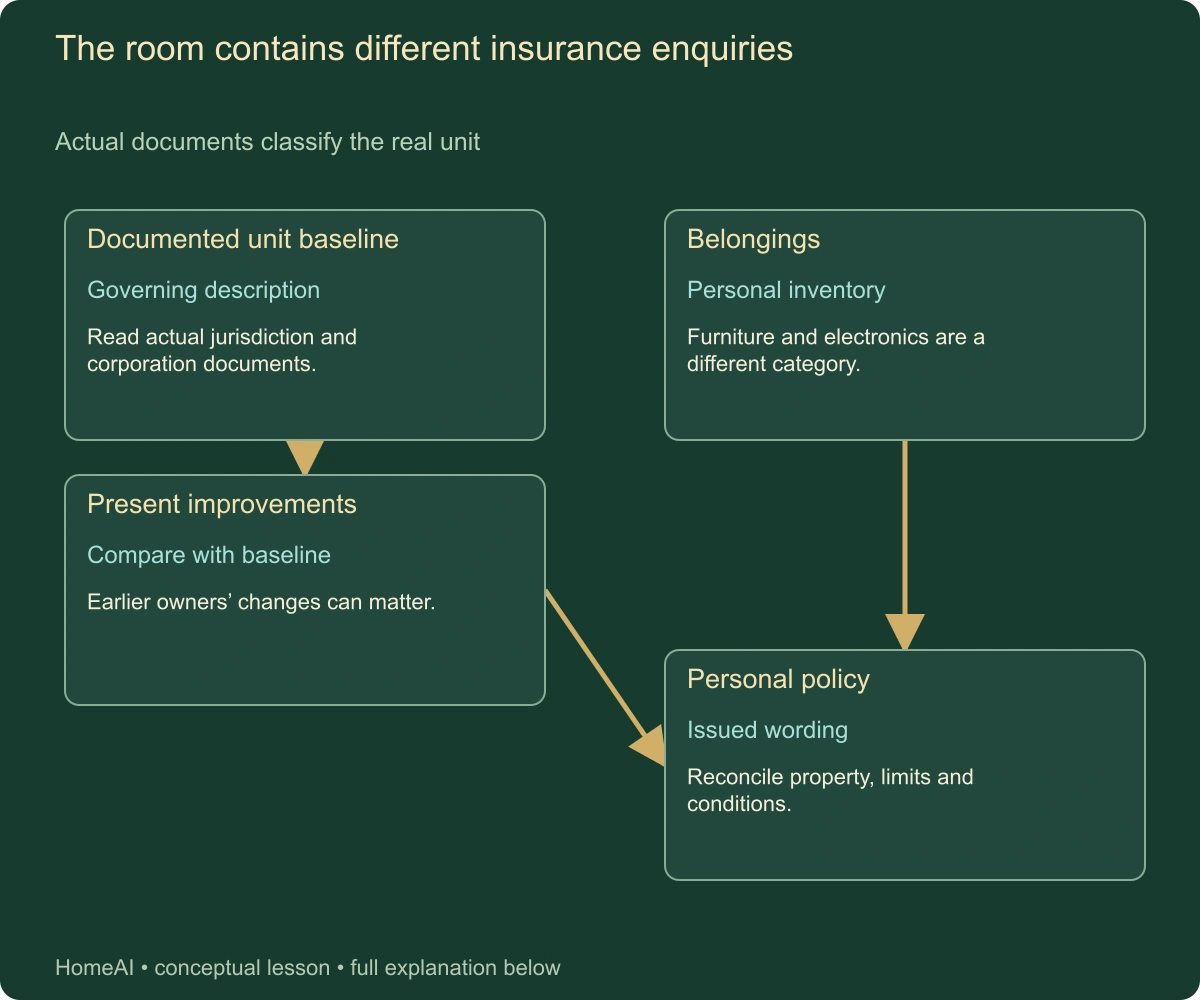
The unit baseline, later improvements and belongings meet different document and policy questions. The connected enquiry explains why a building certificate is not a personal contents policy.
About this illustration
No component classification, replacement valuation or coverage response for an actual unit. This is a conceptual teaching model, not an assessment of your home.
6 picture lessons appear beside the questions in this guide. Use them to understand the explanation, then consider what it means for your home.
Why do a condo owner and the building need different insurance answers?
Picture the apartment’s walls and floor, the sofa and laptop, a replacement kitchen and the shared corridor. They belong to different insurance enquiries even though one event could damage them all. The building’s policy and an owner’s policy have different insured interests, conditions and limits. Begin by identifying what property and responsibility each actual policy addresses.
FCAC’s current home-insurance page tells condo owners to review both their own coverage and the corporation’s coverage. It identifies possible personal-policy subjects including belongings, improvements, liability and additional living expenses, with policy limits and covered-loss conditions. It does not provide a policy for your unit or settle how a particular claim will be handled.
The Ontario Condominium Authority explains the importance of the governing documents’ standard-unit definition and the potential for bylaws to affect deductible responsibility. Alberta uses a standard insurable unit description, with its own legislation and documents. Quebec has its own divided-co-ownership framework and terminology. Do not treat a phrase from one province as the complete Canadian rule.
This guide follows policy coordination and the questions a buyer should take to the manager, insurance professional and legal adviser. It is separate from reserve funding, special-assessment planning and detailed flood-coverage guidance. A healthy reserve balance does not demonstrate that an owner’s belongings or deductible exposure are insured.
Collect documents for the actual building and period before comparing policies. Ask for the current corporation insurance certificate, relevant policy information, standard-unit description or equivalent document, governing insurance provisions and notices of changes. Give the insurance professional accurate facts about the unit, improvements, occupancy and intended use. Keep missing documents visible as unanswered questions.
Keep insurable loss and routine upkeep distinct in the questions you ask. FCAC explains that predictable maintenance-related events are outside ordinary home-insurance protection. A planned replacement programme therefore needs its own funding discussion; personal insurance is not a substitute for the reserve or project enquiry. Ask the insurer about a stated event and wording rather than assuming that any unexpected invoice is an insured loss.
One furnished room contains several insurance questions
The fixed walls, kitchen and floor finishes form a different enquiry from the movable sofa, table and other belongings. Changes made by an earlier owner can matter even though every finish was present at purchase. Compare the actual governing unit description with the present unit and the issued personal policy rather than assigning coverage from this furnished view.
Numbers identify the parts explained below.
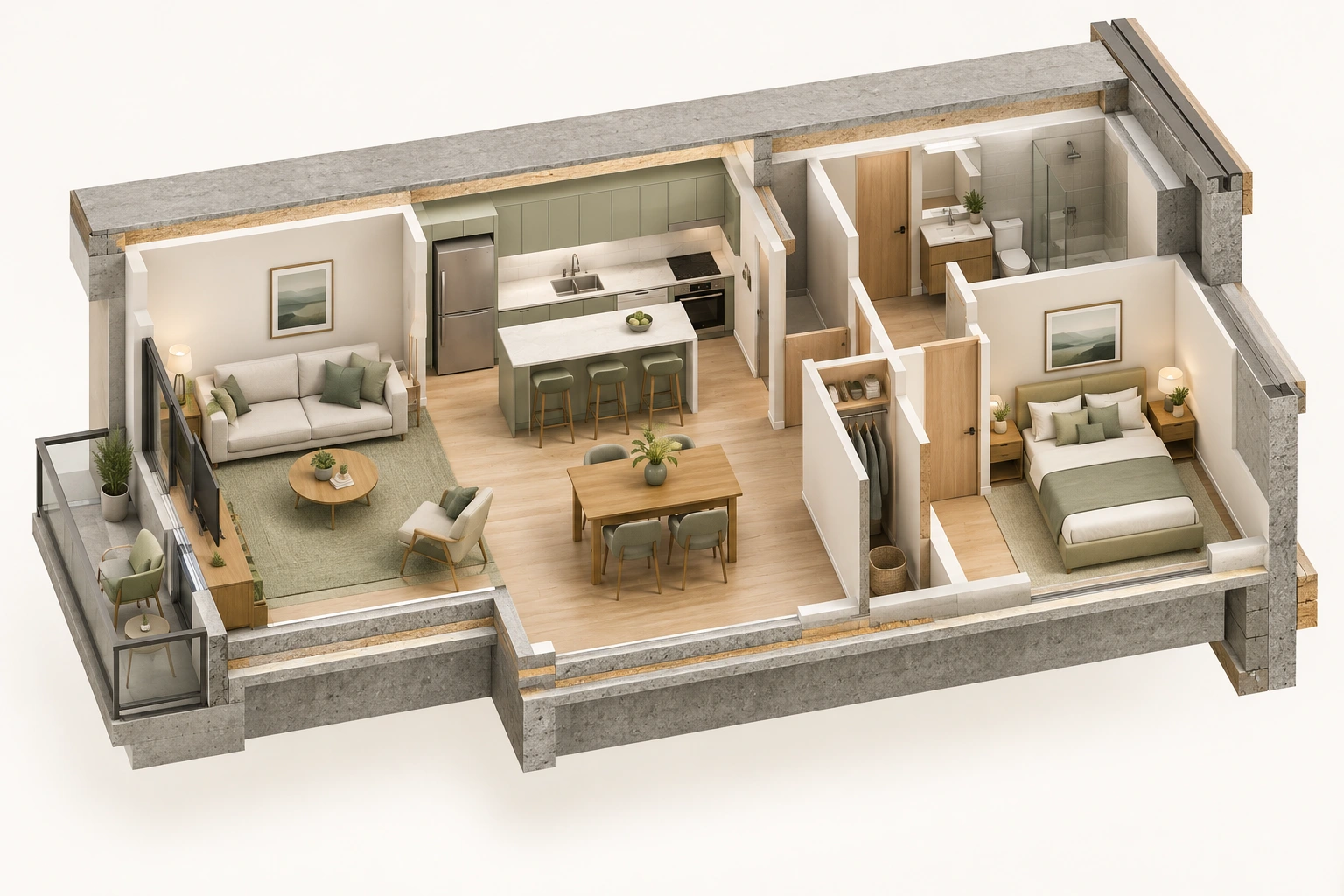
- Fixed finishes
Compare the present unit with the actual governing description.
- Movable belongings
A building certificate is not the contents-policy answer.
- Kitchen and bathroom
Earlier changes need the actual coverage enquiry.
What does this illustration leave out?
No standard-unit classification, improvement value, policy coverage, ownership boundary or structural rating is established. The balcony’s insurance responsibility is not assigned. This illustration explains an idea. It is not an installation guide.
How do building fabric, improvements and contents occupy the same room?
Explore this with HomeAI ↗Opens an editable question. Nothing is sent until you choose to send it.One furnished room contains several insurance questions
The fixed walls, kitchen and floor finishes form a different enquiry from the movable sofa, table and other belongings. Changes made by an earlier owner can matter even though every finish was present at purchase. Compare the actual governing unit description with the present unit and the issued personal policy rather than assigning coverage from this furnished view.
- Walls and floor finishes
- Unit-component enquiry. Read the actual governing description.
- Fitted kitchen and bathroom
- Present improvement enquiry. Appearance does not establish the documented baseline.
- Furniture and belongings
- Personal contents enquiry. Consider inventory, limits and policy conditions separately.
What remains unknown: No standard-unit classification, improvement value, policy coverage, ownership boundary or structural rating is established. The balcony’s insurance responsibility is not assigned.
A useful question: How do building fabric, improvements and contents occupy the same room?
No generated text appears in this picture. Separate fictional context, not an installation or property-specific result.
What does the standard-unit description do?
A standard-unit description provides a documented reference for the components within a unit relevant to the applicable repair and insurance arrangements. It is not a photograph of how every unit looks today. A later owner may have changed finishes or equipment, and the governing description may define what belongs in the insured baseline differently from a buyer’s intuition.
For an Ontario example, the Condominium Authority says the governing documents define the standard unit and distinguish it from improvements. Its article also warns that common-element and vacant-land corporations have different requirements. The actual condominium type matters. Ask the legal adviser and manager which documents apply rather than assuming that an apartment example governs a bare-land purchase.
Compare the description item by item with material features of the actual unit. Ask how walls, floor finishes, cabinetry, fixtures and other components are treated under the documents and policies. This is a document-review task, not an instruction to open assemblies. A visibly expensive countertop does not tell you whether its entire cost or only a difference from a baseline belongs in a particular coverage.
If the description is absent, unclear or appears inconsistent with other documents, ask the manager and legal adviser what the applicable arrangement is and what clarification is needed. Do not fill the gap with a generic internet list. The insurance professional needs the actual answer to assess the personal-policy request.
Keep the complete dated description with the quotation. If it changes, an older personal-policy review may no longer reflect the same document boundary. Ask how changes are communicated and who should revisit coverage. A buyer needs an ongoing process for matching the policies, not merely a one-time statement that the condo has insurance.
A unit sits within a building of other units and shared routes
The rooms, floor boundaries and central service-space context place the apartment within a larger building. That relationship explains why governing descriptions, building insurance and personal insurance must be coordinated. The pale ceiling marks are fictional appearance cues only; visible affected finishes do not identify the water source, responsibility or policy response.
Numbers identify the parts explained below.
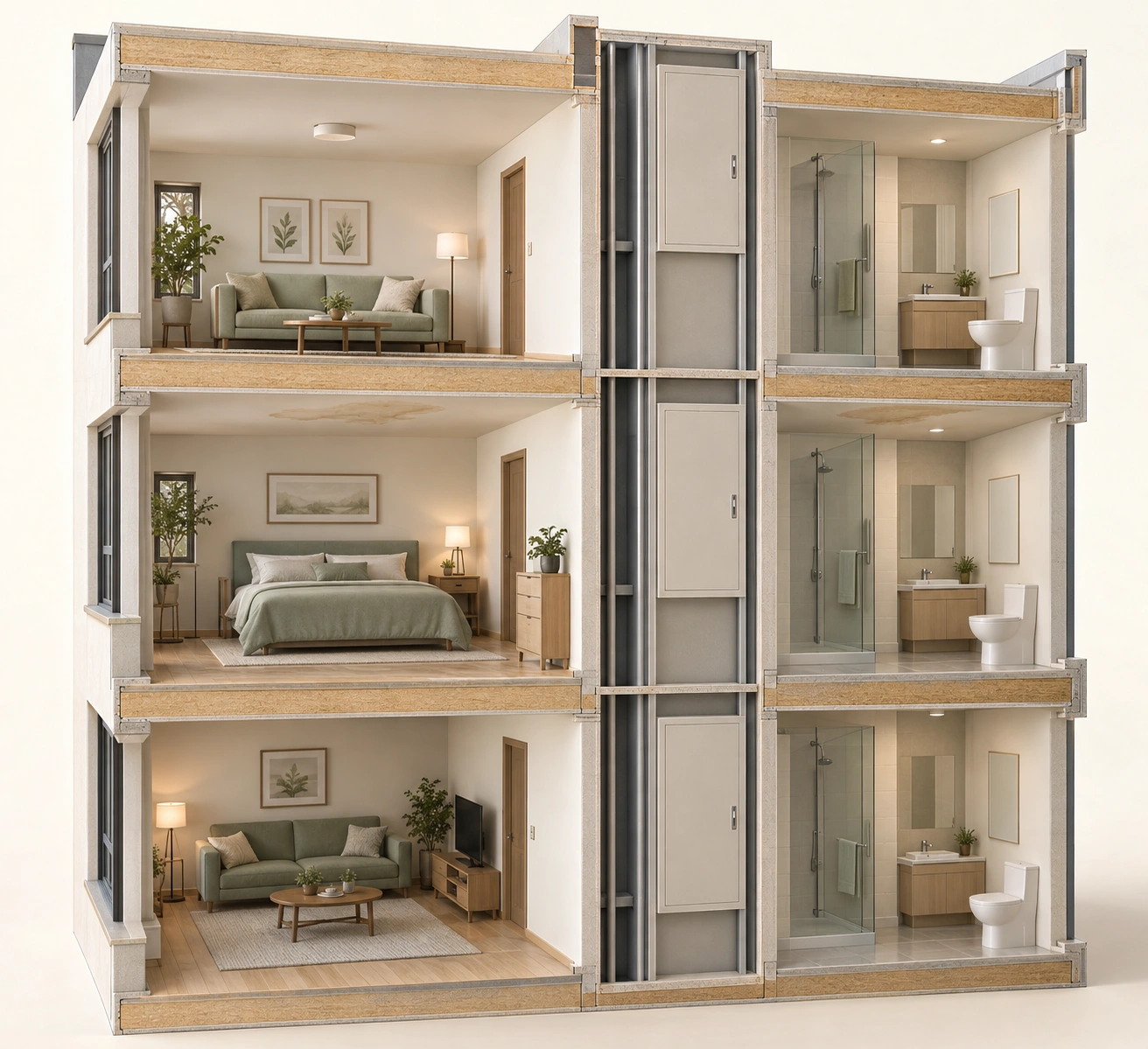
- Apartment rooms
Compare the relevant actual unit description and policy.
- Shared-service context
Location alone does not determine responsibility.
- Ceiling appearance cue
A mark cannot establish source, fault or coverage.
What does this illustration leave out?
No leak origin, actual water damage, pipe connection, standard-unit boundary, negligence, deductible recovery or claim result is established. The closed covers do not authorize access. This illustration explains an idea. It is not an installation guide.
Why can one water event affect several responsibilities?
Explore this with HomeAI ↗Opens an editable question. Nothing is sent until you choose to send it.A unit sits within a building of other units and shared routes
The rooms, floor boundaries and central service-space context place the apartment within a larger building. That relationship explains why governing descriptions, building insurance and personal insurance must be coordinated. The pale ceiling marks are fictional appearance cues only; visible affected finishes do not identify the water source, responsibility or policy response.
- Rooms and finishes
- Unit property questions. Their classification needs actual documents.
- Floor boundaries
- Building relationship. Several units can be involved in one enquiry.
- Closed central covers
- Shared-service context. Their hidden contents and responsibility remain unknown.
What remains unknown: No leak origin, actual water damage, pipe connection, standard-unit boundary, negligence, deductible recovery or claim result is established. The closed covers do not authorize access.
A useful question: Why can one water event affect several responsibilities?
No generated text appears in this picture. Separate fictional context, not an installation or property-specific result.
How do improvements and personal belongings differ?
An improvement concerns a feature of the unit whose insurance treatment must be reconciled with the governing description and policy. Personal belongings are items such as furniture, clothes and electronics. Both can require attention, but they are different categories. A claim for a damaged sofa cannot be understood solely by reading the building’s description of walls and flooring.
FCAC specifically identifies improvements made by previous owners as a possible personal condo-insurance subject. A buyer therefore should not limit the enquiry to renovations they personally intend to make. Ask the seller for relevant improvement information and give the insurer an accurate description of the present unit. Do not assume the current finish is the documented baseline because it was present at purchase.
Make a practical inventory of belongings and significant improvements. Photos, receipts and descriptions can support the enquiry, with sensitive details stored appropriately. An inventory helps explain what needs to be considered; it does not establish that every listed item is insured or the amount payable. Ask about applicable limits and any separately scheduled property.
Ask the insurer how settlement would be measured under the proposed coverage. FCAC distinguishes replacement value from actual cash value, which reflects depreciation under the policy. The label matters to the estimate of personal needs. Do not compare two premiums without identifying whether their settlement basis, limits, deductibles and exclusions are actually comparable.
If records are incomplete, disclose that uncertainty. An insurance professional can explain what information is needed rather than having the buyer invent renovation costs or descriptions. Preserve estimates as estimates and actual receipts as records. Avoid treating an online resale price or purchase price of the condo as a complete replacement-cost assessment of its contents and improvements.
When comparing settlement options, ask about conditions as well as labels. The insurer may need particular evidence or steps under the issued policy. A replacement-value description in a general article is not a commitment to pay an estimated improvement cost. Have the professional explain how the actual wording applies to the property being described, and record any item that needs more information before a quotation can be finalized.
The room contains different insurance enquiries
The unit baseline, later improvements and belongings meet different document and policy questions. The connected enquiry explains why a building certificate is not a personal contents policy.
Numbers identify the parts explained below.
- Documented unit baseline
Governing description. Read actual jurisdiction and corporation documents.
- Present improvements
Compare with baseline. Earlier owners’ changes can matter.
- Belongings
Personal inventory. Furniture and electronics are a different category.
What does this illustration leave out?
No component classification, replacement valuation or coverage response for an actual unit. This illustration explains an idea. It is not an installation guide.
What do the actual unit description and issued personal wording say?
Explore this with HomeAI ↗Opens an editable question. Nothing is sent until you choose to send it.Read the complete figure
The room contains different insurance enquiries
Actual documents classify the real unit
- Documented unit baseline
- Governing description. Read actual jurisdiction and corporation documents.
- Present improvements
- Compare with baseline. Earlier owners’ changes can matter.
- Belongings
- Personal inventory. Furniture and electronics are a different category.
- Personal policy
- Issued wording. Reconcile property, limits and conditions.
- Documented unit baseline → Present improvements: Compare features.
- Present improvements → Personal policy: Coverage enquiry.
- Belongings → Personal policy: Coverage enquiry.
The unit baseline, later improvements and belongings meet different document and policy questions. The connected enquiry explains why a building certificate is not a personal contents policy.
What remains unknown: No component classification, replacement valuation or coverage response for an actual unit.
A useful question: What do the actual unit description and issued personal wording say?
Conceptual teaching diagram. Complete labels and their meanings follow in static text.
Why does the corporation’s deductible matter to an owner?
A deductible is the portion of a covered claim retained under the policy before the insurer’s payment, subject to that policy’s terms. The corporation’s deductible and the owner’s personal deductible are separate amounts under separate arrangements. Knowing one does not answer the other. Ask which peril and policy each quoted amount concerns.
The Ontario Condominium Authority warns that bylaws can extend circumstances in which an owner is responsible for the corporation’s deductible and suggests discussing suitable coverage with an insurance broker. This is a reason to obtain the actual governing provisions and policy details. It is not a finding that every water event will be charged to the apartment where damage is noticed.
An Alberta government fact sheet published February 2020 explains a different regional recovery framework, including origin, exceptions and the need to review personal coverage. That dated explanatory sheet was fully read for this guide. Its historical numeric cap and notification period are deliberately not presented here as current legal advice. Ask an Alberta legal professional to check the current law and actual facts.
Ask the insurance professional whether the proposed personal policy responds to the actual type of deductible responsibility, with what limit, exclusions, conditions and personal deductible. A benefit called loss assessment or deductible coverage should be read in its own wording. Similar product names do not establish that all possible charges from a corporation are covered.
Keep an unknown recovery decision separate from a known policy amount. The corporation can supply its current deductible information, while responsibility for a particular event requires the actual facts and applicable documents. A high deductible is an important planning input; it is not evidence that the buyer already owes that sum.
The event’s origin, the damaged property and the reason for a proposed charge are separate facts. A leak observed in your ceiling does not show which unit or system originated it. A corporation’s deductible figure does not identify the legal basis for recovering it from you. Request the actual technical findings and written explanation, then have the appropriate adviser review the relevant policy and governing provisions.
Four deductible questions must stay distinct
The building amount, responsibility decision, personal coverage and owner deductible are different boundaries. Following the chain avoids assuming that one quoted number answers the whole exposure.
Numbers identify the parts explained below.
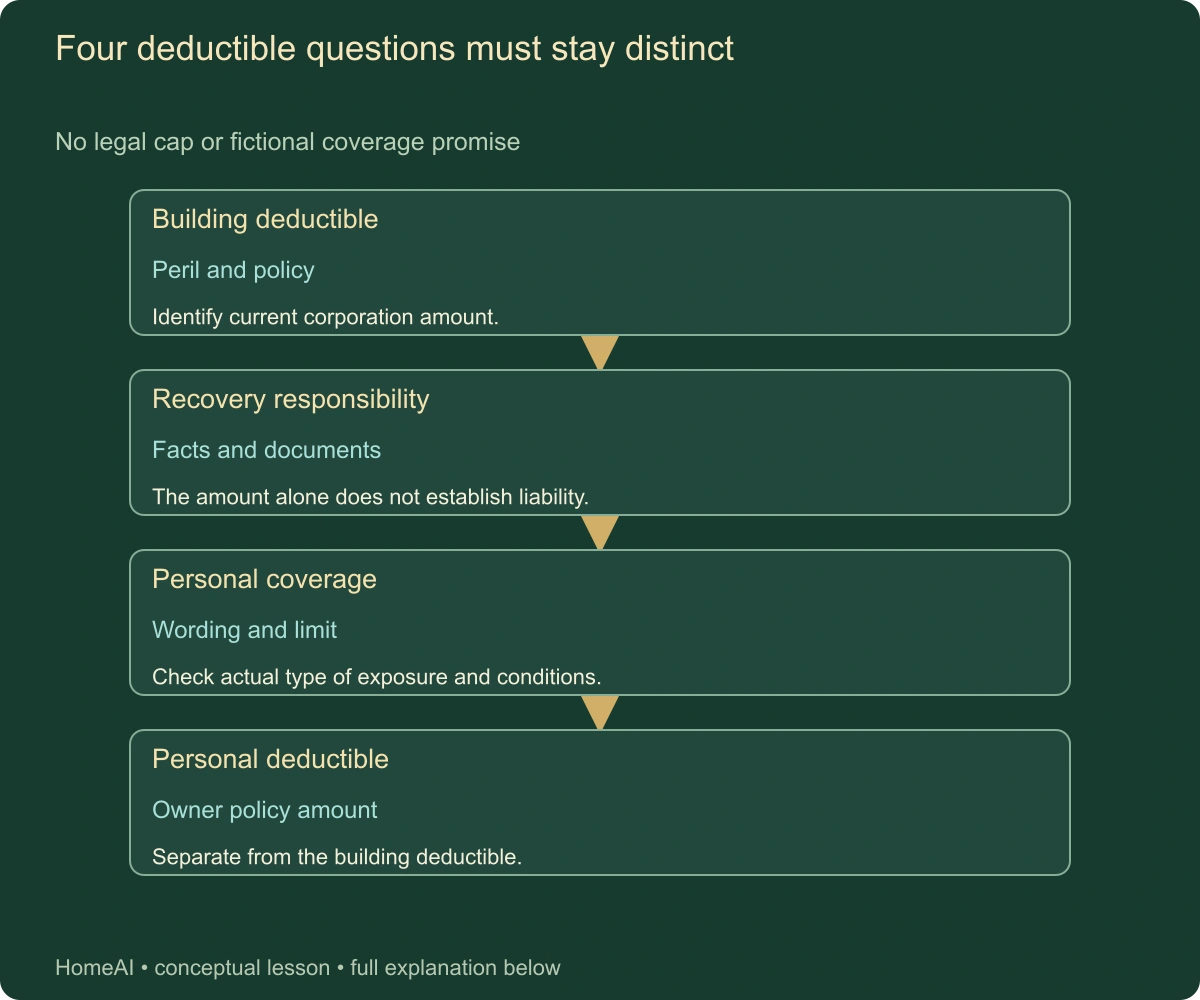
- Building deductible
Peril and policy. Identify current corporation amount.
- Recovery responsibility
Facts and documents. The amount alone does not establish liability.
- Personal coverage
Wording and limit. Check actual type of exposure and conditions.
What does this illustration leave out?
No event, numeric cap, liability or insurer payment is promised. This illustration explains an idea. It is not an installation guide.
What current documents and professional advice answer each boundary?
Explore this with HomeAI ↗Opens an editable question. Nothing is sent until you choose to send it.Different amounts, different questions
- Corporation deductibleRelevant peril and current building policy.
- Owner deductibleThe personal-policy retained amount.
- Recovery responsibilityActual facts, governing provisions and current law.
- Personal coverageIssued wording and limit for the actual exposure.
No event, chargeback or insurer response is decided here.
Further reading: FCAC — Home insurance; Condominium Authority of Ontario — How does condo insurance work.
Read the complete figure
Four deductible questions must stay distinct
No legal cap or fictional coverage promise
- Building deductible
- Peril and policy. Identify current corporation amount.
- Recovery responsibility
- Facts and documents. The amount alone does not establish liability.
- Personal coverage
- Wording and limit. Check actual type of exposure and conditions.
- Personal deductible
- Owner policy amount. Separate from the building deductible.
- Building deductible → Recovery responsibility: Different enquiry.
- Recovery responsibility → Personal coverage: Request actual protection.
- Personal coverage → Personal deductible: Read own terms.
The building amount, responsibility decision, personal coverage and owner deductible are different boundaries. Following the chain avoids assuming that one quoted number answers the whole exposure.
What remains unknown: No event, numeric cap, liability or insurer payment is promised.
A useful question: What current documents and professional advice answer each boundary?
Conceptual teaching diagram. Complete labels and their meanings follow in static text.
What other responsibilities should the personal policy address?
Liability coverage concerns legal liability for injury or damage to others within its terms. Property coverage concerns the insured property. They can be relevant to the same event but answer different questions. Ask the insurance professional how the proposed policy addresses the household, visitors, improvements, contents and potential damage to other units or shared areas.
Additional living expense coverage may help when an insured loss makes the unit temporarily uninhabitable, within the policy’s conditions and limits. It is different from a promise to pay every cost of moving out during any building project. Ask about the actual trigger, amount, duration and expenses addressed instead of relying on the phrase temporary accommodation.
Tell the insurer about occupancy and intended use. FCAC says to inform the insurer if the home is shared or partly rented, and distinguishes business-insurance questions. IBC also tells consumers to contact the insurance representative before renting or making material changes. A quotation based on owner occupancy should not silently be used for an arrangement the insurer has not been told about.
For a rented condo, distinguish the unit owner’s arrangements from the tenant’s own belongings and liability enquiry. The corporation’s policy does not make that discussion unnecessary. Give the appropriate insurance professional the actual occupancy, lease and management facts; this guide does not prescribe a universal landlord or tenant product.
Ask how storage lockers, parking-related personal property and belongings temporarily elsewhere are treated if those matters are important to the household. Do not assume that a locker’s existence in the sale answers the insurance limit for its contents. The title or lease identifies a property interest or use arrangement; the insurance wording determines the coverage question.
What can the certificate and a quotation prove?
An insurance certificate is useful evidence of identified policy information for its stated period. It is not the complete policy wording and does not decide an owner’s claim. Ask the manager or appropriate representative for the current certificate and the relevant deductible and coverage information needed by your insurance professional. Preserve its effective dates and building identity.
A quotation is a proposed insurance arrangement based on supplied facts. Ask what is needed to bind coverage, when it begins, what conditions remain and which documents will be issued. Do not treat an online estimate or a conversation as proof that the intended policy is active for the purchase date.
Check the unit, occupancy, named insured and start date against the transaction and household facts. Ask the legal professional and insurance representative about lender or other requirements that actually apply. A general article cannot determine the exact timing or contractual documents needed for a particular completion.
When policies are compared, request the same material coverages and identify differences. A cheaper premium may accompany a different deductible, lower limit or omitted feature. The useful record connects each quoted amount to the coverage and conditions rather than producing a single insurance total with the differences hidden.
Keep advice and documents together. If an insurance professional says a particular exposure is covered, ask where that answer appears in the issued wording or endorsement and what limitations apply. This creates a reviewable answer without promising that an unknown future event will be accepted as a claim.
Do not use a coverage limit as a property valuation finding. A selected contents amount describes the proposed insurance boundary; it does not certify the value of every item in the apartment. Ask whether the inventory and improvement information are sufficient for the insurer’s assessment. Keep any professional replacement estimate, personal inventory and policy limit clearly labelled so their different purposes survive the handover.
How should a water event be reported and assessed?
Follow the building’s emergency procedure and use its known contact channel for an active water event. Avoid entering an unsafe area or operating shared equipment. The immediate task is to arrange the appropriate safe response. The later insurance enquiry needs accurate observations, but collecting evidence must not delay help or put the resident at risk.
Record what you observed, where, when and whom you contacted, when it is safe to do so. Separate visible water in an apartment from an assessed source or cause. Water can be observed at one place while the origin requires professional investigation. A photograph of a wet ceiling does not determine fault, deductible recovery or the scope of insured damage.
The manager coordinates the building response within their role, qualified technical providers assess the relevant equipment and damage, and insurers assess their policies and claims. Legal advice may be needed for a disputed responsibility. Ask for the actual findings and documents, rather than expecting any one party to settle all technical, insurance and legal questions in a first phone call.
Before authorizing non-emergency alterations or repairs, ask the manager and insurer about the applicable process and approvals. The Ontario Condominium Authority specifically advises speaking to the board or manager before repairs or alterations. Keep urgent safety directions from the responsible responders distinct from later repair and claim arrangements.
Retain incident records, professional reports, correspondence and invoices with their scope and dates. A repair invoice can document work and cost, but it does not by itself establish the event’s origin or insurance entitlement. If a report leaves a cause unresolved, keep that limit visible while requesting the next necessary assessment.
One water event produces several questions
The observation begins the enquiry, while technical findings inform separate responsibility and policy assessments. Water seen in a ceiling does not by itself decide any downstream answer.
Numbers identify the parts explained below.
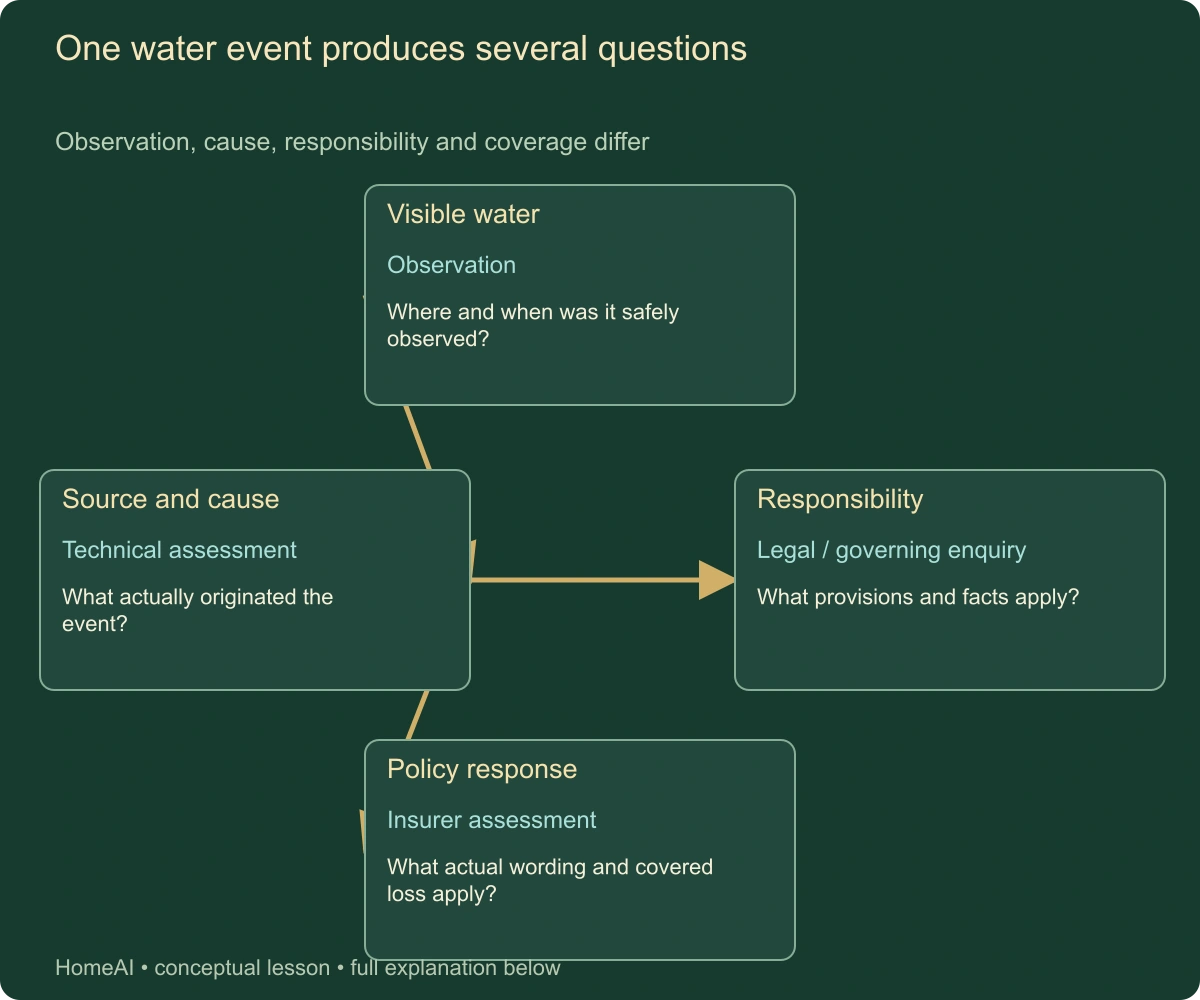
- Visible water
Observation. Where and when was it safely observed?
- Source and cause
Technical assessment. What actually originated the event?
- Responsibility
Legal / governing enquiry. What provisions and facts apply?
What does this illustration leave out?
No source, fault, claim or deductible recovery is established. This illustration explains an idea. It is not an installation guide.
Which question is answered by each actual report?
Explore this with HomeAI ↗Opens an editable question. Nothing is sent until you choose to send it.Read the complete figure
One water event produces several questions
Observation, cause, responsibility and coverage differ
- Visible water
- Observation. Where and when was it safely observed?
- Source and cause
- Technical assessment. What actually originated the event?
- Responsibility
- Legal / governing enquiry. What provisions and facts apply?
- Policy response
- Insurer assessment. What actual wording and covered loss apply?
- Visible water → Source and cause: Investigate safely.
- Source and cause → Responsibility: Relevant findings.
- Source and cause → Policy response: Relevant findings.
The observation begins the enquiry, while technical findings inform separate responsibility and policy assessments. Water seen in a ceiling does not by itself decide any downstream answer.
What remains unknown: No source, fault, claim or deductible recovery is established.
A useful question: Which question is answered by each actual report?
Conceptual teaching diagram. Complete labels and their meanings follow in static text.
How do regional and building differences change the enquiry?
Condominium and strata terminology varies across Canada. Alberta’s standard insurable unit description, Ontario’s standard unit and Quebec’s description of private portions belong to their particular legal and document frameworks. Ask the local legal and insurance professionals to identify the relevant documents. Similar everyday language should not conceal different responsibilities.
IBC Quebec’s current co-ownership page describes the syndicate and co-owner policies as complementary enquiries, including the building, personal property, improvements and liability. That regional explanation supports the need to read both arrangements. It does not import Quebec apportionment rules into another province or establish that any particular assessment is payable by an insurer.
Building type also matters. A tower apartment, townhouse condominium and bare-land arrangement can distribute property and responsibilities differently. Ask which property is common, part of the unit or otherwise managed under the actual documents. An exterior door or private-looking yard should not be assigned an insurance responsibility solely from appearance.
The February 2020 Alberta fact sheet separately discusses bare-land insurance and bylaws, illustrating why type must be identified before applying an apartment example. Its edition remains dated context. Current local law, the corporation’s documents and actual policy must be checked before making a legal responsibility or coverage decision.
Policy information changes over time. Ask for documents covering the intended purchase period and about known pending changes. A certificate from last year can be genuine and still be the wrong basis for today’s quotation. Do not infer that an earlier owner’s personal policy transfers to the buyer or matches the buyer’s needs.
What does a fictional policy-coordination case teach?
In this fictional Ontario purchase, Priya views an apartment with upgraded flooring and receives a corporation insurance certificate. She initially assumes the certificate covers everything inside the unit. The example uses invented facts and no actual claim, insured result, premium or deductible amount.
Priya obtains the governing standard-unit description and relevant insurance provisions through the proper transaction process. She asks her insurance professional to compare the present flooring and other improvements with the documents, consider belongings and liability, and explain the actual deductible-responsibility coverage. Her legal adviser handles questions about the governing provisions.
The example deliberately provides no conclusion about the flooring’s final classification or policy response. Priya still needs the actual documents and issued wording. A manager’s description of typical coverage is recorded as a lead for confirmation, rather than promoted into the insurer’s commitment.
If the corporation later changes its deductible, Priya would ask the insurance professional to revisit the relevant personal coverage with the new document. That is a fresh review question, not evidence that a loss occurred. She retains the earlier documents so the change and advice can be traced.
The lesson is to coordinate the property description, legal responsibility and personal policy before relying on coverage. It does not predict a claim outcome or turn one fictional apartment into a Canadian insurance rule. An unanswered classification or endorsement question belongs beside the purchase decision until the appropriate professional resolves it.
Priya also asks whether the personal quotation assumes the unit will be occupied by her household from completion. If she intends to rent it later, that plan needs a fresh disclosure and coverage discussion. The fictional case supplies no insurer acceptance of either use. It illustrates why policy coordination includes accurate household facts as well as the corporation’s documents.
What should be reviewed at purchase and renewal?
At purchase, retain the complete corporation information, relevant unit description, governing provisions, personal quotation, issued policy and endorsements. Record which insurance and legal professionals answered the material questions and when. Keep the evidence of active coverage and start date with the transaction record.
At renewal, compare current corporation documents with the previous review. Ask about changes to deductibles, insured property, exclusions or the unit description that matter to the personal policy. Have the insurance professional explain any resulting adjustment. A renewal premium notice alone may not tell the whole story of changed coverage.
Update the unit and belongings information after material changes and notify the insurer as required by the actual arrangement. IBC advises contacting the insurance representative before renovations, business use or rental changes. Keep plans, approvals, invoices and issued policy changes distinct so a proposed project is not mistaken for completed and insured work.
If a claim or charge is disputed, ask the insurer or legal adviser which review process applies and preserve deadlines from the actual correspondence. This guide does not prescribe a universal dispute route or decide liability. A clear chronology and complete wording help the responsible reviewer understand the question.
The final useful answer is specific: these documents define the building and unit enquiry, this policy addresses these personal needs within these conditions, and these questions remain open. It is a continuing record of actual decisions. The words condo insured, on their own, are too broad to support a purchase or household plan.
Keep the full wording accessible to the household, with current contacts and renewal dates. A saved premium receipt is useful payment evidence but does not replace the policy or endorsements. When advice changes, preserve the earlier record and identify the new facts so a future reviewer can follow the decision.
Coordinate documents for the same period
The building and unit documents inform the personal quotation, which still needs its own issued-policy and timing confirmation. An older certificate and a new premium cannot be assumed to describe the same boundary.
Numbers identify the parts explained below.
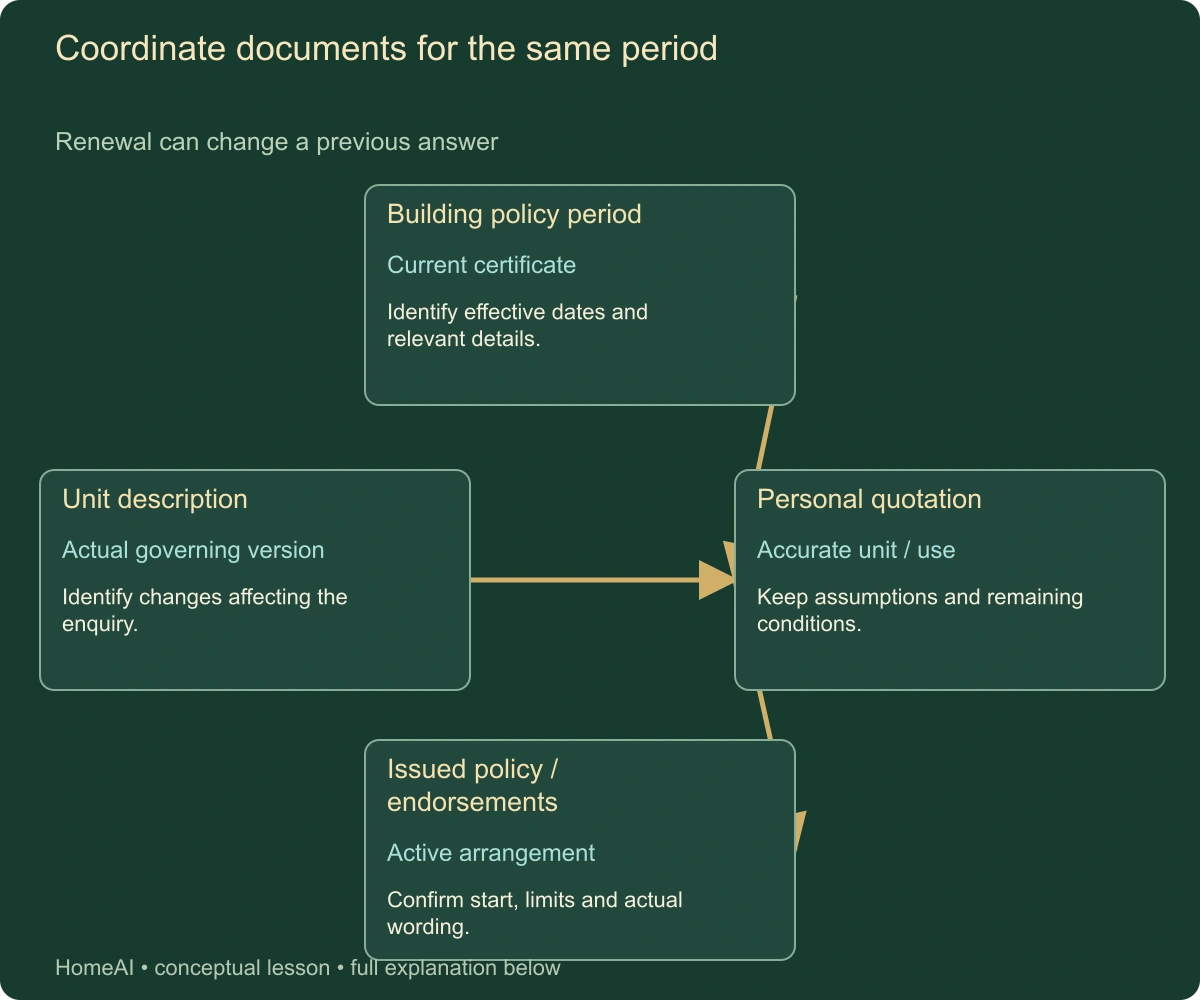
- Building policy period
Current certificate. Identify effective dates and relevant details.
- Unit description
Actual governing version. Identify changes affecting the enquiry.
- Personal quotation
Accurate unit / use. Keep assumptions and remaining conditions.
What does this illustration leave out?
No active policy, lender satisfaction or future claim acceptance. This illustration explains an idea. It is not an installation guide.
Do all current documents and accurate occupancy facts match?
Explore this with HomeAI ↗Opens an editable question. Nothing is sent until you choose to send it.Keep learning about the connected parts
- Condo reserves: connect the money to the building
- A condo assessment notice: follow the purpose, scope and decision
- Flood risk and insurance: ask two separate evidence questions
- Build a water-system evidence file
- What changes when the home type changes?
- Apartment water systems: risers, central hot water and shared response
Canadian context and authorities · Visual atlas · Learning labs
Read the complete figure
Coordinate documents for the same period
Renewal can change a previous answer
- Building policy period
- Current certificate. Identify effective dates and relevant details.
- Unit description
- Actual governing version. Identify changes affecting the enquiry.
- Personal quotation
- Accurate unit / use. Keep assumptions and remaining conditions.
- Issued policy / endorsements
- Active arrangement. Confirm start, limits and actual wording.
- Building policy period → Personal quotation: Give current information.
- Unit description → Personal quotation: Reconcile baseline.
- Personal quotation → Issued policy / endorsements: Binding process.
The building and unit documents inform the personal quotation, which still needs its own issued-policy and timing confirmation. An older certificate and a new premium cannot be assumed to describe the same boundary.
What remains unknown: No active policy, lender satisfaction or future claim acceptance.
A useful question: Do all current documents and accurate occupancy facts match?
Conceptual teaching diagram. Complete labels and their meanings follow in static text.
Practice the distinction.
One certificate does not answer every unit question
Fictional Ontario buyer Priya receives a corporation certificate for an apartment with upgraded flooring.
Reported observations
- The governing unit description still needs reconciliation.
- Personal belongings, improvements and deductible exposure need actual policy review.
- No final flooring classification or claim response is supplied.
A useful next question
Obtain professional answers and issued wording for the accurate unit/occupancy facts; no insurer approval is invented.
Know what the words mean.
- Standard-unit description
- The relevant governing description used to reconcile unit components and insurance/repair questions in its jurisdiction.
- Improvement
- A unit feature whose treatment must be compared with the actual governing description and policy.
- Personal contents
- Belongings such as furniture and electronics, distinct from the building component enquiry.
- Corporation deductible
- The retained portion under the corporation policy, distinct from a personal-policy deductible.
- Deductible responsibility
- The actual legal/document enquiry about who bears a deductible for the event; not decided by its amount.
- Policy endorsement
- An issued policy provision modifying or adding coverage under its actual wording.
- Additional living expenses
- Coverage for defined extra living costs following the relevant insured loss, within policy terms.
Questions to bring
to the conversation.
- Which description and current building policy apply?
- What contents/improvements and actual deductible responsibility does the personal policy address?
- Which conditions, limits and unanswered classifications remain?
Separate a showing observation, an existing record and a new professional assessment. Unknown means a question remains; it does not automatically mean a defect.
Use the evidence planner ↗Go to the source.
Original HomeAI explanation informed by these public references. Sources support the underlying guidance; they have not reviewed or endorsed HomeAI. Diagrams are conceptual, and calculator outputs depend on your inputs.
Current FCAC, CAO and IBC full bodies reviewed October 13, 2026. Alberta Feb2020 sheet remains dated context; no numeric liability cap/current legal rule adopted. Ontario/Quebec concepts are not universalCanada rules. Actual policies, current law, documents and event findings control.
Publication & source review
First published .
Sources reviewed .
Have a question about your home?
Start with the symptom, timing and what you have observed.
Ask HomeAI