- Read the study, approved plan, financial records and recent decisions together.
- Low fees or a large balance cannot establish adequate funding by themselves.
- Clarify responsibilities and outstanding work using the applicable provincial framework and the corporation’s records.
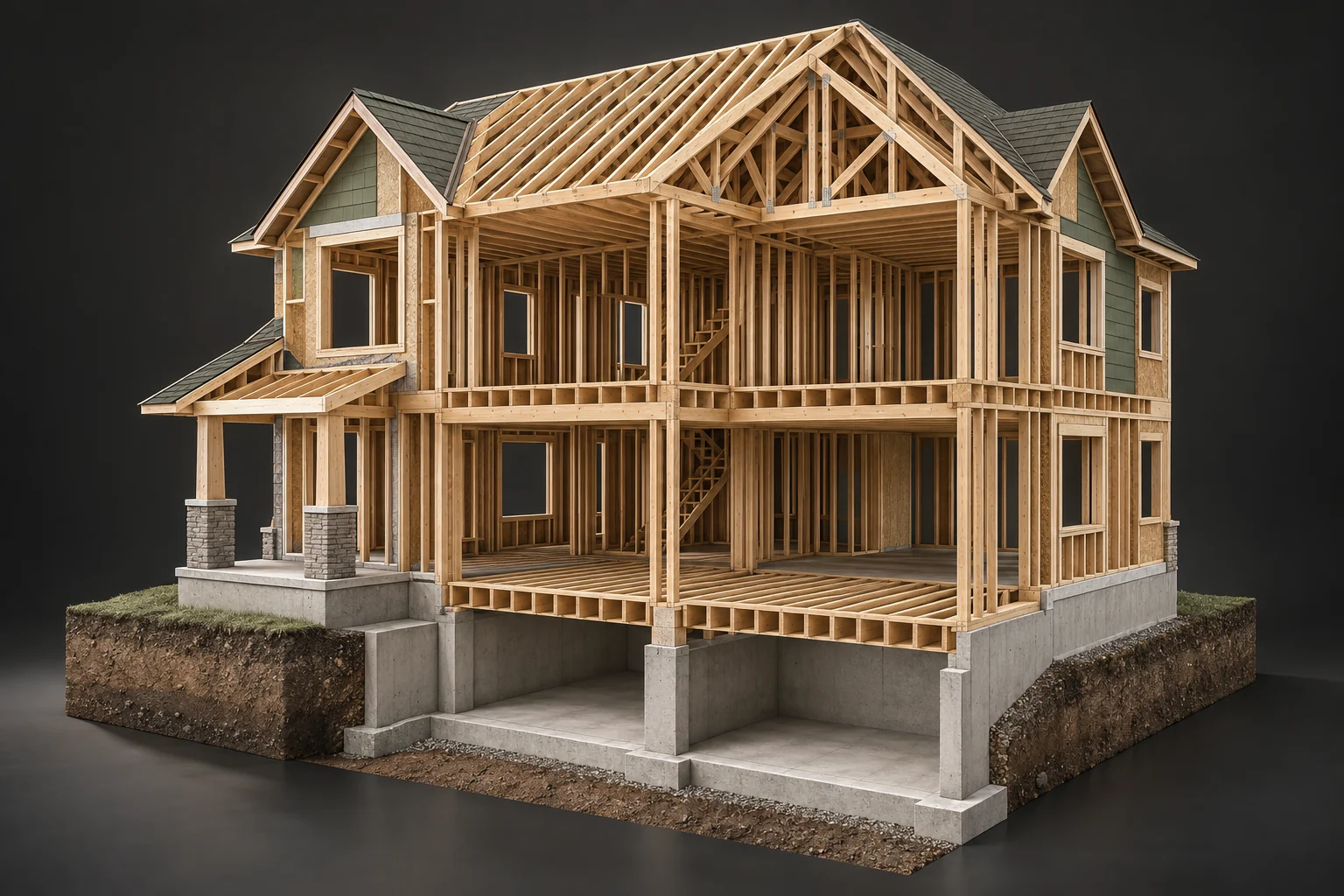
Conceptual architecture. Layout, sizes and routes are illustrative; the picture does not describe your home’s condition.
Explore this in the visual atlas ↗2 picture lessons appear beside the questions in this guide. Use them to understand the explanation, then consider what it means for your home.
Buy the unit and understand the shared system
A condo combines the unit, shared property, governance and financial obligations. Its appearance does not establish ownership or repair boundaries. Have your legal professional explain the relevant documents for the actual property.
Separate private-unit condition, shared-asset condition and the corporation’s management plan. Renovated finishes do not answer the reserve question. Your realtor coordinates records and access, reviewers interpret documents, and technical specialists assess defined systems. Clarify which work each engagement includes.
Building form changes the systems you share
The models show different physical arrangements, shared walls and a common-equipment example.
Numbers identify the parts explained below.
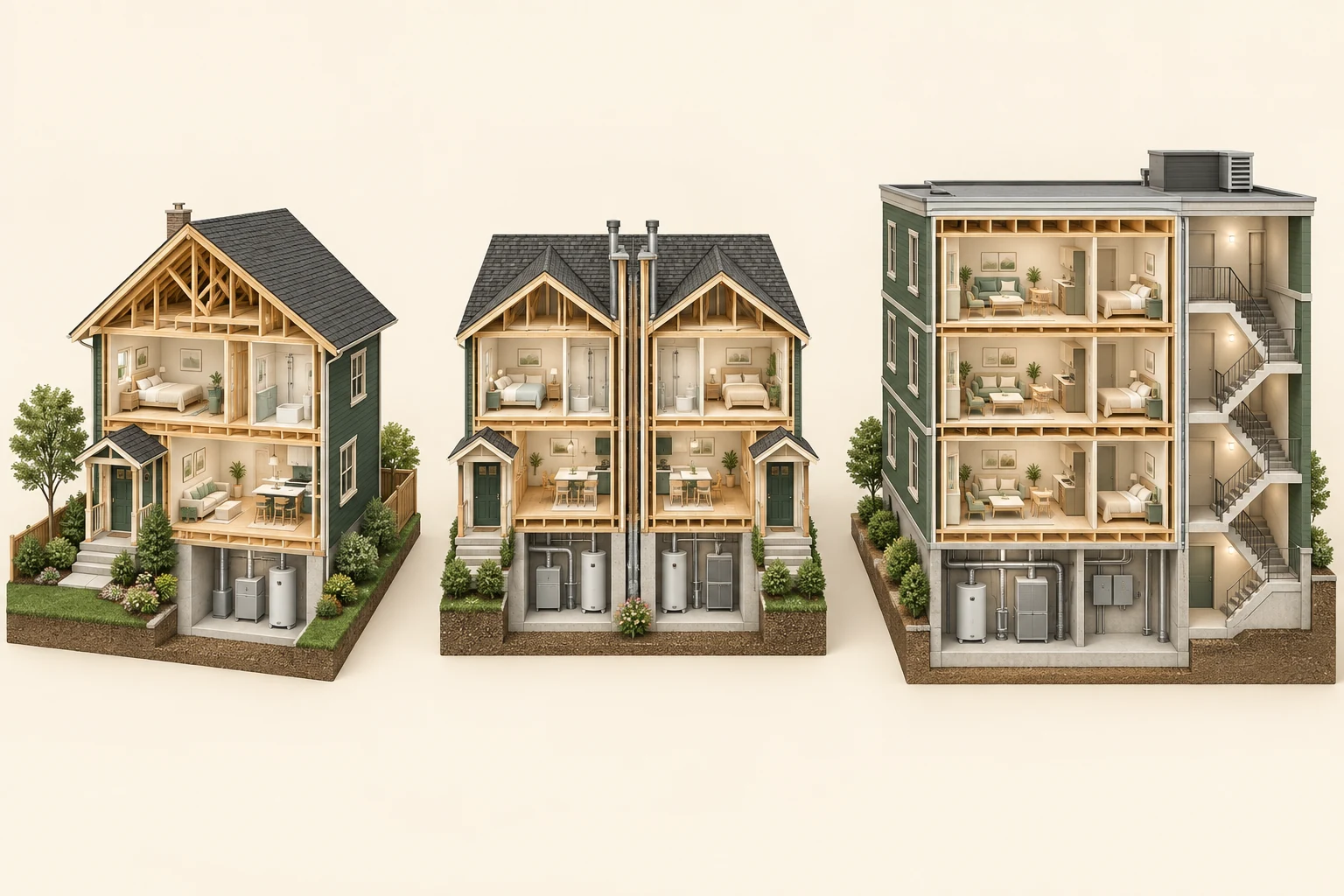
- Detached form
Confirm legal ownership and services; a detached home can still have shared obligations.
- Attached form
A shared wall does not by itself make a home a condominium.
- Stacked homes
Common equipment and access need building documents and actual inspection scope.
What does this illustration leave out?
A building shape does not establish tenure, common-property boundaries, fees, responsibility or insurance. This illustration explains an idea. It is not an installation guide.
Which systems and maintenance responsibilities are private, shared or governed by documents for this property?
Explore this with HomeAI ↗Opens an editable question. Nothing is sent until you choose to send it.Know what the reserve documents are for
Alberta’s current reserve-fund guidance describes funds for major common-property repairs and replacement, rather than routine maintenance. A third-party study assesses the property and estimates needs; the board’s approved plan sets out decisions for funding and work. Alberta states that a study must be completed at least every five years and should consider a thirty-year timeframe. These are Alberta-specific facts, not a rule for every Canadian condominium. Check current provincial guidance and the corporation’s circumstances.
Read the latest study, its assessment date and the approved plan together. Identify the assets considered, exclusions, timing, cost assumptions and recommendations. Ask whether significant changes occurred after the assessment. A report’s existence does not establish that all its recommendations have been adopted, funded or completed. A funding plan’s existence does not establish that the assumed costs and timing still fit the condition of the building. The important question is how the current documents relate to each other and to actual work.
Follow assets from condition to spending
Choose several major assets relevant to the building: roof assemblies, exterior walls, elevators, parking structures, piping or other shared systems. For each, trace the reported condition, anticipated work, proposed date, adopted decision and actual spending. Ask what evidence supports the scope. Was the estimate based on an assessment, a contractor proposal or a broad allowance? Is there an unresolved investigation that could change the work? Different evidence provides different confidence, even when every item appears in a neat table.
Pay attention to changed timing. A project moved later may reflect a justified revised assessment, an altered scope, funding constraints or an unresolved decision. Do not label every postponement as negligent or every extension of life as proof of good management. Ask for the reason, supporting professional opinion and any interim measures. A repeated symptom in meeting records may warrant a technical follow-up question. The reviewer should distinguish a documented concern from speculation about its cause or eventual cost.
Test the funding logic with a simple example
Suppose an illustrative building anticipates a $500,000 project in three years, has $200,000 available for it and plans $30,000 of additional annual contributions for three years. Ignoring income and all other spending, the arithmetic leaves a $210,000 gap. This does not calculate your assessment. It demonstrates why a bank balance alone cannot answer a funding question. Other projects, timing, financing, actual contributions and cost changes could materially alter the result.
Ask the reviewer to explain the real funding model instead of using a universal dollars-per-unit rule. Check which cash is available, which spending is committed, what assumptions govern future contributions and whether estimates remain current. Explore what changes if the project occurs sooner or has a different scope. Ask the appropriate professionals about the options and responsibilities. HomeAI can organize scenarios with clearly stated assumptions; it cannot determine an eventual levy, borrowing decision or the legal allocation among owners.
Read budgets and decisions alongside the forecast
Request the relevant current financial records, operating budget, reserve information, meeting records and notices through the appropriate process. Document entitlements and terminology vary by province, so consult current official guidance and your legal professional. Read operating pressures separately from major asset renewal. A low monthly contribution is a fact about the present charge, not evidence that future work is adequately funded. A higher charge can reflect many different services and decisions rather than a simple condition ranking.
Use meeting records to identify questions about projects, repeated failures, investigations, scope changes or financing. Ask for updates when a record says a decision is pending. Confirm whether a proposal became an adopted decision and whether a notice describes a past or future obligation. Do not rely on an informal remark that no assessment is coming. Ask what has actually been decided and what remains uncertain, then have the legal professional explain how known obligations affect the particular sale.
Make repair responsibilities explicit
For a component important to your plans, ask who owns it, who maintains it, who pays when it fails and what approval is needed to change it. The answers may not all be the same. Windows, balconies, heating equipment, parking and exterior penetrations are examples of items worth clarifying in the actual documents. Avoid a blanket statement that inside belongs to you and outside belongs to the corporation; it can omit distinctions that matter to a renovation or repair.
Ask about the interaction between a private project and shared systems. Installing charging equipment, changing ventilation or altering a window can involve technical capacity and governance permission. Obtain the required explanation before assigning value to the project. Read insurance questions with the relevant insurance professional and legal reviewer rather than assuming the corporation’s policy covers every private improvement or expense. The goal is a property-specific understanding of responsibilities, with the source documents preserved.
Send technical uncertainties to the right specialist
A document reviewer can identify a pattern in the records without establishing the physical condition of a concealed asset. If an engineering report, envelope investigation or large repair proposal raises a material question, ask a suitably qualified specialist to explain its scope and implications. Preserve the full report and its exclusions. A short meeting summary saying a consultant attended should not replace the consultant’s actual findings. Ask whether further access, tests or updated costing are required.
For sellers, gather the current record set and avoid presenting an older study as if it described all subsequent changes. For buyers, coordinate document delivery and review timing with your transaction professionals. Missing documents or unanswered questions affect the confidence of the assessment; they are not automatically proof of insolvency or a defect. Decide which gaps must be resolved and obtain advice before making a commitment. A portal can help you identify the gaps but cannot clear the corporation for purchase.
Compare buildings using transparent questions
Compare shared assets, condition evidence, upcoming work, funding assumptions and record completeness. More documentation can reveal more issues; little documentation should not earn a favourable result by default. Identify what would change your decision.
Use the provincial framework identified by CMHC and the relevant professionals. Keep your household budget in view without predicting fees, levies or resale outcomes. Preserve the document trail and unresolved technical questions.
Match common-system findings with the financial plan
A financial projection and a technical condition report answer different questions. Ask how the reserve plan uses the assessed condition, scope, quantities and timing for the actual common systems. A unit’s fresh finishes cannot establish the roof, enclosure, shared services or ventilation condition. Likewise, a large fund balance alone does not show whether the planned work and assumptions are adequate. Have qualified condominium and technical advisors review the relevant documents together.
Keep recommendations, proposed projects, approved work and completed work distinct. Ask what has changed since the study and whether the cost and timing assumptions have been updated. A budget line is not proof of completed remediation. CMHC’s provincial and territorial fact-sheet portal is a useful starting point for the different legal frameworks; use the current applicable authority and legal advice rather than importing one province’s reserve or document rules across Canada.
The facade and the funding request need a scope link.
A three-storey apartment-like building model with a white exterior face, window groups, balconies, an open side exposing furnished floor levels and edge layers, a separate exploded wall/window specimen supported on rods, three blank cards and a forest-green binder. The building specimen and blank cards contain no proposed work, price, funding resolution or inspected condition.
Numbers identify the parts explained below.
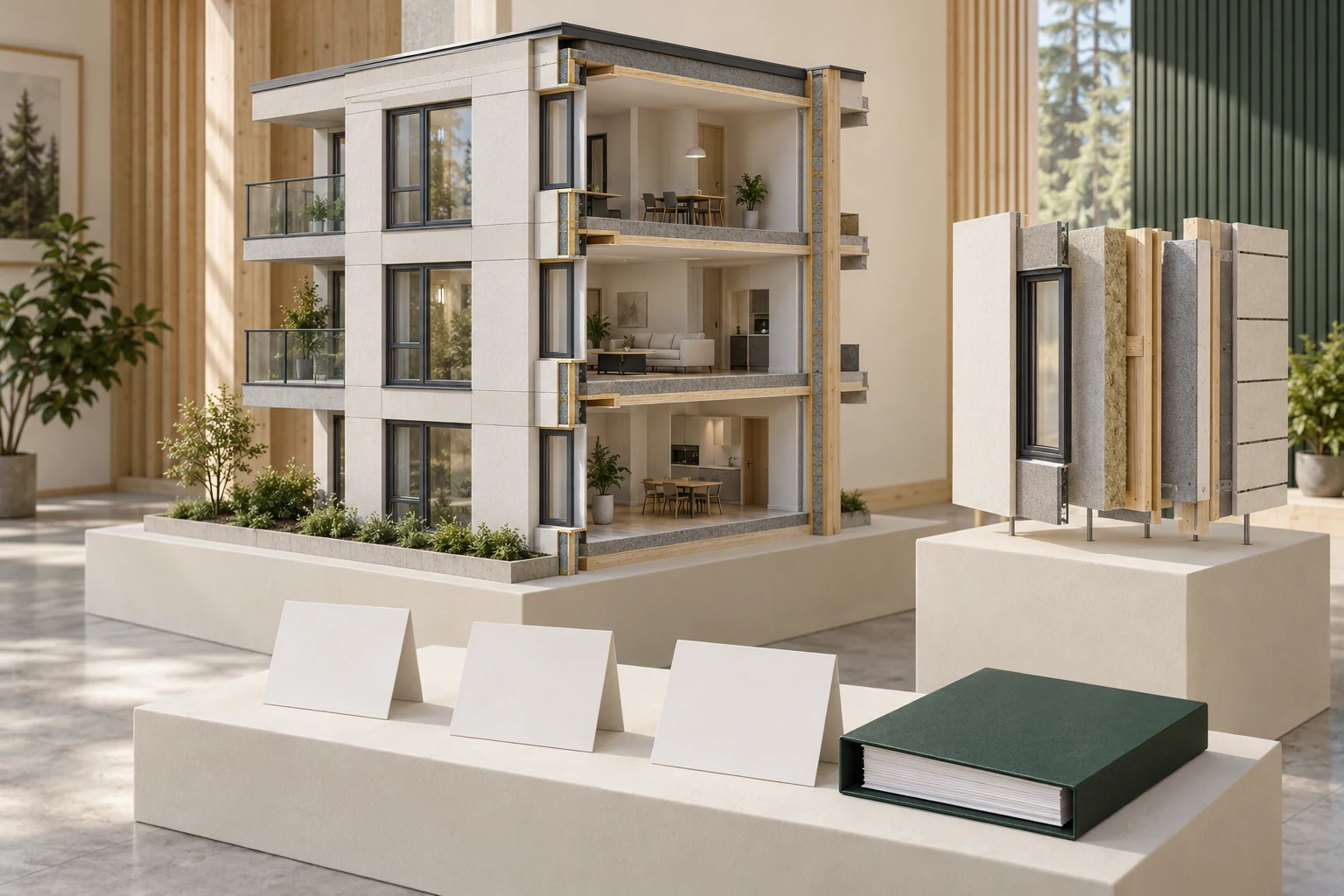
- Exterior face and window grouping
Spatial context only; no inspected condition, repair extent or phase is established.
- Separate layer specimen
Visible detached layers, with no identified material, approved order or installed detail.
- Blank comparison cards
Props for fictional record boundaries; no real scope or project status is readable.
What does this illustration leave out?
Built form does not establish condominium/strata tenure, unit/common/limited-common ownership, repair responsibility or document entitlement. The building and specimen have no actual inspection, defect, water entry, recommended repair, contract, phase, funding or completion status. Outer-face and infill material identities, layer ordering, flashing, anchorage, fire/acoustic separation, guardrail safety and approved assembly details are unestablished. The detached exploded specimen is conceptual and cannot prove construction at any depicted facade location or a suitable renewal design. Blank cards and binder are not real reports, executed drawings/contracts, approved resolutions, completion certificates or warranty records. No depicted geometry measures assessed/contracted/completed coverage or indicates a cleared/fully repaired building. This illustration explains an idea. It is not an installation guide.
Which actual project, records and funding decisions explain this assessment, and which work remains outside the request?
Explore this with HomeAI ↗Opens an editable question. Nothing is sent until you choose to send it.Ask how shared systems affect the unit’s intended use
Ventilation, heating, water and electrical arrangements can include both private and common elements. Ask which equipment serves the unit, who maintains it, what changes require permission and which assessment describes its performance. A unit-level service receipt may leave a common-system question open. Smoke or heat readiness may depend on shared operating choices that a buyer cannot change independently.
Provide your intended changes to the appropriate corporation, advisor and specialist. Permission, capacity and technical suitability are separate answers. Ask for the relevant written process and record the constraints without assuming that ownership of a unit grants authority over every connected system. HomeAI can organize the evidence and explain why the documents interact; it cannot certify the reserve plan, approve alterations or interpret the condominium agreement as your legal representative.
Keep learning about the connected parts
- Condo insurance: coordinate the unit, personal policy and deductible
- Apartment water systems: risers, central hot water and shared response
- Parkades and podium waterproofing: trace the assembly before judging the repair
- Buying a condo before completion: connect the future unit, contract and closing stages
Practice the distinction.
A funded item can still have an unresolved scope
Fictional condominium buyers receive a reserve plan identifying future envelope work and a later board update.
Reported observations
- The plan assumes a particular timing and cost.
- The update says further assessment is being considered.
Compare the explanations
Expand each possibility to see the evidence needed to distinguish it. Similar symptoms can have different mechanisms.
Financial planning evidence
The plan can be useful while depending on assumptions that have not all been confirmed.
Current plan, supporting reports, dates and assumptions.
Technical scope still developing
Additional findings could change the proposed work or its timing without proving a shortfall today.
The relevant assessment, board records and current jurisdiction-specific document process.
A useful next question
Have qualified advisors compare the current documents and explain unresolved scope, responsibilities and transaction implications.
A plan entry does not certify funding sufficiency, predict a special assessment or determine legal duties.
Know what the words mean.
- Reserve assumption
- A scope, cost, timing or service-life premise used in a financial plan.
- Common-system boundary
- The documented division of shared and individual infrastructure and responsibilities.
Questions to bring
to the conversation.
- What major work is approaching, and what evidence supports its timing and scope?
- Does the current funding plan align with the latest study and actual spending?
- Which decisions, assessments or unresolved investigations appear in recent records?
- Who will explain technical findings and legal responsibilities before the purchase decision?
Separate a showing observation, an existing record and a new professional assessment. Unknown means a question remains; it does not automatically mean a defect.
Use the evidence planner ↗Go to the source.
Original HomeAI explanation informed by these public references. Sources support the underlying guidance; they have not reviewed or endorsed HomeAI. Diagrams are conceptual, and calculator outputs depend on your inputs.
Publication & source review
First published .
- Government of Alberta · Condominium reserve funds
- Government of Alberta · Condominium information and document resources
- CMHC · Provincial condominium fact sheets
- CMHC · Provincial and territorial condominium fact sheets
- Health Canada · Guidance for cleaner air spaces during wildfire smoke events
- National Research Council Canada · Codes Canada frequently asked questions
Have a question about your home?
Start with the symptom, timing and what you have observed.
Ask HomeAI