- Identify the actual repaired stretch and distinguish it from the inspected stretch and remaining route.
- Work date, method, material, applicable approvals and method-specific completion evidence should describe the same job.
- Payment and current fixture drainage do not establish whole-route condition, cause, liability, insurance or transferable warranty coverage.
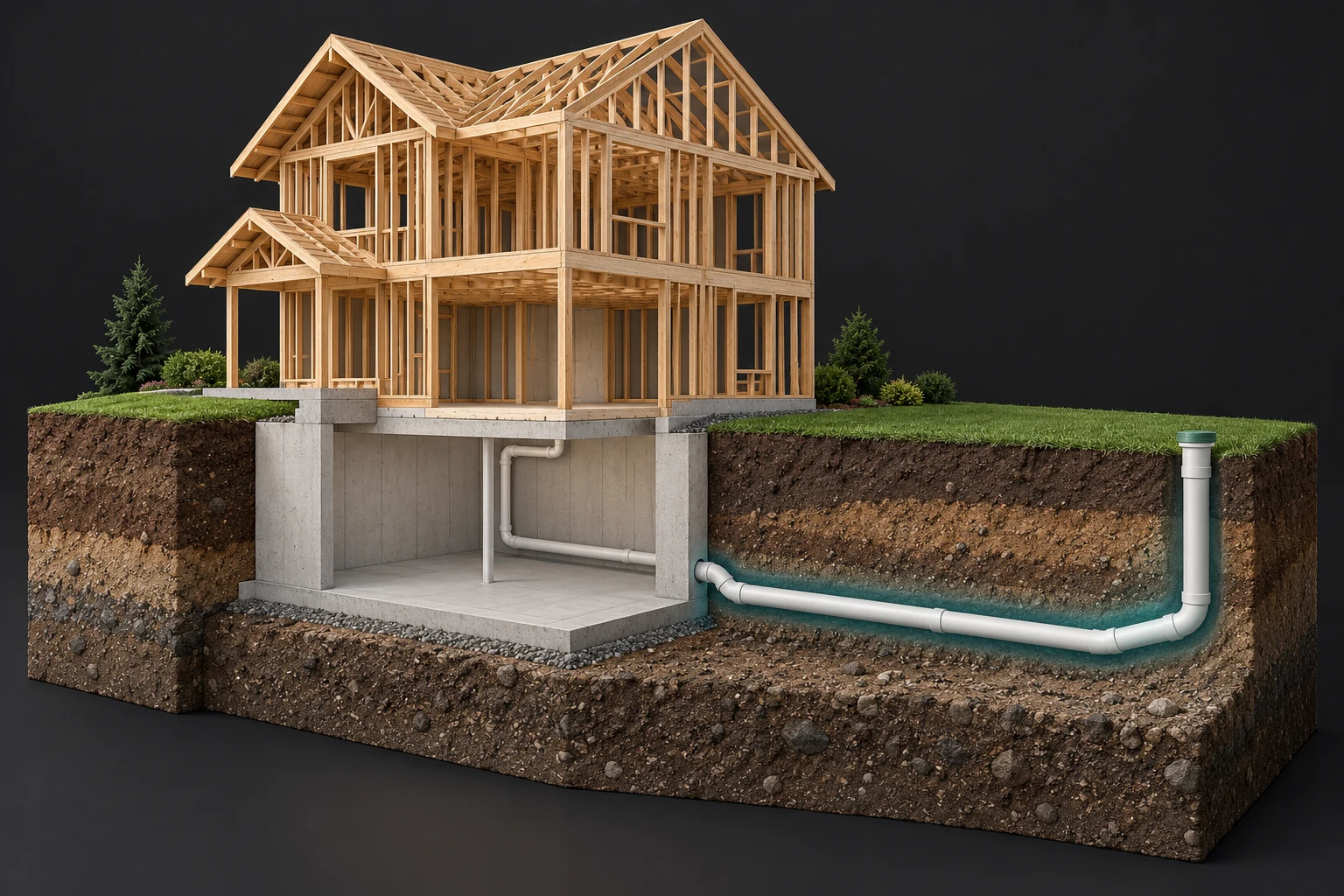
Conceptual architecture. Layout, sizes and routes are illustrative; the picture does not describe your home’s condition.
Explore this in the visual atlas ↗5 picture lessons appear beside the questions in this guide. Use them to understand the explanation, then consider what it means for your home.
What job does the phrase “sewer repaired” actually describe?
Start with the completed task, not the headline. A clearing visit, local pipe repair, liner installation and replacement of a specified stretch are different work histories. Ask the seller for the original service report, contract or accepted quotation, invoices and completion documents. Preserve the author’s wording if the method is unclear. Do not translate a receipt saying drain service into the entire private sewer replaced.
Build one short job description: property, work dates, contractor, reason recorded by the professional, actual method and named limits. A quotation describes a proposal; an invoice describes charged work; a professional completion report describes its stated assessment. Compare them for changes and request clarification from the author where possible. Payment adds a financial record, but does not establish what every concealed segment looks like now or determine why the original problem occurred.
Name the stretch covered by the reported work.
The soil block exposes the exterior of three coloured pipe stretches. Two dark band-like joints separate the middle stretch. The left mouth is open; the right stretch meets the far soil edge. A blank notebook and a separate cream-coloured hollow specimen sit on the plinth.
Numbers identify the parts explained below.
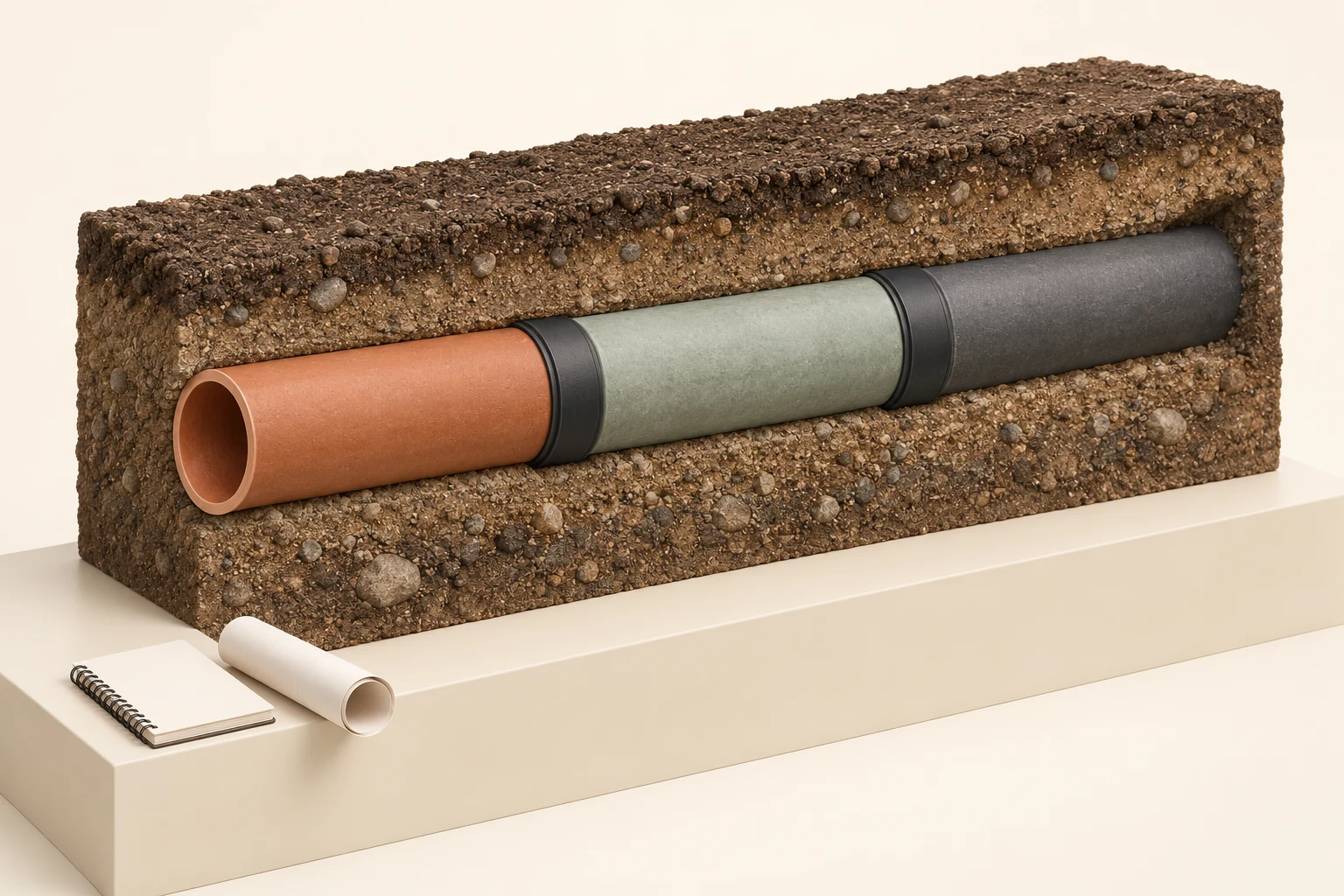
- Left band-like joint
A visible specimen boundary is not a located work endpoint or an ownership boundary.
- Right band-like joint
The second band helps name a limited stretch; actual location and work limits need records.
- Blank notebook
Read the actual author, date, method, work extent and limitations; the blank prop establishes none of them.
What does this illustration leave out?
Colours establish no material identity, product, age or repair method. The exterior view shows no longitudinal interior inspection, liner bond, watertightness, diameter, gradient, bedding adequacy, located endpoints or legal boundary. The model is not footage, an actual repair, an approval or a condition finding. This illustration explains an idea. It is not an installation guide.
Which located endpoints, work method and dated record define the repaired extent, and what lies outside it?
Explore this with HomeAI ↗Opens an editable question. Nothing is sent until you choose to send it.How can I join the repair location to the earlier camera run?
Ask the provider to identify the access point, direction and distance reference for each inspection and repair record. A counter reading measured from one cleanout is not interchangeable with a reading taken from another access in the opposite direction. A work sketch should make the connection between the observed concern, the repaired limits and the relevant property route understandable. Preserve any estimated or unconfirmed location as such.
For example, two fictional reports may both show a feature at eight metres but use different starting points. That number alone cannot establish the same joint or surface position. Have the qualified provider reconcile the references, including any locating or survey method and stated limitations. An illustration of a line under a lawn supplies no actual depth, easement or excavation location. Buyers should not dig or open a cleanout to settle a discrepancy themselves.
A specimen boundary is different from a located endpoint.
The soil block exposes the exterior of three coloured pipe stretches. Two dark band-like joints separate the middle stretch. The left mouth is open; the right stretch meets the far soil edge. A blank notebook and a separate cream-coloured hollow specimen sit on the plinth.
Numbers identify the parts explained below.
- Open left mouth
A small visible opening does not establish a complete interior inspection or the upstream route.
- Right exterior stretch
The route meeting soil is a conceptual remainder; the actual downstream endpoint and condition remain unknown.
- Blank notebook
Read the actual author, date, method, work extent and limitations; the blank prop establishes none of them.
What does this illustration leave out?
Colours establish no material identity, product, age or repair method. The exterior view shows no longitudinal interior inspection, liner bond, watertightness, diameter, gradient, bedding adequacy, located endpoints or legal boundary. The model is not footage, an actual repair, an approval or a condition finding. This illustration explains an idea. It is not an installation guide.
How are the original camera references and the final repaired locations reconciled by the actual records?
Explore this with HomeAI ↗Opens an editable question. Nothing is sent until you choose to send it.What changed if the job was cleaning rather than pipe repair?
Cleaning can remove a restriction and produce a different visible interior afterward. Ask which deposits or roots were reported, whether a pre-work view was possible, what extent was cleaned and what the subsequent report could evaluate. The relevant result may be restored passage with a remaining joint or wall concern. Keep that distinction when describing the service to the next owner.
A paid clearing invoice and a freely draining fixture do not demonstrate that every fault was repaired or every downstream stretch was inspected. If the documentation does not identify the cause, do not invent one from the cleaning equipment named on the receipt. Ask a qualified specialist whether the available records answer the purchase question or whether a defined follow-up is needed. Recurrent blockage history belongs with the dates and locations, rather than a promise that routine cleaning permanently prevents recurrence.
Roots and a joint: a possible mechanism
The enlarged specimen depicts fine roots at an illustrative joint opening. It is separate from the main scene and not to scale.
Numbers identify the parts explained below.
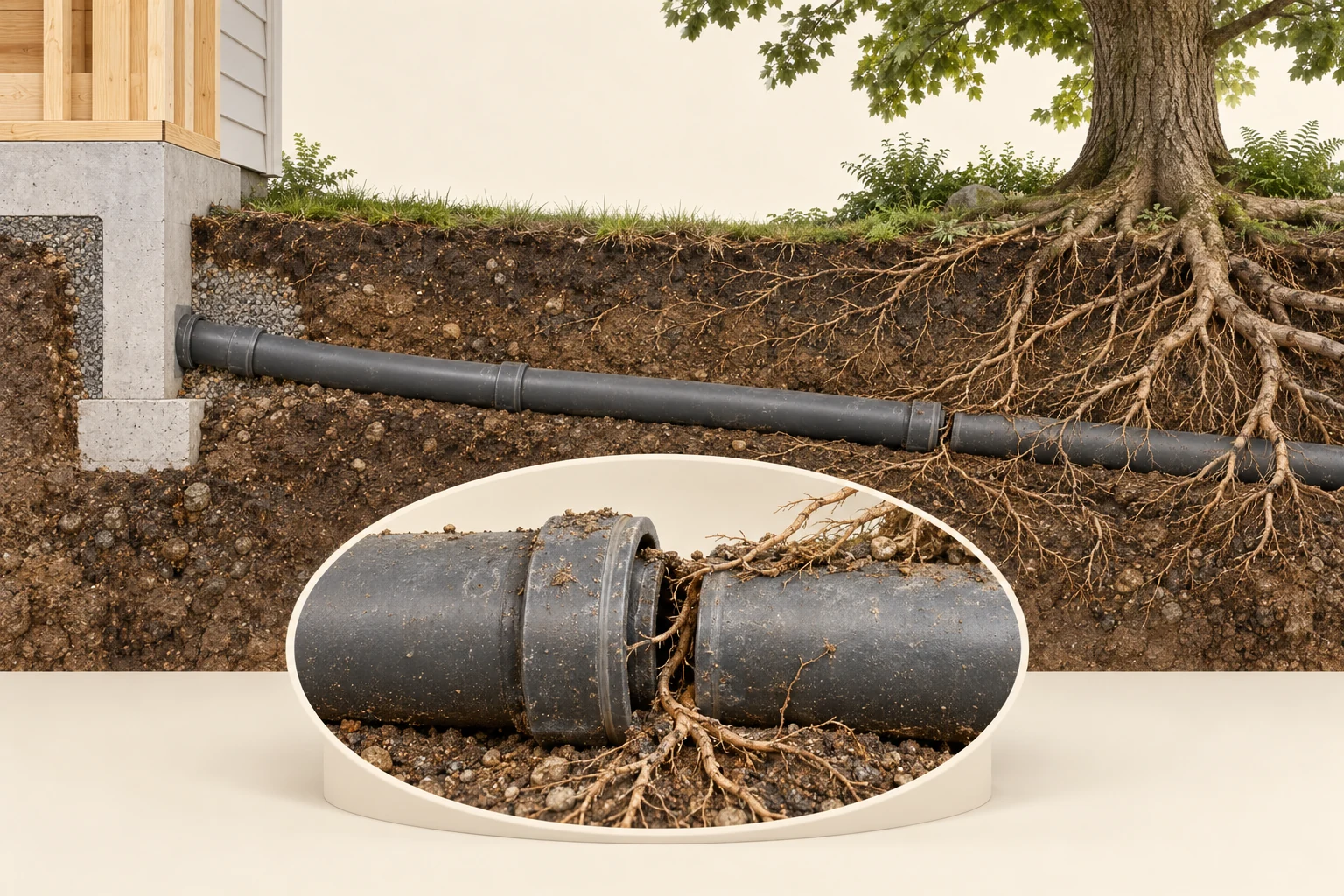
- Tree and soil
Tree proximity is context, not evidence of a blocked or damaged sewer.
- Buried route
Locate the actual private/public segments before applying a neighbourhood record.
- Joint specimen
A depicted entry opportunity does not show which event happened first or what repair is needed.
What does this illustration leave out?
Material, joint condition, root presence, support, grade and responsibility at a real property need their own evidence. This illustration explains an idea. It is not an installation guide.
What does a sewer recording actually show about roots and joints, and what remains unknown about cause, support and repair?
Explore this with HomeAI ↗Opens an editable question. Nothing is sent until you choose to send it.Which records matter for a liner, local repair or replacement?
Method determines what should be clarified. For a local excavated repair, ask what length and junctions were replaced, what materials were joined and which installation/completion records apply. For a liner, ask the responsible professional for its actual limits, identified system and the completion evidence appropriate to that installation. A replacement through a longer route should identify the new extent and any retained connections or pipe. A job can combine methods.
Toronto’s February 25, 2024 municipal CIPP specification separates stages of CCTV from material, cure and sample-test records. It excludes sewer services, private-property work and work under the Ontario Building Code. Its distinctions help frame questions; its engineering acceptance criteria are not a private-home checklist. Ask the actual contractor and authority what requirements governed this particular repair and what results were supplied, without importing municipal quantities or deadlines.
Does post-work footage cover the work that was promised?
Read the final recording with its report, date, access and endpoint. Compare the repair’s limits with the footage’s visible limits. Were both repair interfaces examined? Was there water or another visibility restriction? Did later corrective work occur after this recording? A video made after cleaning but before lining cannot become proof of the completed liner. If another report was issued, retain the sequence and the original findings.
Ask the professional to explain the method’s conclusion: visible interior assessment, identified measurement, leak-related test or another defined check. Each answers a different question. For the named municipal Toronto programme, completed CCTV, sample testing and deficiency resolution are separately documented. Private work needs its own applicable completion scope. A visually clear interior does not independently establish external support, every hidden connection or an untested property of the repair material.
The camera sees an inspected stretch
The crawler and illuminated pipe interior illustrate what a camera can view within the accessible stretch. This is an illustration, not footage of an inspected home.
Numbers identify the parts explained below.
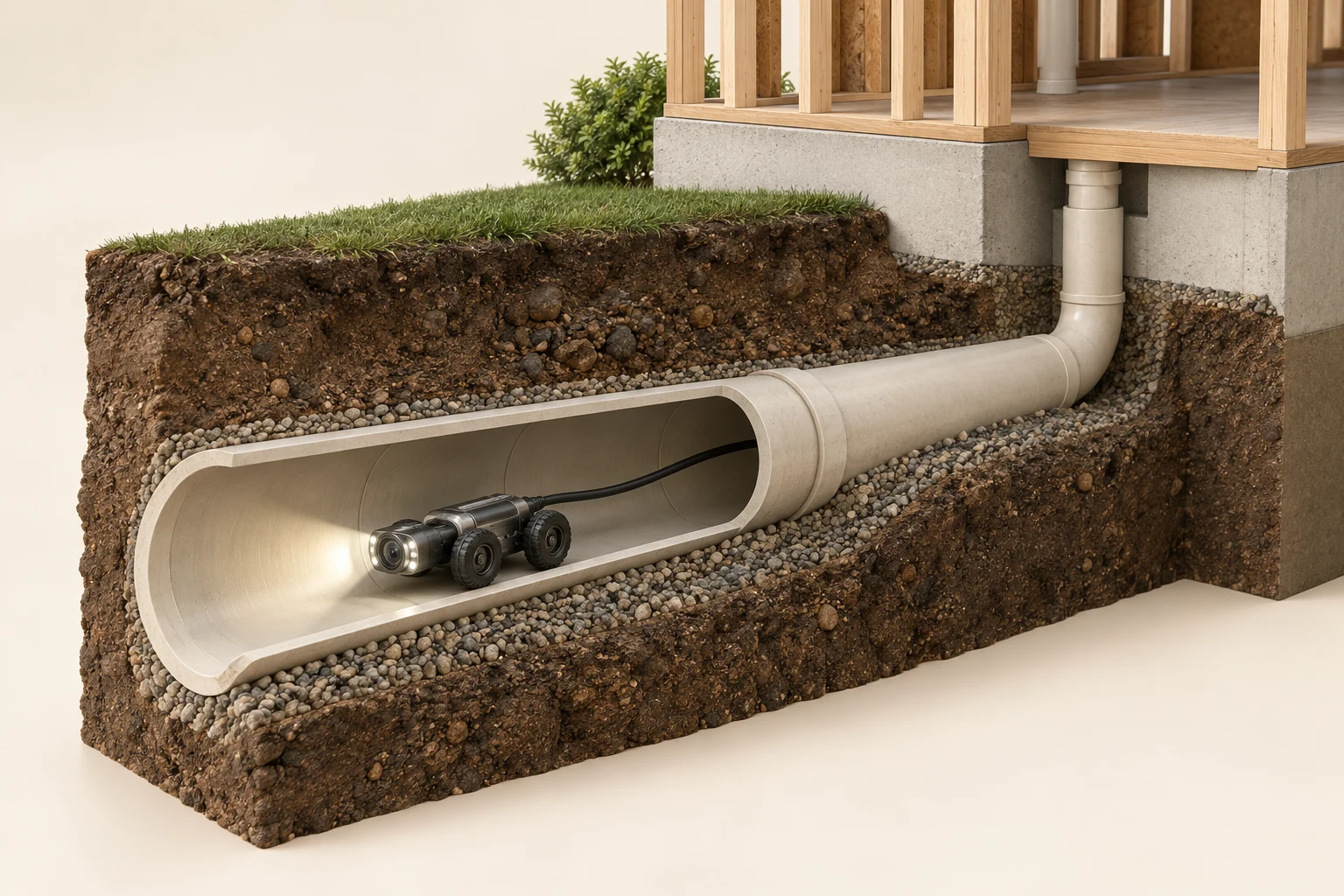
- Camera and light
A recording needs a defined start, direction, endpoint and visibility limits. A camera picture alone does not establish inspected reach.
- Visible interior
An interior observation can prompt a question; the exterior soil and hidden connections are outside this view.
- Continuing route
The pipe beyond the recorded endpoint remains uninspected. A distance counter is not a survey or a legal boundary.
What does this illustration leave out?
The complete route, uninspected remainder, actual material, leaks, external support, measured grade, surface location and ownership require separate records or assessment. This illustration explains an idea. It is not an installation guide.
Which stretch does the sewer recording actually cover, and what evidence is still needed for the unseen route, location or support?
Explore this with HomeAI ↗Opens an editable question. Nothing is sent until you choose to send it.Completion evidence must match the promised work.
The soil block exposes the exterior of three coloured pipe stretches. Two dark band-like joints separate the middle stretch. The left mouth is open; the right stretch meets the far soil edge. A blank notebook and a separate cream-coloured hollow specimen sit on the plinth.
Numbers identify the parts explained below.
- Middle coloured stretch
Colour is a specimen distinction, not a pipe material, lining method or successful repair result.
- Right exterior stretch
The route meeting soil is a conceptual remainder; the actual downstream endpoint and condition remain unknown.
- Blank notebook
Read the actual author, date, method, work extent and limitations; the blank prop establishes none of them.
What does this illustration leave out?
Colours establish no material identity, product, age or repair method. The exterior view shows no longitudinal interior inspection, liner bond, watertightness, diameter, gradient, bedding adequacy, located endpoints or legal boundary. The model is not footage, an actual repair, an approval or a condition finding. This illustration explains an idea. It is not an installation guide.
Which method-specific completion check covers the actual repair, and which remaining stretches were not inspected?
Explore this with HomeAI ↗Opens an editable question. Nothing is sent until you choose to send it.Which local approval and status belong to this exact repair?
Confirm the authority and how it classifies the actual work. Calgary’s published plumbing guidance distinguishes constructing, extending or altering plumbing and replacing water/sewer lines from listed leak-repair and blockage-removal exceptions. That distinction is a local example, not a Canadian permit exemption for anything called repair. Calgary also describes a separate City-infrastructure connection process. Ask which records apply to the actual location, method and date.
Toronto’s stand-alone drain process requests site or key-plan documentation, and its inspection guidance identifies final inspection and permit closure. Obtain property-specific permit numbers, results and any outstanding conditions through the authorised process. A permit issued for proposed work, an appointment booked and a completed inspection have different meanings. Neither a missing copied document nor a closed local record resolves the whole pipe’s present condition; ask the authority to clarify status rather than guessing.
What about branch connections, access and the restored yard?
The main repaired stretch is only one part of the job description. Ask whether any live branch, shared connection, cleanout or transition was affected and how its completed state was documented. Where lining is involved, clarify whether a connection needed reinstatement and what confirms it. Toronto’s municipal specification tracks service-connection records separately; the actual private installation has its own configuration and requirements. A running sink cannot establish every branch’s status.
Surface reinstatement is another scope: driveway, lawn, landscaping, internal finishes and safe future access may have separate completion dates. Ask what was restored, what remains temporary and whether settling or drainage questions require follow-up. An attractive new lawn does not document the buried repair, while a buried-work report may say nothing about restored grading. Keep the responsible contact and actual agreement for each open item instead of treating a single invoice as completion of every dependent task.
Does a camera location also authorise ground disturbance?
No. A sewer-location record supports its stated technical question; it does not identify every nearby utility or provide every permission for further work. Utility Safety Partners explains that private/customer-owned buried facilities may require separate locating arrangements, that locate documents have an expiry, and that its notification centre does not issue excavation permits or crossing agreements. Those are Alberta process distinctions, with the relevant local service and authority needed elsewhere.
If the repair records reveal an unresolved route or further work is proposed, have qualified providers define the locating, access, permissions and safety requirements. Shared services and easements should be clarified through the appropriate property and legal records. Do not infer the ownership boundary from a generic picture or the contractor’s distance counter. A buyer can request a clearer brief and authorised documents without attempting excavation, chamber entry or powered clearing.
What if the repaired part is clear but the rest is uninspected?
Keep three extents visible in your notes: the repair, the inspection coverage and the relevant remaining route. They can overlap without matching. A post-work inspection that stops beyond a local repair can provide evidence about that repair while leaving the connection farther away unanswered. That is a bounded information gap, neither a passed remainder nor proof of another defect.
Ask which remaining question could materially change your plans and which assessment can answer it. Do not automatically order every possible test; the specialist should explain suitable methods, access and limitations. Keep new findings linked to the completed job without assuming they show the same cause. Technical condition, cost allocation, contractual remedies, insurance and warranty transfer are separate decisions requiring the responsible professionals, actual agreements and provider terms.
How would a buyer read a fictional partial-repair file?
Explicitly fictional example: a seller supplies an invoice for a local pipe replacement between two identified points. An earlier camera report starts at a garage cleanout; the final recording starts inside the house and ends before the public connection. A copied approval refers to proposed work, while the closure or final inspection result is not supplied. The repair may be real and useful; the assembled file has unresolved reference and status questions.
The buyer asks the provider to reconcile the two camera origins with the repaired limits, requests the relevant local completion status through authorised channels, and commissions only the follow-up needed for the uninspected route. Their transaction advisers address timing and reliance. The final handover retains the untouched stretch and any unresolved coverage terms. Nothing in this invented case establishes roots, a neighbourhood risk rate, fault, insurer payment or a reason to approve or reject the purchase.
More records can narrow the question; they do not remove every limit.
Explore three separate invented files. They are not a chronology of your home, a score or a recommendation to order every test.
No case establishes warranty coverage, repair liability, local acceptance or the condition of the entire route. Match the next question to the actual decision and the provider’s scope.
Read what a camera scope covers ↗Practice the distinction.
One repair, two camera origins and an open status question
Explicitly fictional buyer, contractor and documents: a local replacement is reported, recordings use different starting points, and the supplied approval describes proposed work.
Reported observations
- The invoice identifies only a local replaced stretch.
- The pre-work and final recording origins differ.
- The final recording does not reach the public connection.
- The applicable completed inspection/closure status has not been supplied.
Compare the explanations
Expand each possibility to see the evidence needed to distinguish it. Similar symptoms can have different mechanisms.
A completed local repair with incomplete handover records
The work and its useful evidence may be real while references or final documents need clarification.
Provider reconciliation and the applicable authority’s property-specific status.
A consequential question remains beyond the repair
The relevant remaining route is uninspected, without a defect established.
A qualified, authorised follow-up scope for that remaining question.
A useful next question
Join the repair limits, method, chronology and local completion status, then retain the remainder as an explicit gap.
No cause, private/public liability, coverage promise, root-risk diagnosis or transaction recommendation is represented.
Know what the words mean.
- Repair extent
- The specifically identified stretch or components addressed by a completed job, with start/end limits.
- Distance reference
- The origin and direction used for a reported distance along the pipe; different references require reconciliation.
- Cured-in-place pipe (CIPP)
- A lining method using an installed material cured in an existing pipe; the applicable design and completion requirements are project-specific.
- Service reinstatement
- Restoring an affected connection to its intended service after work, with method-specific confirmation.
- Completion evidence
- Records addressing what was installed or repaired and how the promised result was checked; distinguish them from proposal and payment records.
- Uninspected remainder
- Relevant route outside the actual reported assessment, with neither a passed condition nor a defect established.
Questions to bring
to the conversation.
- Do the address, work dates, contractor and original documents identify the same repair?
- Where are the repair’s start/end limits, and how do their reference points relate to the inspection and property route?
- Was the work cleaning, a local repair, lining, replacement or a combination, and what was left in place?
- Which local permits, connection permissions, inspections and outstanding conditions apply to this exact work?
- What completed-work report, recording, test or installation evidence addresses the method and named extent?
- Were relevant branches/connections and surface reinstatement included, excluded or separately verified?
- Which remaining extent, recurrence question, coverage term or responsibility still needs qualified clarification?
Separate a showing observation, an existing record and a new professional assessment. Unknown means a question remains; it does not automatically mean a defect.
Use the evidence planner ↗Go to the source.
Original HomeAI explanation informed by these public references. Sources support the underlying guidance; they have not reviewed or endorsed HomeAI. Diagrams are conceptual, and calculator outputs depend on your inputs.
Publication & source review
First published .
Sources reviewed .
- City of Calgary · Homeowner electrical and plumbing permits
Where this reference applies
Jurisdiction: Calgary, Alberta; named local plumbing process
The page distinguishes constructing/extending/altering plumbing and replacing water/sewer lines from listed leak-repair/blockage-removal exceptions. Confirm classification and applicable approvals for the actual work with the authority; no national permit exemption or homeowner repair procedure.
- City of Calgary · Installing water and sewer connections
Where this reference applies
Jurisdiction: Calgary, Alberta; private servicing and City infrastructure connection context
Private service responsibilities, City-infrastructure connection inspection and approved indemnified-contractor context. This guidance does not adjudicate a particular repair, cause, easement, cost allocation or liability.
- City of Toronto · Stand-alone plumbing and drain permits
Where this reference applies
Jurisdiction: Toronto, Ontario; local stand-alone permit documentation
Publisher publication date: 2017-11-17
Publisher modification date: 2026-08-18
Site/key plan and plumbing documentation for this local process; buried piping repair/replacement appears in its categories. Fees, design qualifications and local requirements are not applied to another municipality or used to decide a specific past-work status.
- City of Toronto · Building inspections
Where this reference applies
Jurisdiction: Toronto, Ontario; municipal permit-inspection process
Publisher publication date: 2017-11-17
Publisher modification date: 2026-09-09
Final inspection and permit closure are explicit local process steps; permit/inspection status must be tied to the actual property and permit. No closed record is expanded into a present whole-sewer condition guarantee.
- City of Toronto · TS 4.10: CIPP lining of sewers and culverts
Where this reference applies
Jurisdiction: Toronto municipal sewer/culvert engineering contract specification; excludes sewer services, private-property and Ontario Building Code sewer work
Edition: TS 4.10; February 25, 2024; 51 PDF pages including appendices; bounded sections read
Illustrates separate preliminary/prepared/completed CCTV, material/cure and sample-test records, service reconnection and deficiency resolution. Municipal contractual quantities, deadlines, acceptance limits and warranty requirements are not private residential requirements.
- Utility Safety Partners · Locate questions and permissions
Where this reference applies
Jurisdiction: Alberta; buried-utility safety notification and locating context
Private/customer-owned facilities may require separate locating arrangements; locate documents have an expiry; the notification centre does not issue excavation permits or crossing agreements. No locator procedure, universal responsibility boundary or permission to excavate.
Have a question about your home?
Start with the symptom, timing and what you have observed.
Ask HomeAI