- Plan around household functions and their dependencies, rather than assuming each labelled appliance works.
- Separate a verified backup arrangement from safe water, communications, access and relocation contingencies.
- Keep model-specific instructions and local emergency directions available offline; a checklist cannot clear a hazard.
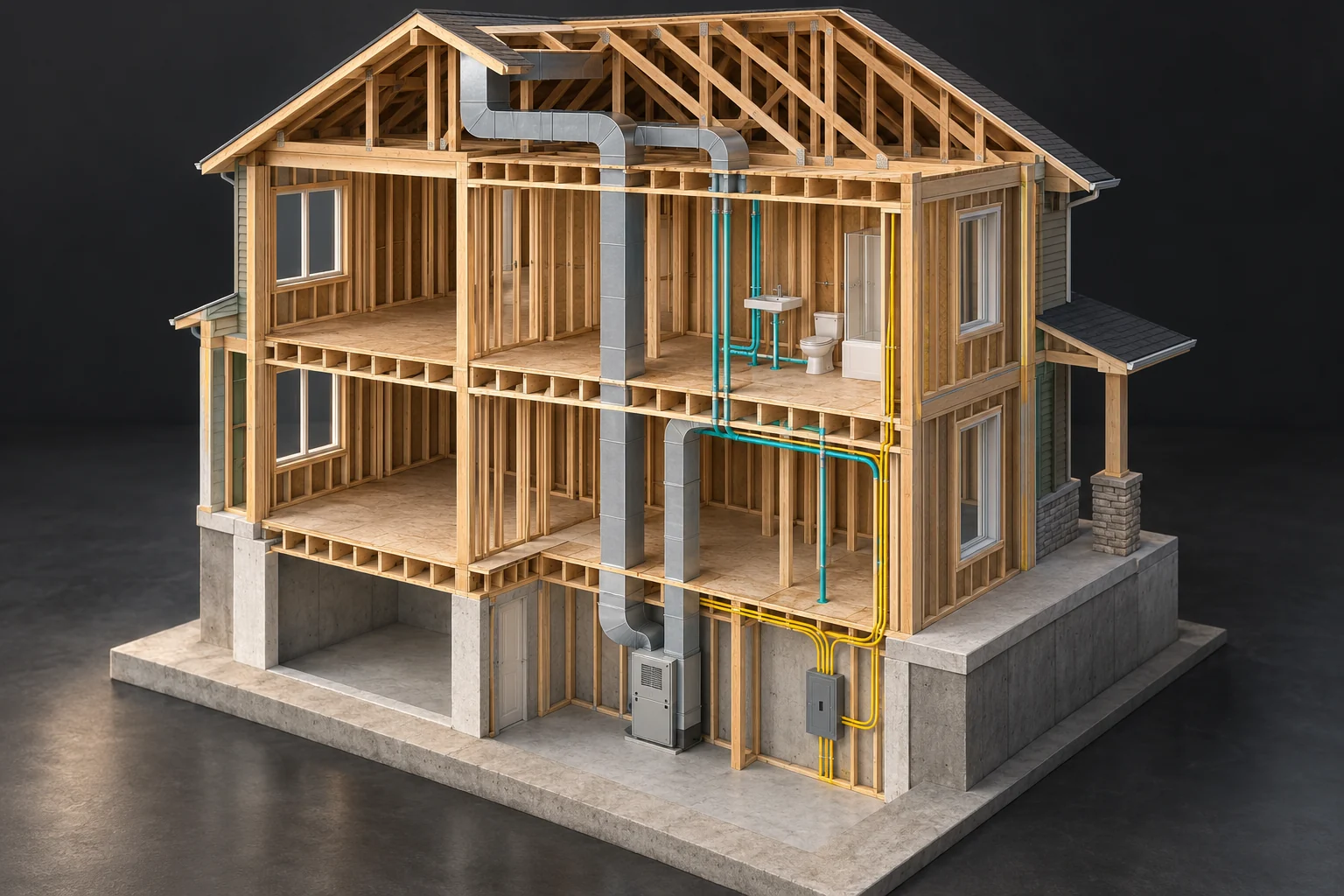
Conceptual architecture. Layout, sizes and routes are illustrative; the picture does not describe your home’s condition.
Explore this in the visual atlas ↗3 picture lessons appear beside the questions in this guide. Use them to understand the explanation, then consider what it means for your home.
Which household functions should the plan protect?
Start with the result the household needs: safe shelter, drinking water, essential treatment, communication and a way to leave. Then name the equipment and external service behind each function. This avoids a common mistake: writing refrigerator, furnace and router on a list and treating their presence as proof of continuity. A function can depend on several components, permissions or services.
Create one row per function with its equipment identity, power dependency, confirmed backup scope, alternative and contact. Use three clear evidence states: reported by someone, established by a named record or assessment, and still unknown. A directory label or builder brochure belongs in the first category until its actual scope is confirmed. Keep the record accessible without the very internet service it describes.
Public Safety Canada recommends a household emergency plan alongside equipment preparation. Here the useful deliverable is a dependency map and an agreed contingency, rather than a numerical readiness score. A buyer or new-home owner can begin that map during handover, while the responsible providers explain equipment and local services.
A power interruption can affect several home functions.
Visible routes locate different system functions. Closed equipment keeps this a planning illustration.
Numbers identify the parts explained below.
- Routes
Trace the question using records; colour is only this illustration’s key.
- Closed equipment
A professional defines access and measurements. Do not open a panel for this lesson.
- Room endpoint
A symptom at one room does not locate the fault.
What does this illustration leave out?
Capacity, continuity, hidden condition, electrical safety and actual delivered performance are not established. This illustration explains an idea. It is not an installation guide.
Which actual heating, water, communications and access functions depend on electricity, and what plan covers each?
Explore this with HomeAI ↗Opens an editable question. Nothing is sent until you choose to send it.Why can a fuel-heated house still lose heat?
A heat source and heat delivery are different jobs. A gas furnace may depend on electrical controls and a circulating blower. A hydronic arrangement may require pumps and controls. An electric heat pump needs its actual electrical supply and operating arrangement. Identify this home's system with the heating provider; the fuel type alone cannot answer which function survives a power failure.
The enclosure also matters: stored warmth is gradually lost while heating is unavailable, and the rate depends on the actual building and weather. A well-insulated home cannot be assigned a safe indoor duration from its appearance. Record the household's needs and obtain an appropriate cold- or hot-weather contingency before an event, without adopting a universal temperature or hour threshold from a fictional example.
Ask the provider to explain the installed equipment's approved outage and recovery instructions, including any verified backup. Do not bypass safety controls, improvise a heat source or use a stove or barbecue for space heating. A fireplace's appearance does not establish its permitted operation, venting condition or electrical independence. If the home becomes unsafe, follow emergency directions and use the relocation plan.
What changes when water or wastewater equipment loses power?
First identify municipal supply, a private well or a shared arrangement. A private well commonly uses an electric pump; wastewater or basement drainage may have separate electrically driven equipment. List these separately, including treatment and alarms, then have the relevant plumber, well contractor or installer explain the actual outage limitations. Pumping water and establishing that it is safe to drink are different tasks.
Health Canada's private-well guidance warns that using stored water during an outage can depressurize that system and increase contamination risk. It advises avoiding faucets, showers and flushing in that context, and testing before use after complete pressure loss or loss of flow. These are private-well precautions, rather than a rule silently applied to every municipal household. Obtain local drinking-water advice and prepare a safe alternative supply.
A working sump backup does not establish an unrestricted discharge or functioning sewer protection. Keep the separate pump-and-backwater readiness record attached. Never enter wet electrical areas to reach a pump or shutoff. Following flood contact, well and electrical equipment require the appropriate qualified assessment; clear-looking water and restored electricity do not certify safe reuse.
Water and wastewater have their own power dependencies.
The scene distinguishes a water source from a wastewater route and its land context.
Numbers identify the parts explained below.
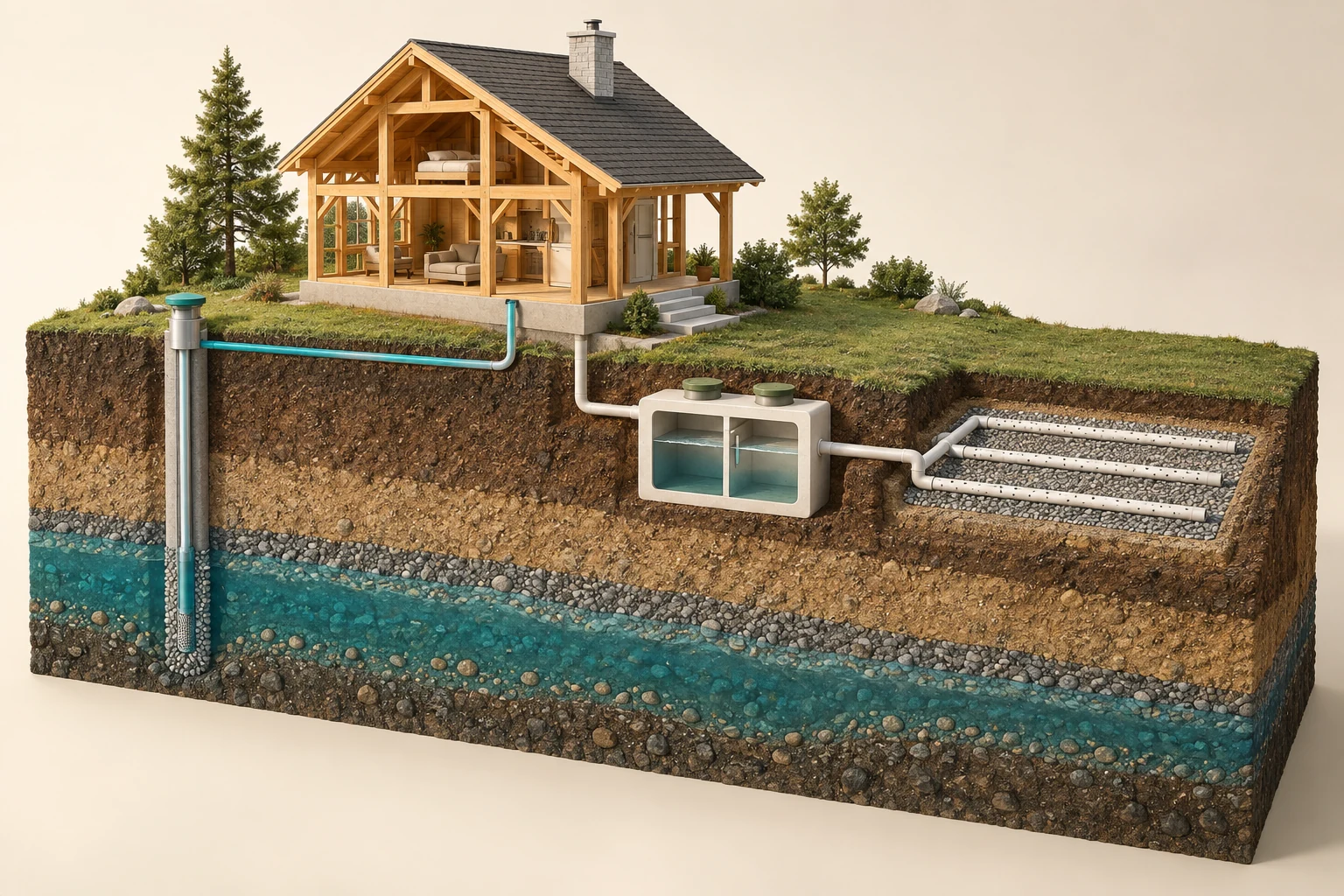
- Water source
Identify the actual source and sampling scope.
- Wastewater route
Records and an appropriate assessment establish the installed system.
- Land context
A visible layout is not a permitted location or an isolation-distance design.
What does this illustration leave out?
Actual locations, isolation, capacity, setbacks, groundwater and sample results are not supplied. This illustration explains an idea. It is not an installation guide.
Which pumps, treatment or alarms depend on power, and what actual operating instructions apply during an interruption?
Explore this with HomeAI ↗Opens an editable question. Nothing is sent until you choose to send it.How will you communicate if the router still has power?
Separate local equipment from the external network. A powered modem or router establishes neither internet service nor the availability of a particular phone, monitoring service or emergency call route. Ask the service provider what the household's actual arrangement needs, including any supplied backup and its limits. Keep the answer model- and account-specific; another home's demonstration does not verify yours.
Public Safety Canada advises planning information sources and keeping a battery-powered or crank radio available if internet service is down. Put utility reporting contacts, local alert channels, household contacts and meeting arrangements on an offline page. Consider who needs help receiving or understanding alerts, and who can check in when the usual channel fails.
Practise finding the page and discussing the agreed check-in without interrupting utility service or calling emergency numbers as a test. A power bank can support an identified device under its instructions, but a displayed charge percentage is no guarantee of network access or a particular duration. Update contact changes so a polished printed plan does not retain an obsolete route.
What backup evidence belongs beside the household plan?
Keep equipment identity, model-matched instructions, protected-load schedule, commissioning findings and operating exclusions together. A verified selected circuit answers an electrical question; it does not establish every appliance dependency, water-quality outcome or outside service. The backup-battery companion owns the deeper distinction between power, energy, starting demand and duration assumptions.
The Powerwall 3 owner manual illustrates this boundary: partial-backup loads are selected during design and other loads excluded at installation. That named-product explanation does not identify your protected equipment or authorize operating another product. Ask the installed system's provider which arrangement was completed and what findings support it, rather than converting a generic whole-home picture into an as-built record.
BC Hydro also distinguishes configured backup from ordinary self-generation shutdown, and warns that storage can deplete or lack solar recharge during an outage. Keep an alternative when the backup is unavailable. Do not disconnect grid supply, overload equipment, open cabinets or exercise transfer devices to prove the list yourself. Any authorized verification needs its professional scope and safe conditions.
A closed cabinet does not state backup coverage.
Visible routes locate different system functions. Closed equipment keeps this a planning illustration.
Numbers identify the parts explained below.
- Routes
Trace the question using records; colour is only this illustration’s key.
- Closed equipment
A professional defines access and measurements. Do not open a panel for this lesson.
- Room endpoint
A symptom at one room does not locate the fault.
What does this illustration leave out?
Capacity, continuity, hidden condition, electrical safety and actual delivered performance are not established. This illustration explains an idea. It is not an installation guide.
Which functions are documented as supplied by the installed backup arrangement, and which remain outside it?
Explore this with HomeAI ↗Opens an editable question. Nothing is sent until you choose to send it.Why must a generator plan include location and connection?
Fuel-burning backup introduces hazards alongside a useful power source. Health Canada says to operate a fuel-burning generator outdoors at least six metres from buildings, with exhaust directed away from openings. It must never operate inside a home, garage or shed. Open doors, fans or a CO shutdown feature do not make indoor operation safe or replace working CO alarms.
Plan the suitable location and approved arrangement with the qualified provider before purchase or an emergency. This guide supplies no wiring, cord-selection, fuel or starting sequence. Never plug a generator into a wall outlet or improvise a connection to house wiring. In Ontario, ESA explains the transfer-device and notification requirements for permanent connection and strongly recommends a Licensed Electrical Contractor; confirm the relevant authority and utility process elsewhere.
ESA also warns against powering equipment damaged by water. An outage does not prove that a wet electrical area is de-energized, especially where other supplies exist. Stay clear and arrange utility/emergency help. If a CO alarm sounds, leave immediately for fresh air, call 911 or local emergency services from outside and follow responders' return directions.
How do refrigeration and drinking-water plans avoid false reassurance?
Prepare food and water supplies appropriate to the household, including allergies and other needs. Keep appliance thermometer information and the event timing available. Health Canada advises limiting refrigerator and freezer door opening and using temperature evidence; it warns that contaminated food may have no obvious smell or appearance. A single outage duration cannot clear every food item.
Read the current Health Canada guidance for the actual food and conditions, and use the appropriate professional for medication storage questions. Do not taste-test questionable food or assume outdoor winter storage is safe. The owner record can preserve time, observed temperature and actions taken without assigning a chatbot verdict to each item.
Follow local authorities about drinking-water safety and any notice affecting the actual supply. A powered treatment light, clear water or a restored pump does not establish suitability after contamination or system pressure loss. Obtain the manufacturer's applicable recovery instructions and local health advice. Keep safe alternative water available; this guide does not supply a universal boiling or chemical-treatment recipe.
Who needs a separate medical, access or relocation arrangement?
Discuss electrically powered medical equipment, refrigerated medicines and monitoring needs with the care team and equipment provider. Ask them to define the appropriate contingency for the person and device, including access to treatment if household power or communications fails. BC Hydro expressly cautions against relying on household storage as the sole life-sustaining supply.
Map safe exits, help contacts, meeting places and transport alternatives. A shared-building elevator, powered access device or common pump needs the manager's actual outage arrangement; a private unit's backup cannot establish common-service continuity. Include pets, service animals and anyone needing assistance, while keeping personal health details in the appropriate private record.
A relocation plan should remain usable if the first destination or route is unavailable. Discuss those alternatives in advance and follow local evacuation instructions during an event. The plan records agreed actions and support, without promising that a facility, neighbour or transport service will always be available. Immediate danger takes priority over completing the equipment log.
What should happen when electricity returns?
Restoration of the utility supply and safe reuse of each affected system are separate findings. If water, fire, unusual odours, damage or alarms affected equipment, keep people clear and arrange the relevant emergency or qualified help. Ontario's ESA flood guidance describes utility isolation and licensed electrical assessment; the local restoration process must be confirmed for the actual address.
Follow model-specific owner instructions for unaffected equipment and the provider's recovery scope where a system was interrupted or damaged. This page gives no main-switch, valve, battery-reset or restart sequence. A plumber or heating provider may need to address drained or frozen arrangements; a well or treatment provider may need to address pressure and water-quality concerns.
After immediate needs are resolved, record the outage timing, observed warnings, affected functions, professional findings and remaining limits. Separate requested work, completed work and verified operation. Replace used supplies and revise the contingency that proved difficult. A later clear service finding has a particular scope; it does not retrospectively prove that all household functions remained safe throughout the event.
How would a fictional household use the plan?
A fictional new-home household receives a folder marked backup ready and finds a battery cabinet, well equipment and a router. The protected-load schedule confirms refrigeration and selected lighting, while well-pump connection and external internet continuity remain unanswered. The household records those gaps rather than renaming the folder outage-proof.
They ask the installer and well contractor to define the equipment and pressure-related scope. They keep safe alternative water, an offline contact page and a radio information route. Their care team separately addresses a family member's powered medical device. No power interruption, generator connection or unsafe electrical entry is staged to demonstrate readiness.
Suppose the completed records clarify some supplied loads while a communications-service limit remains. That limit stays beside the agreed check-in and relocation alternatives. The example assigns no actual runtime, safe food period or water-quality result. For buyers and builders, the useful handover is the same readable function-by-function file, kept current as equipment, occupants and services change.
Keep learning about the connected parts
- Buying a home with propane: understand the tank, supply and handover
- Buying a home with a standby generator: engine, switching and handover
- Power bars, surge protection and UPS: understand the different jobs
- How home internet works: follow the service, router and room connection
- Smart-home automations: follow the sensor, rule and physical result
- Leaving a home vacant: connect water, heat, attendance and return
Practice the distinction.
Backup ready still leaves the water and communication questions open
Fictional learning scenario: a new home's selected backup loads are documented, while well-pump supply and external internet continuity remain unresolved.
Reported observations
- The installed schedule identifies refrigeration and selected lighting.
- Well-pump connection and pressure-related instructions need qualified clarification.
- Medical continuity is addressed separately with the care team.
Compare the explanations
Expand each possibility to see the evidence needed to distinguish it. Similar symptoms can have different mechanisms.
The documented arrangement supports a defined function
Actual equipment and supplied-load findings can support the identified task within their limits.
Model-matched instructions, installed schedule and scoped commissioning findings.
Another necessary link is unavailable or unverified
A function can still depend on a pump, external network or support arrangement outside that record.
The appropriate provider's answer and an agreed safe contingency.
A useful next question
Finish the unresolved function rows with the responsible providers, retain offline contacts and review the household alternatives.
No medical continuity, equipment compatibility, runtime, safe food duration, water quality or emergency-service availability is proved.
Know what the words mean.
- Household function
- An outcome such as safe shelter, drinking water or communication that can depend on several pieces of equipment and external services.
- Dependency map
- A record linking a needed function to power, equipment, services, confirmed scope and a safe alternative.
- Protected-load schedule
- The installed backup record identifying the supplied loads and exclusions; separate from a generic whole-home claim.
- External-service dependency
- A service outside the house, such as a communications network, whose availability is not established by local equipment having power.
- Recovery scope
- The identified checks and qualified actions needed before an affected system returns to ordinary use.
Questions to bring
to the conversation.
- Which heating, water, wastewater, refrigeration, communications and access functions matter to this household?
- Which connections and backup limits have a qualified provider actually verified?
- What safe alternative applies if a needed function is unavailable or a warning is triggered?
- Where are the utility, equipment, local-authority and household support contacts kept offline?
- Who has confirmed the medical, accessibility and shared-building arrangements?
- What restoration findings and unresolved limits must be recorded before normal use resumes?
Separate a showing observation, an existing record and a new professional assessment. Unknown means a question remains; it does not automatically mean a defect.
Use the evidence planner ↗Go to the source.
Original HomeAI explanation informed by these public references. Sources support the underlying guidance; they have not reviewed or endorsed HomeAI. Diagrams are conceptual, and calculator outputs depend on your inputs.
Publication & source review
First published .
Sources reviewed .
- Public Safety Canada · Power outages: preparation, response and recovery
Where this reference applies
Jurisdiction: Canada; household preparedness education
Publisher publication date: 2025-08-06
Publisher modification date: 2026-03-12
Current household planning, communications and medical/accessibility contingencies; approved professional generator connection and safe response. Equipment switching, system draining, restart sequences and the broad portable-battery placement statement are not reproduced.
- Public Safety Canada · Make an emergency plan
Where this reference applies
Jurisdiction: Canada; household planning
Publisher publication date: 2025-08-06
Publisher modification date: 2025-09-12
Offline copies, contacts, safe exits, meeting places, household needs and local-authority directions. A planning discussion does not verify equipment, an evacuation service or building safety.
- Health Canada · Carbon monoxide: preventing exposure
Where this reference applies
Jurisdiction: Canada; CO safety education
Publisher publication date: 2024-11-12
Publisher modification date: 2024-11-12
Immediate evacuation and emergency call for a CO alarm; fuel-burning generators outdoors at least 6 metres from buildings with exhaust away from openings; garage/shed and outdoor-combustion prohibitions. No fuel, connection, refuelling or appliance-repair instructions.
- Health Canada · Food and drinking water safety in an emergency
Where this reference applies
Jurisdiction: Canada; food and water emergency education
Publisher publication date: 2023-03-07
Publisher modification date: 2026-05-08
Prepare supplies, retain appliance temperature evidence, limit door opening, avoid outdoor food storage and sensory-only clearance; follow local water advice. No guaranteed safe duration, individualized food verdict or generic water-treatment recipe.
- Health Canada · Well safety during and after emergencies
Where this reference applies
Jurisdiction: Canada; private well systems
Publisher publication date: 2024-08-02
Publisher modification date: 2024-08-02
Outage-related pump/pressure and contamination concern, alternative water, testing following complete pressure loss, manufacturer treatment-system questions and qualified inspection after flooding. Well-specific restrictions must not be applied indiscriminately to municipal supplies; no flushing, disinfecting, thawing or restart procedure.
- Electrical Safety Authority · Generator safety
Where this reference applies
Jurisdiction: Ontario; electrical safety and connection process
Transfer-device purpose, notification and licensed-contractor process for permanent connection; no indoor/garage operation or supply to water-damaged equipment. Ontario authorization names are not national rules; no wiring, cord-selection or operating sequence.
- Electrical Safety Authority · Flood safety
Where this reference applies
Jurisdiction: Ontario; electrical flood safety and restoration process
Avoid flooded electrical areas, arrange utility isolation, do not repair water-affected electrical systems yourself, qualified review before restoration. The Ontario ESA/LEC process remains locally scoped; an outage is not proof all sources are isolated.
- BC Hydro · Self-generation and power outages
Where this reference applies
Jurisdiction: BC Hydro service territory, British Columbia
Generation shutdown versus configured backup, conditional solar recharge, depletion and the warning against sole life-sustaining-power reliance. No household runtime, compatibility or automatic recharge promise.
- Tesla · Powerwall 3 owner's manual and safety instructions, published June 2025
Where this reference applies
Jurisdiction: Manufacturer-specific Powerwall 3 equipment named in the manual; confirm applicable market/model edition
Captured 24-page PDF: PDF pages 4–5 prohibit unqualified service/opening; PDF page 11 (printed page 9) identifies design-selected partial-backup loads. Publication month is printed on PDF page 24. No switching, resetting, manual override, isolation or installation directions are reproduced; no clearance for medical reliance.
Have a question about your home?
Start with the symptom, timing and what you have observed.
Ask HomeAI