Jump to a question in this guide
- What are you buying when the land is leased?
- Why must the exact type of arrangement be identified first?
- How do the home, parcel and lease description connect?
- Which clocks matter besides the lease's original length?
- What does renewal mean in the actual document?
- How should rent, taxes and shared charges be compared?
- Why are assignment, mortgage consent and residency separate enquiries?
- What changes when the buyer receives a sublease?
- Which services and access rights support the home?
- How do repairs, alterations and improvements fit the lease?
- How should financing and insurance be checked?
- How can the household compare different arrangements fairly?
- What does a fictional remaining-term enquiry reveal?
- What should the final leased-home handover preserve?
- Identify the interest in the home, the right to use the site and the complete lease or sublease chain before comparing the price.
- Original lease length, remaining term and the household’s intended horizon are different; an unconfirmed renewal stays a dependency.
- Confirm assignment, borrowing, residency, continuing payments, services and improvement responsibilities under the actual local arrangement.
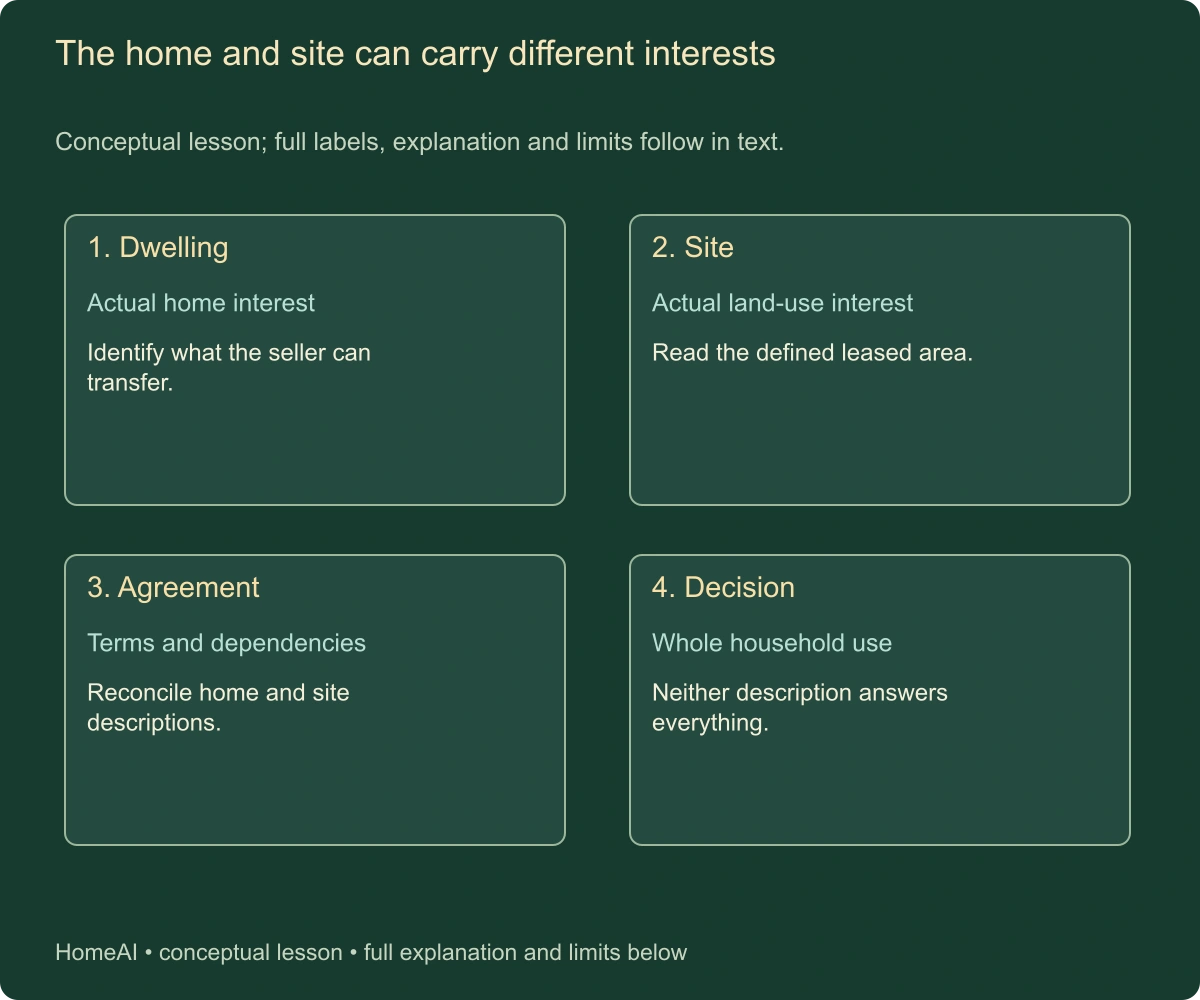
Four related enquiries, with no implied common ownership.
About this illustration
No actual title, site boundary, lease or transfer approval. This is a conceptual teaching model, not an assessment of your home.
7 picture lessons appear beside the questions in this guide. Use them to understand the explanation, then consider what it means for your home.
What are you buying when the land is leased?
A house provides shelter through its roof, walls, floors and services. The land provides the location and space on which those improvements stand. In a leased-land arrangement, the rights proposed for purchase or transfer can involve the home and a right to occupy or use the site without transferring ownership of the underlying land. The actual documents must establish that arrangement; the appearance of a conventional detached home cannot.
Start with three separate questions. What interest in the home is being transferred? What right allows it to remain on and use this site? What continuing terms govern the household's use, payments, services and future changes? A listing price or description such as leasehold answers none of these completely. Ask the legal professional to explain the proposed interests in ordinary language using the actual agreement and land records.
The relevant arrangements are not all alike. A provincial land-lease community, a Parks Canada residential lease and an interest on First Nation lands can involve different law, authorities, registration and consent. First Nations also have different land-management arrangements. This guide does not select a legal regime from an address or a label. The actual First Nation, lessor, authority and legal adviser must establish the process appropriate to that parcel.
The existing title-and-survey guide explains wider site and document reconciliation. This guide follows the leased-land transaction itself: the interests, term, renewal, assignment, borrowing, services and end-of-term responsibilities. It is not an appraisal of whether leasehold or freehold is a better investment. A household needs to understand the actual rights and obligations before comparing price, financing or long-term plans.
A physical inspection still matters. A clear lease does not establish the condition of the home, and a favourable inspection does not establish a continuing right to use the site. Keep technical and legal enquiries connected but distinct. The household's decision depends on both the actual building and the actual arrangement supporting its occupation.
The home and site can carry different interests
Four related enquiries, with no implied common ownership.
Numbers identify the parts explained below.
- Dwelling
Actual home interest. Identify what the seller can transfer.
- Site
Actual land-use interest. Read the defined leased area.
- Agreement
Terms and dependencies. Reconcile home and site descriptions.
What does this illustration leave out?
No actual title, site boundary, lease or transfer approval. This illustration explains an idea. It is not an installation guide.
Which actual documents and qualified advice resolve the distinction?
Explore this with HomeAI ↗Opens an editable question. Nothing is sent until you choose to send it.Which home, site and rights does the actual agreement describe
Architectural home cutaway, garden and driveway; no drawn legal ownership boundary; all service routes hidden.
Numbers identify the parts explained below.

- Visible context
Architectural home cutaway, garden and driveway; no drawn legal ownership boundary; all service routes hidden.
- Limit
Conceptual generated context. No actual property, installed design, topology, measured performance, approval, ownership or responsibility established.
What does this illustration leave out?
Conceptual generated context. No actual property, installed design, topology, measured performance, approval, ownership or responsibility established. This illustration explains an idea. It is not an installation guide.
Which home, site and rights does the actual agreement describe?
Explore this with HomeAI ↗Opens an editable question. Nothing is sent until you choose to send it.The home and site can carry different interests
Conceptual lesson; full labels, explanation and limits follow in text.
- Dwelling
- Actual home interest. Identify what the seller can transfer.
- Site
- Actual land-use interest. Read the defined leased area.
- Agreement
- Terms and dependencies. Reconcile home and site descriptions.
- Decision
- Whole household use. Neither description answers everything.
Four related enquiries, with no implied common ownership.
What remains unknown: No actual title, site boundary, lease or transfer approval.
A useful question: Which actual documents and qualified advice resolve the distinction?
Which home, site and rights does the actual agreement describe
Architectural home cutaway, garden and driveway; no drawn legal ownership boundary; all service routes hidden.
What remains unknown: Conceptual generated context. No actual property, installed design, topology, measured performance, approval, ownership or responsibility established.
A useful question: Which home, site and rights does the actual agreement describe?
Why must the exact type of arrangement be identified first?
The word lease can describe different relationships. A household might receive an assignment of an existing lease, enter a new site agreement or acquire a sublease under a larger head lease. Each places the buyer in a different document chain. Ask which exact instrument is proposed and who has authority to grant or transfer it. Do not assume that every transaction starts a new full term.
Indigenous Services Canada's current designated-reserve-land policy, modified October 22, 2025, distinguishes head leases, subleases and assignments within its stated policy scope. This is one named land-management context, not a rule for all First Nations or all Canadian leases. Its practical lesson here is that the buyer must identify the interest and document chain before treating a sale as a straightforward transfer of land ownership.
Ontario's current standard-lease guide, updated October 27, 2025, expressly excludes sites in mobile-home parks and land-lease communities from that template. A familiar apartment lease form therefore should not be selected merely because both arrangements involve rent. The Landlord and Tenant Board's currently served land-lease brochure prints a June 22, 2007 release date; it provides historical context only here, with its legal numbers and procedures withheld as current advice.
A life lease is another term that should not be silently substituted for a site lease. If the transaction involves a right to occupy housing under a sponsor's arrangement, ask the adviser to identify that actual model and obtain the relevant documents. This guide establishes no life-lease rights or tax treatment. Similar terminology does not establish identical ownership, financing or resale conditions.
Write the identified model at the top of the transaction file, with the relevant authority, document date and remaining uncertainty. That simple step prevents later cost comparisons from combining a prepaid sublease, a periodically reviewed ground lease and an ordinary site rental as if their continuing obligations were the same.
How do the home, parcel and lease description connect?
Ask for the complete executed lease or site agreement, its schedules and plans, amendments, assignments and any relevant governing documents. The legal description should identify the land or portion concerned. The home description and supplied records should identify what is being transferred. A street address or marketing lot number may be useful for finding the property without being the complete legal description.
Compare those records with the actual site through the appropriate survey and legal process. Ask whether the garden, driveway, parking, shed and other areas the seller uses fall within the leased premises, shared areas or a separate permission. A fence or hedge shows a physical feature, not a legal finding. Do not move markers, enter neighbouring land or create a boundary from an online map.
The ISC designated-land policy requires defined land descriptions and addresses other interests and access within its own scope. The guide uses that as an example of why the lease's location and related interests matter. It does not decide that a particular registration is valid, that a plan is current or that every visible improvement is permitted.
Ask the adviser to reconcile discrepancies rather than treating them as a calculation problem. If the seller's plan shows one site and an amendment shows another, determine which record governs and whether the physical arrangement matches it. A contractor's quotation based on the larger area would not resolve the legal question. Likewise, a correct legal description does not show the present condition of every improvement.
Keep the complete location references with later service and alteration records. A document that concerns a larger community parcel may not establish the rights of one home. The useful answer identifies this home, this site and these associated rights under the current document chain, with any unresolved portion plainly recorded.
Which clocks matter besides the lease's original length?
The original lease length, the remaining period and the household's intended time in the home are different facts. A long original term may have much less time remaining. An assignment ordinarily needs to be read as the actual existing interest being transferred, rather than assumed to create a fresh term. Obtain the commencement, expiry and relevant amendment dates from the documents and the adviser's explanation.
Put the proposed completion date beside those dates. If a brochure describes a lease when the development first opened, its term description may no longer express the period available to a new buyer. A seller's statement that the lease is long term can be accurate but incomplete. Ask the legal professional to calculate and explain the remaining documented period for the actual transaction.
Borrowing has its own dates: mortgage term, amortization, maturity and any lender conditions relevant to the lease. The lender must assess the actual security and remaining rights. This guide supplies no minimum remaining term or promise of financing. A household should not import a threshold from another lender or assume that a previous owner's loan establishes current approval.
Planned use creates another horizon. The buyer may expect to live there, renovate, retire, rent it or eventually sell. Each intention needs to fit the actual permitted use and rights. A proposed major improvement late in a lease raises a different decision from ordinary maintenance, even when both concern the same roof or room. The agreement and professional advice determine the applicable responsibilities.
A clear timeline labels contractual dates, proposed dates and unresolved future events separately. It does not draw an automatic arrow from expiry to renewal. The household can then see what is known and which hoped-for extension or future sale would be necessary for its preferred plan to work.
Remaining term and household horizon differ
Compare the actual lease clock with the household plan; renewal remains a distinct uncertainty.
Numbers identify the parts explained below.
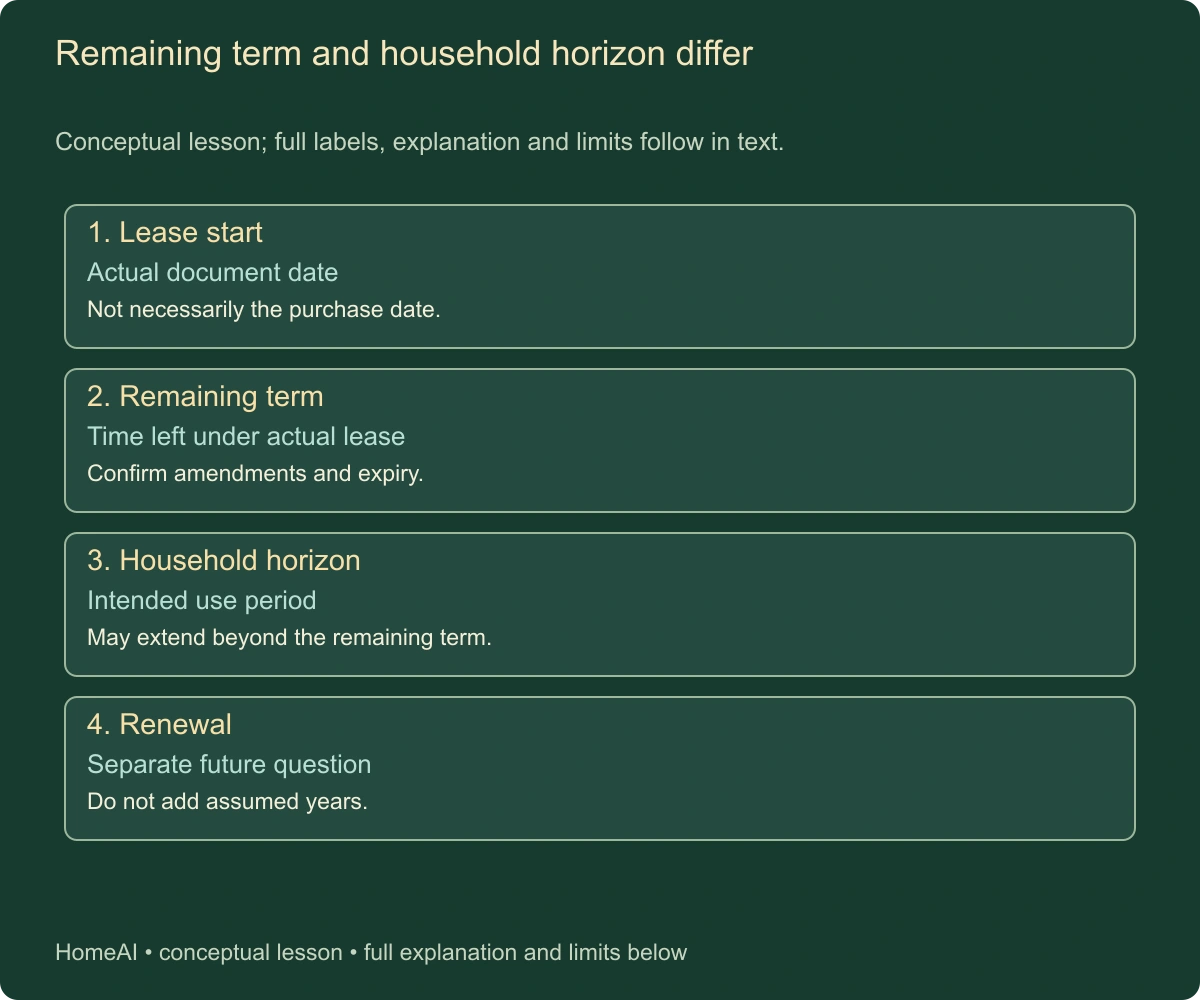
- Lease start
Actual document date. Not necessarily the purchase date.
- Remaining term
Time left under actual lease. Confirm amendments and expiry.
- Household horizon
Intended use period. May extend beyond the remaining term.
What does this illustration leave out?
No actual expiry, automatic renewal, eviction or lender rule. This illustration explains an idea. It is not an installation guide.
Which actual documents and qualified advice resolve the distinction?
Explore this with HomeAI ↗Opens an editable question. Nothing is sent until you choose to send it.Remaining term and household horizon differ
Conceptual lesson; full labels, explanation and limits follow in text.
- Lease start
- Actual document date. Not necessarily the purchase date.
- Remaining term
- Time left under actual lease. Confirm amendments and expiry.
- Household horizon
- Intended use period. May extend beyond the remaining term.
- Renewal
- Separate future question. Do not add assumed years.
Compare the actual lease clock with the household plan; renewal remains a distinct uncertainty.
What remains unknown: No actual expiry, automatic renewal, eviction or lender rule.
A useful question: Which actual documents and qualified advice resolve the distinction?
What does renewal mean in the actual document?
Renewal can refer to a contractual option, a process to request another term or an expectation based on past practice. Those are different levels of certainty. Ask the adviser to identify the exact clause, who may exercise it, what conditions apply, how the future terms are determined and what remains subject to a new decision. A neighbour's successful renewal is context, not the buyer's own right.
Keep an extension of the present agreement distinct from a replacement or new agreement. A document can change dates, rent, responsibilities or other conditions. The household needs to understand what continues and what may be renegotiated. This guide does not declare that a lessor must renew, may refuse freely or must pay compensation; those are property-specific legal questions.
Ask whether the proposed transaction depends on renewal before completion or merely anticipates it later. A request made by the seller should not be treated as an approved amendment. Obtain the actual executed record or authority confirmation through the legal process. If it remains pending, keep that dependency visible beside the planned completion and financing.
Prepaid rent also should not be confused with perpetual occupation. Ask which period and obligation the payment covers and what happens afterward. A price described as including the lease may refer to an existing payment arrangement while other charges and conditions continue. The legal professional must explain the actual words rather than the household assuming that prepaid means no future lease enquiry is necessary.
Consider what uncertainty means for the decision without inventing a probability. The buyer can identify which plans fit the confirmed period and which rely on an unconfirmed extension. That distinction is more useful than assigning an optimistic future value to rights that the documents have not yet established.
Continuation needs its own evidence
Current occupancy and possible continuation are separate findings.
Numbers identify the parts explained below.
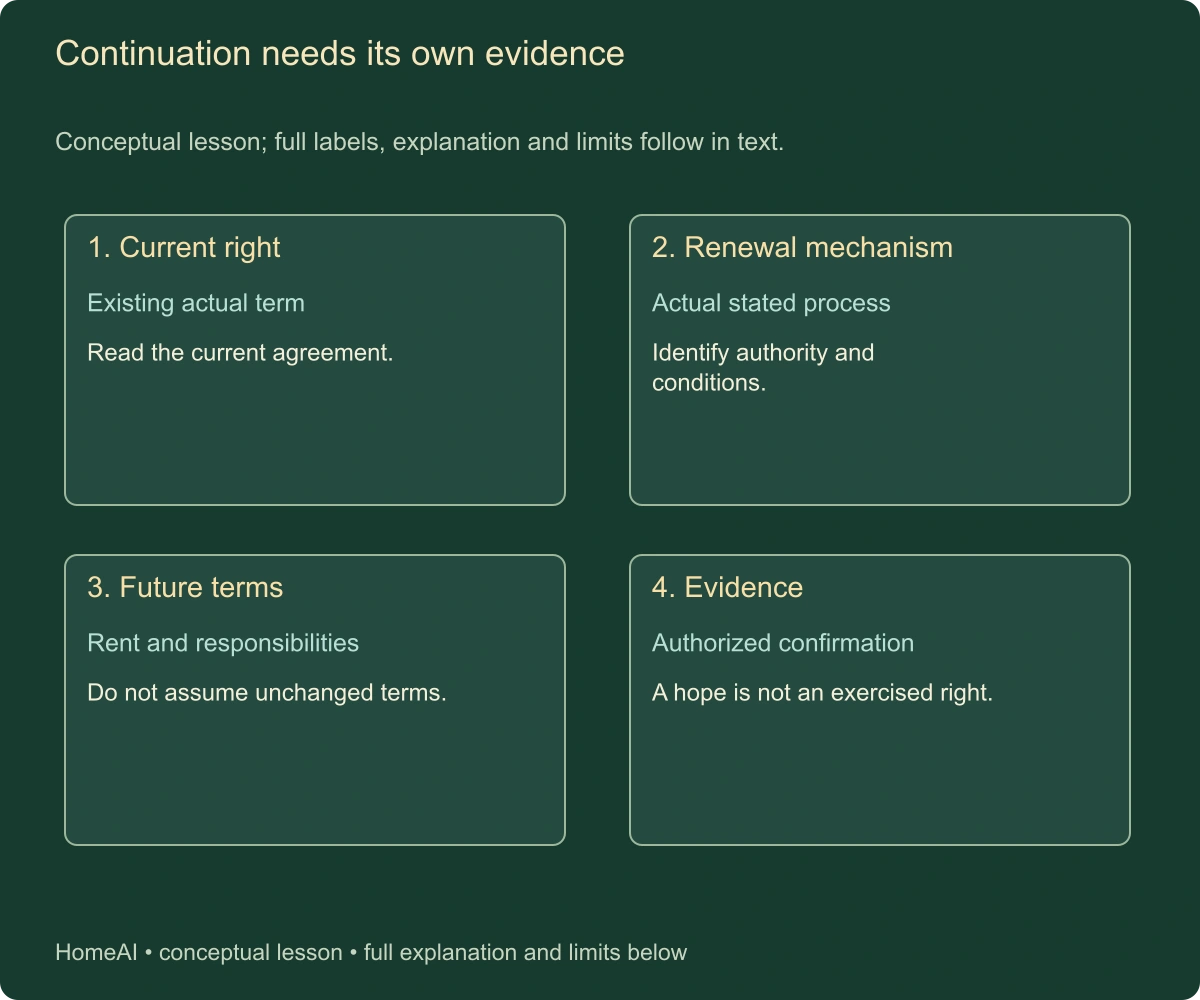
- Current right
Existing actual term. Read the current agreement.
- Renewal mechanism
Actual stated process. Identify authority and conditions.
- Future terms
Rent and responsibilities. Do not assume unchanged terms.
What does this illustration leave out?
No guaranteed renewal, future rent or legal remedy. This illustration explains an idea. It is not an installation guide.
Which actual documents and qualified advice resolve the distinction?
Explore this with HomeAI ↗Opens an editable question. Nothing is sent until you choose to send it.Continuation needs its own evidence
Conceptual lesson; full labels, explanation and limits follow in text.
- Current right
- Existing actual term. Read the current agreement.
- Renewal mechanism
- Actual stated process. Identify authority and conditions.
- Future terms
- Rent and responsibilities. Do not assume unchanged terms.
- Evidence
- Authorized confirmation. A hope is not an exercised right.
Current occupancy and possible continuation are separate findings.
What remains unknown: No guaranteed renewal, future rent or legal remedy.
A useful question: Which actual documents and qualified advice resolve the distinction?
How should rent, taxes and shared charges be compared?
Separate the purchase amount from continuing obligations. Ask what current rent or other consideration pays for, whether any portion was prepaid, which services are included and which charges are separate. Obtain the applicable documents and a dated statement through authorized channels. A seller's monthly total can conceal several different obligations or exclude amounts paid less frequently.
The actual agreement may contain a rent-review or adjustment mechanism. Ask how and when it operates, who initiates it and what evidence determines the result. The ISC designated-land policy addresses rent review in its own scope, but its sample frequencies and mechanisms are not universal household rules. The buyer needs the applicable lease, not a convenient public policy number copied into a budget.
Taxes and service charges also need their own explanation. Ask who is billed, which property or improvement the amount concerns and how it reaches the household. This guide supplies no tax exemption or universal assessment arrangement for leased land or First Nation lands. The legal and tax advisers must establish the actual position and the relevant authority's current requirements.
Compare costs over the same period and with the same inclusions. If one arrangement includes road or water service while another requires separate payments, display that difference. Do not add the same service twice or omit a known periodic charge because it is absent from the monthly bill. Where future amounts are unknown, keep the current figure and future mechanism separate instead of forecasting a guaranteed total.
Ask about arrears, adjustments and completion treatment using the actual account and agreement. A seller's promise to pay an amount is distinct from confirmation that it has been dealt with. The buyer's continuing-obligation record should show what starts, what continues and what remains unresolved, rather than relying on the phrase all fees included.
Several payments can coexist
Identify each charge and responsibility before comparing total household obligations.
Numbers identify the parts explained below.
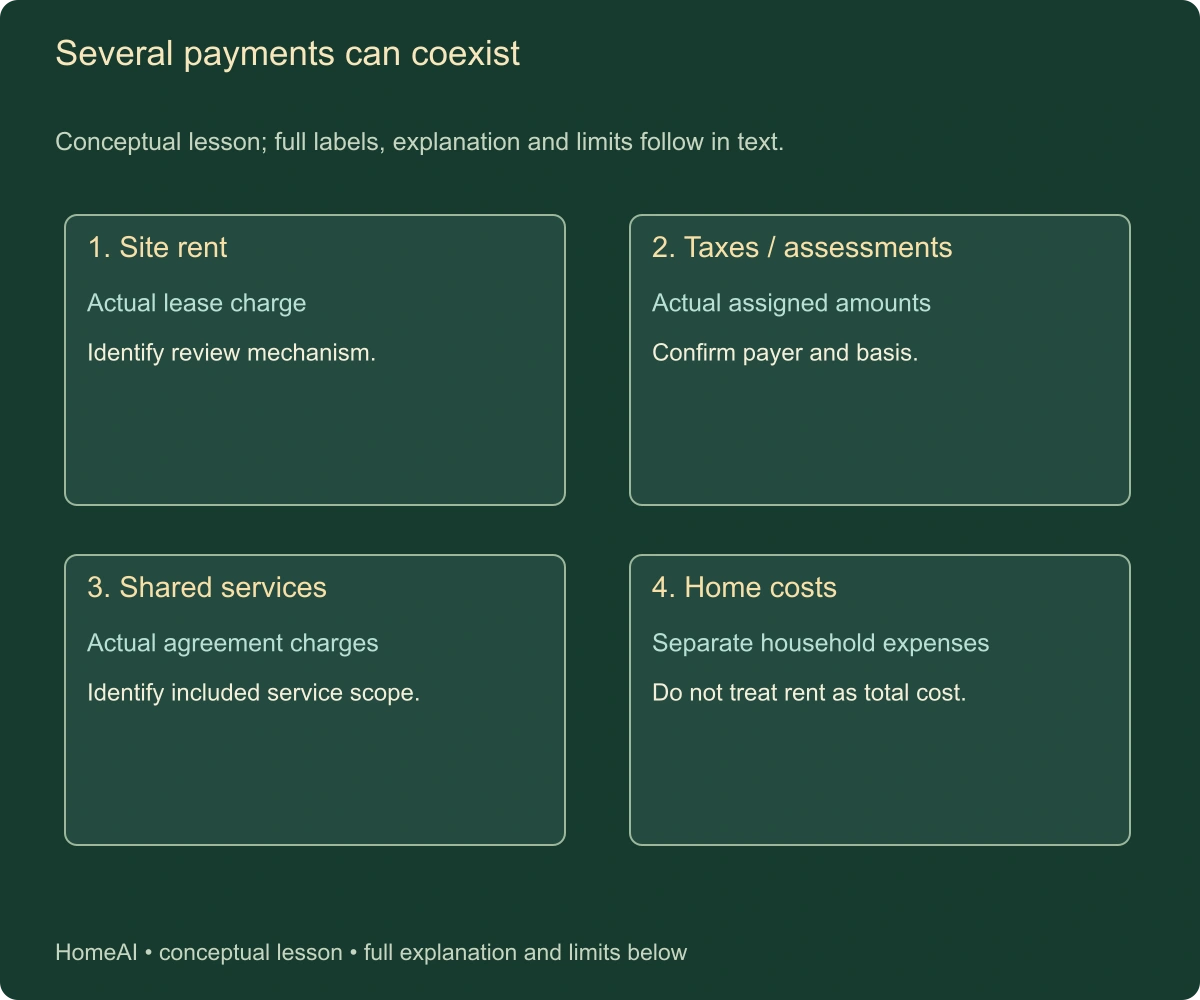
- Site rent
Actual lease charge. Identify review mechanism.
- Taxes / assessments
Actual assigned amounts. Confirm payer and basis.
- Shared services
Actual agreement charges. Identify included service scope.
What does this illustration leave out?
No rates, universal tax allocation or fixed future cost. This illustration explains an idea. It is not an installation guide.
Which actual documents and qualified advice resolve the distinction?
Explore this with HomeAI ↗Opens an editable question. Nothing is sent until you choose to send it.Several payments can coexist
Conceptual lesson; full labels, explanation and limits follow in text.
- Site rent
- Actual lease charge. Identify review mechanism.
- Taxes / assessments
- Actual assigned amounts. Confirm payer and basis.
- Shared services
- Actual agreement charges. Identify included service scope.
- Home costs
- Separate household expenses. Do not treat rent as total cost.
Identify each charge and responsibility before comparing total household obligations.
What remains unknown: No rates, universal tax allocation or fixed future cost.
A useful question: Which actual documents and qualified advice resolve the distinction?
Why are assignment, mortgage consent and residency separate enquiries?
Assignment concerns transferring the identified interest. Mortgage consent or acknowledgement concerns the proposed borrowing and security under the applicable arrangement. Eligibility to reside concerns whether the intended occupant meets relevant restrictions. These processes can interact without becoming a single approval. Ask the adviser and responsible authority which answers are required for the actual transaction.
Parks Canada's Jasper services page, modified September 17, 2026, separately identifies assignment/mortgage, sublease, renewal and lease-information services. Its current eligibility page, modified May 26, 2026, distinguishes holding a residential lease from eligibility to live in Jasper. These are named national-park examples, not Canadian-wide lease requirements. The guide adopts no processing-time promise or conclusion that a particular buyer qualifies.
For any required consent, identify who requests it, which documents and proposed dates it concerns and what confirms the outcome. A completed purchase agreement does not itself establish that the authority or lessor has approved the transfer. A lender indication does not necessarily establish every required land-interest consent. Keep each confirmation with its own scope and conditions.
Where information is private, use the account holder's or authorized representative's process. A buyer's interest in the property does not authorize access to another person's confidential account, credit or personal eligibility records. Request the relevant transaction confirmation through known professional and authority channels rather than attempting to inspect private material directly.
The useful completion plan identifies the sequence and dependencies without predicting approval. If a consent or eligibility question is outstanding, record it as its own hold. The household can then understand whether its decision is waiting on a document, a legal interpretation, an authority decision or a financing condition.
What changes when the buyer receives a sublease?
A sublease sits within a wider lease relationship. Ask for the relevant head lease and amendments as well as the proposed sublease, because the household's rights may depend on terms beyond its own document. The actual agreement chain determines the effect. A shorter summary supplied by a seller cannot establish every upstream obligation or restriction.
The current ISC designated-land policy illustrates a head-lease/sublease distinction and discusses the relationship between their terms within that policy. This guide uses the example to prompt document-chain questions, not to apply that policy to every First Nation or provincial development. The actual land-management authority and legal adviser must establish what governs this parcel and transaction.
Ask how the documents address permitted use, duration, payment, default, amendments and consent. Also ask what the buyer needs to know about the upstream interest's standing. A well-maintained home can sit within a document chain that still needs legal reconciliation. Conversely, the existence of a head lease is not itself a finding that an arrangement is defective or insecure.
If a non-disturbance or similar agreement is mentioned, obtain its actual text and the legal explanation of the parties and circumstances it covers. Its title alone is not a guarantee that the household can remain under every future event. Keep any conditions, limits and unresolved signatures visible. This guide supplies no enforcement or insolvency conclusion.
For a proposed resale, ask which consents and continuing responsibilities apply to assignment of the sublease itself. Do not assume the seller automatically leaves every obligation behind or that the new buyer can change the head lease. The legal professional should explain the actual release, assignment and completion evidence for the parties involved.
A sublease has its own dependencies
The two agreements are related but not interchangeable; the actual documents determine the relationship.
Numbers identify the parts explained below.
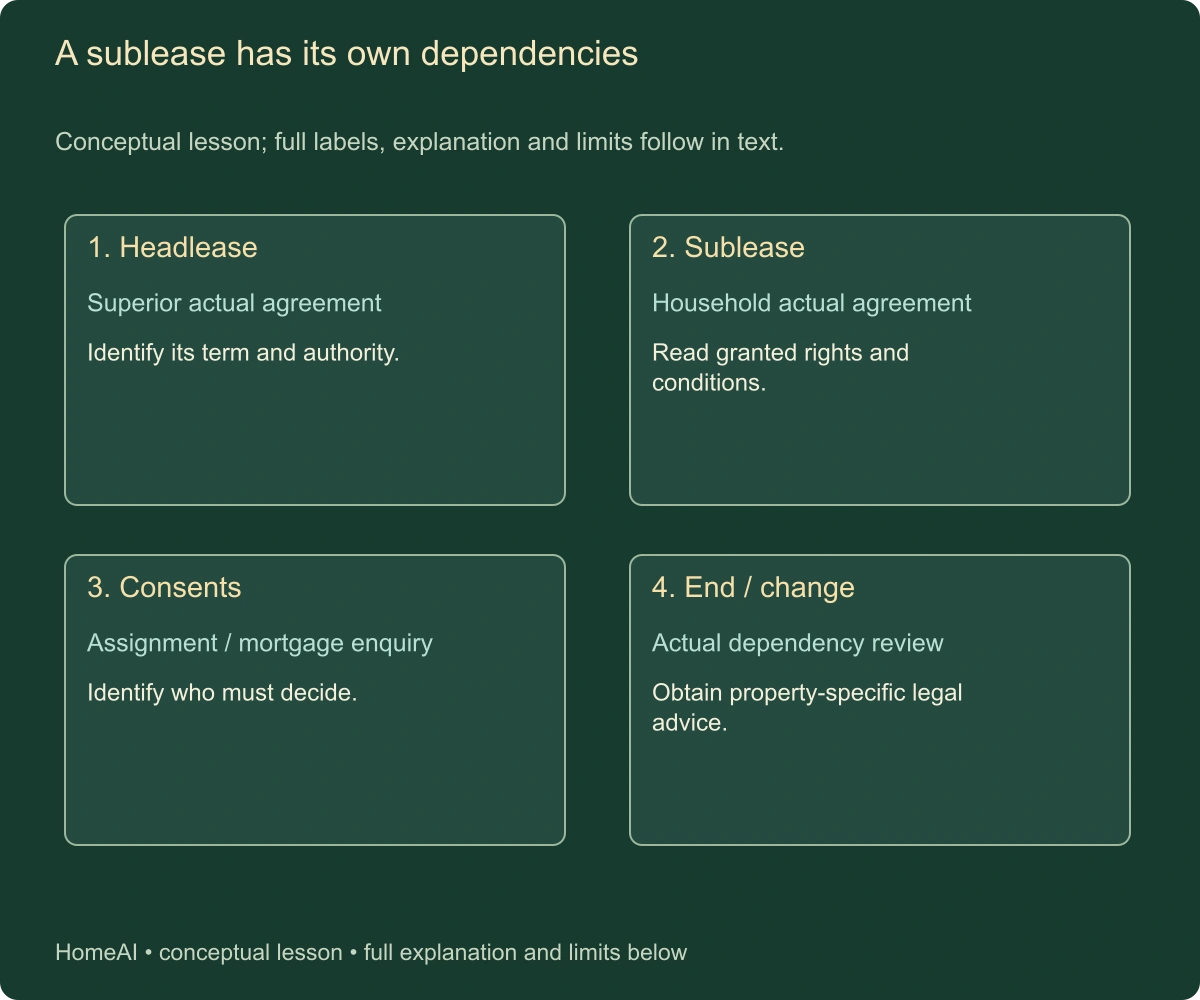
- Headlease
Superior actual agreement. Identify its term and authority.
- Sublease
Household actual agreement. Read granted rights and conditions.
- Consents
Assignment / mortgage enquiry. Identify who must decide.
What does this illustration leave out?
No universal First Nation model or legal outcome. This illustration explains an idea. It is not an installation guide.
Which actual documents and qualified advice resolve the distinction?
Explore this with HomeAI ↗Opens an editable question. Nothing is sent until you choose to send it.A sublease has its own dependencies
Conceptual lesson; full labels, explanation and limits follow in text.
- Headlease
- Superior actual agreement. Identify its term and authority.
- Sublease
- Household actual agreement. Read granted rights and conditions.
- Consents
- Assignment / mortgage enquiry. Identify who must decide.
- End / change
- Actual dependency review. Obtain property-specific legal advice.
The two agreements are related but not interchangeable; the actual documents determine the relationship.
What remains unknown: No universal First Nation model or legal outcome.
A useful question: Which actual documents and qualified advice resolve the distinction?
Which services and access rights support the home?
A livable home depends on water, wastewater handling, energy, waste collection and practical access, among other services relevant to its location. Some may be supplied by a community operator, municipality, utility or another party. Ask who provides each actual service, which agreement covers it and where household maintenance responsibility begins. Leasing the site does not answer those questions by itself.
The ISC designated-land policy treats access and service agreements as separate matters within its scope. That supports checking the actual connections and rights rather than assuming the underlying lease includes every service. The private-roads/shared-services guide provides wider detail on off-lot dependencies. Here the buyer needs to know how those dependencies connect to the leased home and its continuing obligations.
A service can be present while its condition, capacity or legal arrangement remains unconfirmed. A working tap during a viewing is an observation; it is not a water-quality, private-system or infrastructure assessment. A utility bill describes an account relationship without demonstrating every buried component. Use the relevant provider and qualified professional for the actual technical enquiry.
Ask how service changes, interruption notices and concerns reach the household. If a community representative coordinates shared work, identify that role and the authorized reporting process. Do not assume a site owner's general maintenance statement means they service every appliance or interior connection. The actual boundary should explain the shared part and the household part.
Keep service records and the legal access answer alongside the lease. A renewal, assignment or home replacement may leave the service arrangement unchanged or require additional coordination. The household needs the actual answer before relying on a proposed alteration or transaction, rather than treating a familiar-looking community as proof of identical services at every site.
How do repairs, alterations and improvements fit the lease?
A roof repair, new porch, larger addition and replacement home are different projects. Each can raise technical, land-use, agreement and authority questions. Ask what the actual lease permits, which permissions are required and which professionals or authorities review the work. A contractor's willingness to build does not establish the right to change the leased site.
Begin with the current home and approved records. Ask whether existing additions, decks, sheds and other improvements match the actual documents. A missing record should be referred for reconciliation, not silently described as proof of unauthorized work. The relevant legal and technical advisers must determine the significance and next step for that location.
The household also needs to understand who owns improvements during the agreement and what happens to them when it ends. Do not assume the buyer can always move the house, must always remove it or will receive a particular payment. A permanent-looking building, a mobile-home label and a landlord's informal comment do not settle the actual contractual and legal answer.
Consider the different time horizons before commissioning major work. The useful question is whether the proposed investment and intended use fit the confirmed rights and responsibilities, including the documented remaining period. This guide provides no formula for the amount worth spending. Actual costs, approvals, condition and household plans inform the decision.
Keep an executed permission and technical completion record separate. Permission addresses the authorized proposal; the contractor and professional records address what was performed and assessed. When both matter, the handover file needs both. A finished addition is evidence of a physical change without proving every agreement, approval and performance question was answered.
How should financing and insurance be checked?
Ask the lender or mortgage adviser to assess the actual interest being acquired, the document chain, remaining period and required consents. A loan approval for a conventional land-and-home purchase should not be assumed to apply unchanged to a leasehold or site-home arrangement. Provide accurate facts and obtain the actual proposal and conditions before relying on its funds.
The lender's security and the household's ownership rights need a clear explanation. The ISC designated-land policy discusses mortgage acknowledgements within its own scope, while Jasper identifies its own assignment/mortgage process. These examples show why a general promise that banks lend here is incomplete. The reader's lender and legal professional must establish their actual requirements.
Insurance also needs the right property description. Ask the insurer or broker which home, contents, improvements and liabilities the actual policy addresses and which responsibilities sit elsewhere. Supply the leased-land and service arrangement accurately. This guide promises no coverage, premium or rebuilding entitlement and does not infer insurance from a lender's willingness to consider the transaction.
A proposed total budget should include the confirmed borrowing and insurance costs alongside rent, services and other identified obligations. Keep quotation expiry, conditions and effective dates visible. A seller's past premium or mortgage payment is useful history but not the buyer's own current quotation. The household should compare the actual proposals on the same scope and date.
If a provider cannot yet give a final answer because a lease amendment or consent remains pending, record that dependency. Do not substitute a guessed rate or describe the financing as complete. The next task is to supply the actual missing information and obtain the provider's response through the authorized process.
How can the household compare different arrangements fairly?
Start with the confirmed rights, feasible use and continuing obligations, then compare costs. A cheaper purchase amount can accompany different site charges, remaining rights or services. A more expensive alternative can still have its own risks and required work. No single price establishes the better household choice without those differences being understood.
Use a common comparison period and include the same categories. Purchase funds, borrowing, rent, identified periodic reviews, service costs, insurance, maintenance and proposed work can have different timing. Show what is known, what depends on a future event and what is unquoted. An honest comparison can contain unresolved cells rather than fabricate an all-in winner.
Do not invent a resale value, renewal probability or future land purchase. The household can consider how its intended plans depend on those events, but an expectation should remain labelled as such. Ask the appropriate professionals about the actual market and document implications. A general statement that leasehold always appreciates less or is always harder to finance would exceed this guide's evidence.
Some differences can make an option unsuitable rather than merely more costly. A confirmed occupancy restriction may conflict with the intended use; an unresolved consent may prevent completion on the preferred date; the proposed lender may not accept the actual interest. These are distinct enquiries with different next steps. Money alone may not resolve them.
Record the reasoning in ordinary language: this arrangement supports these confirmed uses and dates, has these continuing obligations, and leaves these questions open. That gives the household a decision it can review with its advisers. It does not convert legal, technical and personal suitability into one unsupported investment score.
What does a fictional remaining-term enquiry reveal?
In this fictional transaction, Jules is considering a permanent home on leased land. The sales description emphasizes the lease's original long term, but the supplied documents need to be reconciled to establish the actual remaining period. No real property, lessor, authority, lender or legal result is represented. Jules treats the listing statement as a starting question rather than proof of a new term.
For learning only, suppose the documents ultimately establish an invented 18-year remaining period, while Jules hopes to use the home for an invented 25-year plan. The seven-year difference is not a prediction of eviction, a bank policy or a statement that renewal is unavailable. It shows that part of the desired plan extends beyond the assumed confirmed period and needs its own actual answer.
Jules asks the legal professional to explain any renewal provision, the proposed assignment, required consents and improvement responsibilities. The lender receives the same document facts, rather than an advertising summary. The service enquiry separately identifies who maintains the actual water and road arrangements. None of these requests creates an invented approval or condition finding.
Suppose a renewal request is pending but not executed. Jules records that as a renewal hold. If the site plan is also unclear, that is a different location hold. If financing awaits the authority's consent, that is a documented dependency between two processes. Keeping them separate makes the next requests useful and prevents one favourable answer from being presented as completion of the whole transaction.
The fictional case ends with a decision framework, not a winning property. Jules must compare the actual rights, quotations, technical information and household plans with the advisers' answers. The lesson is that a home's apparent permanence and a lease's original length cannot substitute for the remaining documented rights and actual completion requirements.
Fictional horizon: 18 years versus 25
Fictional arithmetic shows a seven-year difference, without inventing a renewal or a lender policy.
Numbers identify the parts explained below.
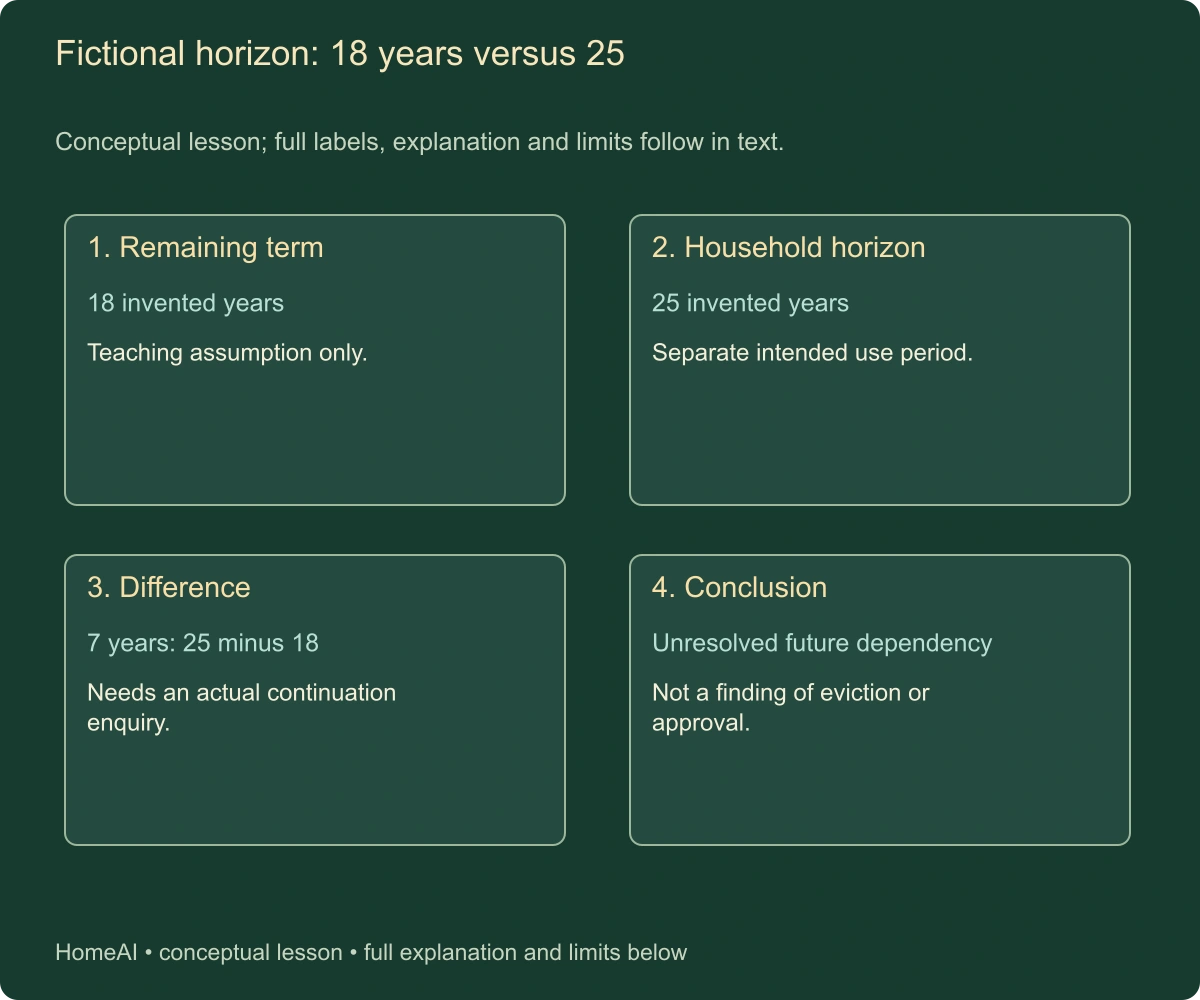
- Remaining term
18 invented years. Teaching assumption only.
- Household horizon
25 invented years. Separate intended use period.
- Difference
7 years: 25 minus 18. Needs an actual continuation enquiry.
What does this illustration leave out?
No actual lease, finance approval or end-of-term result. This illustration explains an idea. It is not an installation guide.
Which actual documents and qualified advice resolve the distinction?
Explore this with HomeAI ↗Opens an editable question. Nothing is sent until you choose to send it.Fictional horizon: 18 years versus 25
Conceptual lesson; full labels, explanation and limits follow in text.
- Remaining term
- 18 invented years. Teaching assumption only.
- Household horizon
- 25 invented years. Separate intended use period.
- Difference
- 7 years: 25 minus 18. Needs an actual continuation enquiry.
- Conclusion
- Unresolved future dependency. Not a finding of eviction or approval.
Fictional arithmetic shows a seven-year difference, without inventing a renewal or a lender policy.
What remains unknown: No actual lease, finance approval or end-of-term result.
A useful question: Which actual documents and qualified advice resolve the distinction?
What should the final leased-home handover preserve?
Keep the complete current document chain, relevant plans, amendments, executed assignments, required consents and authority confirmations. Identify the actual home and site covered. Preserve the dated statement of continuing payments and services, relevant insurance and financing records, and approved alterations with their completion evidence. Handle personal account and eligibility information through the appropriate restricted process.
Ask the legal professional which record confirms that the proposed interest and related registration or other completion steps were actually dealt with. A signed purchase agreement, a consent request and physical possession are different stages. The final note should identify the completed result and any remaining task rather than assume that the keys establish every legal and administrative answer.
Give the household a practical service map: this party receives site and shared-service enquiries, these providers handle household accounts, and these qualified professionals service the identified equipment. Keep manuals and technical records separate from the lease while linking them to the same home. A legal handover should not erase the ongoing operating information the resident needs.
Preserve the reason for any unresolved item and the person or authority who can answer it. An old policy page, missing plan, pending amendment and unconfirmed account each have different limits. Future owners benefit from knowing what was actually established rather than inheriting a folder in which every paper is implicitly treated as current and complete.
The useful final explanation is specific: these rights in this home and site were acquired under these documents, these terms and payments continue, these consents were obtained, and these matters remain open. That is a reliable foundation for living in, maintaining and eventually transferring the home without inventing certainty that the actual records never supplied.
Keep learning about the connected parts
- Title, survey and physical property: reconcile the actual site
- Private roads and shared services: connect access, upkeep and the actual agreement
- Inherited equipment agreements: identify what transfers
Canadian context and authorities · Visual atlas · Learning labs
Practice the distinction.
What does a fictional remaining-term enquiry reveal?
In this fictional transaction, Jules is considering a permanent home on leased land. The sales description emphasizes the lease's original long term, but the supplied documents need to be reconciled to establish the actual remaining period. No real property, lessor, authority, lender or legal result is represented. Jules treats the listing statement as a starting question rather than proof of a new term.
Reported observations
- For learning only, suppose the documents ultimately establish an invented 18-year remaining period, while Jules hopes to use the home for an invented 25-year plan. The seven-year difference is not a prediction of eviction, a bank policy or a statement that renewal is unavailable. It shows that part of the desired plan extends beyond the assumed confirmed period and needs its own actual answer.
- Jules asks the legal professional to explain any renewal provision, the proposed assignment, required consents and improvement responsibilities. The lender receives the same document facts, rather than an advertising summary. The service enquiry separately identifies who maintains the actual water and road arrangements. None of these requests creates an invented approval or condition finding.
A useful next question
The fictional case ends with a decision framework, not a winning property. Jules must compare the actual rights, quotations, technical information and household plans with the advisers' answers. The lesson is that a home's apparent permanence and a lease's original length cannot substitute for the remaining documented rights and actual completion requirements.
Know what the words mean.
- Home interest
- The actual interest in the dwelling being acquired.
- Site interest
- The actual right to occupy or use the identified land.
- Remaining term
- The period left under the actual lease.
- Renewal
- A future continuation governed by its actual process and terms.
- Assignment
- A transfer requiring the actual agreement and applicable approvals.
- Headlease
- The superior lease in a particular lease/sublease arrangement.
- Sublease
- A subordinate lease whose own terms and dependencies need review.
Questions to bring
to the conversation.
- What interests and complete document chain are being transferred for this exact home and site?
- How much documented time remains, what renewal or consent is confirmed, and which part of the household’s plan depends on a future decision?
- Which payments, services, alteration duties, financing conditions and end-of-term questions must be resolved before relying on the purchase?
Separate a showing observation, an existing record and a new professional assessment. Unknown means a question remains; it does not automatically mean a defect.
Use the evidence planner ↗Go to the source.
Original HomeAI explanation informed by these public references. Sources support the underlying guidance; they have not reviewed or endorsed HomeAI. Diagrams are conceptual, and calculator outputs depend on your inputs.
Primary Canadian bodies read October 14, 2026 with recorded editions and jurisdiction limits. Historical sources and unread/access-held bodies are explicitly distinguished. Illustrations and fictional cases establish no actual condition, legal, health, coverage, financing or completion result. Actual documents and qualified advice control.
Publication & source review
First published .
Sources reviewed .
Have a question about your home?
Start with the symptom, timing and what you have observed.
Ask HomeAI